

-
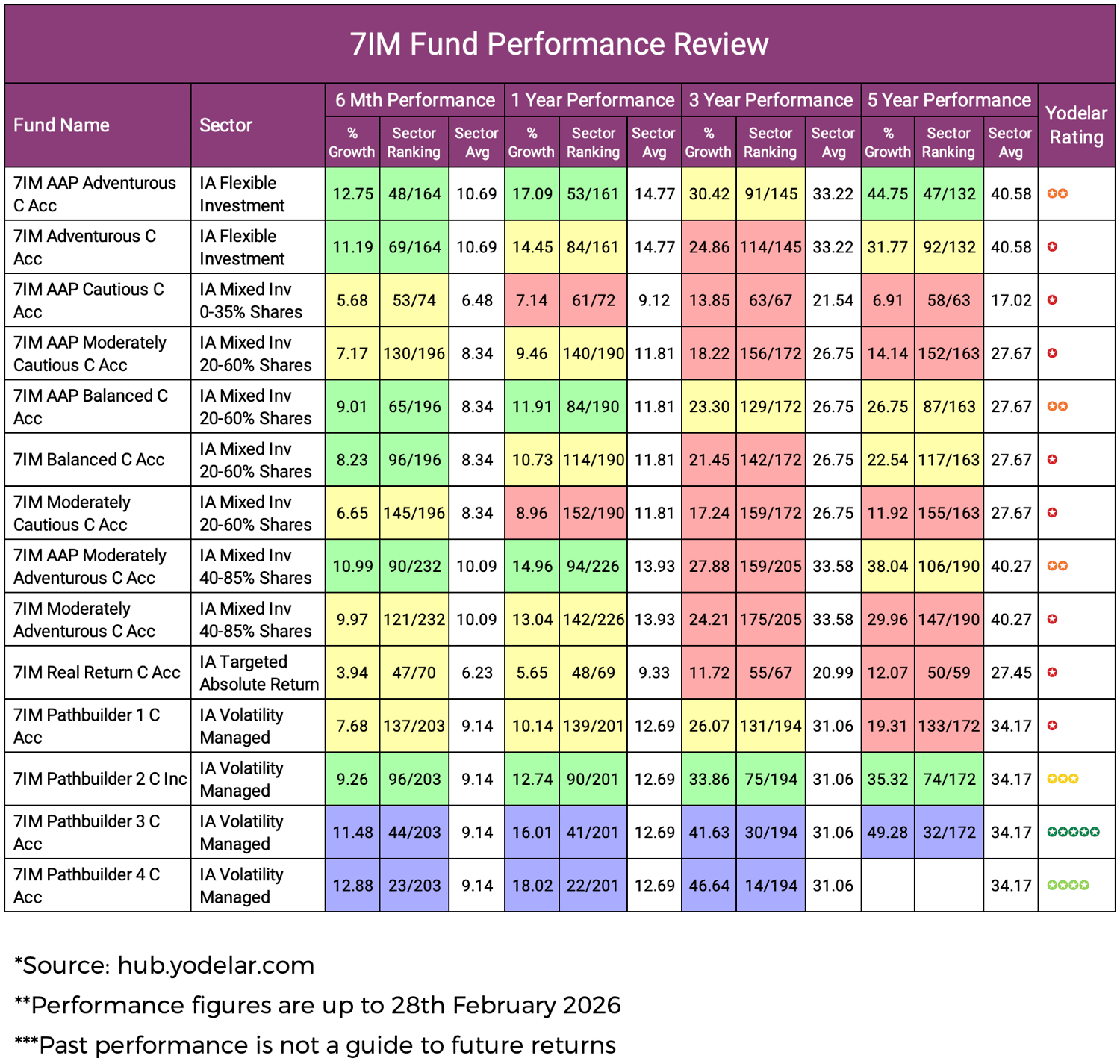
Only 1 of 14 funds achieved a 5-star Yodelar rating, while 8 funds were rated just 1 star, showing that results across the 7IM range have been heavily weighted towards weaker sector rankings.
-
The standout fund was 7IM Pathbuilder 3, returning 49.28% over five years versus a sector average of 34.17%, and the only fund to consistently rank among the strongest in its peer group.
-
In contrast, core funds such as 7IM Balanced returned 22.54% over five years against a sector average of 27.67%, despite higher charges of up to 1.75%, highlighting the gap between cost and outcome.
-
Across the AAP range, funds such as 7IM AAP Moderately Cautious and 7IM AAP Cautious consistently ranked in the lower half of their sectors over 1, 3 and 5 years.
7IM offers a simple proposition. Pick a risk level, invest in one fund, and the manager takes care of the mix of shares, bonds and other assets. For investors looking to reduce complexity, that can feel like a practical solution.
However, simplicity has not led to consistently strong results. Based on performance data to 28 February 2026, outcomes across the 7IM range have been mixed. Only one fund achieved a 5 star Yodelar rating, while eight of the 14 funds reviewed were rated just 1 star. Only two funds outperformed their sector averages over one, three and five years.
This matters because labels such as Balanced or Adventurous can appear reassuring, but they only describe a broad level of risk. They do not show whether a fund has been competitive within its sector, whether its charges have been justified, or whether the underlying portfolio has been effective.
This review analyses the performance and sector ranking of all 14 funds managed by 7IM. It also provides a closer look at 10 core funds drawn from the AAP, Multi Manager and Pathbuilder ranges.

7IM Performance Review
The table below shows the 6 month, 1, 3 and 5 year performance, sector ranking and overall Yodelar rating for all 14 7IM funds analysed in this report. The results highlight that only two funds achieved a top performing 4 or 5 star rating, while 11 were rated as lower performing 1 or 2 star funds.
How Yodelar Rates Fund Performance
7IM AAP Funds
The AAP range is positioned as 7IM’s lower-cost, passive-led solution, with five risk profiles from Cautious through to Adventurous. 7IM says the approach combines active asset allocation with primarily passive and smart passive instruments.
7IM AAP Cautious C Acc sits at the lower-risk end of the range, so investors could expect steadier behaviour rather than big returns. Even on that basis, the figures are weak. It returned 7.14% over one year against a sector average of 9.12%, 13.85% over three years against 21.54%, and 6.91% over five years against 17.02%. Its rankings sat close to the bottom of its sector over the main periods. For a fund designed to do the steady part of the job, that is a poor outcome.
7IM AAP Moderately Cautious C Acc has not looked much stronger. It returned 9.46% over one year against a sector average of 11.81%, 18.22% over three years against 26.75%, and 14.14% over five years against 27.67%. That left it well down its peer group over three and five years. For investors using it as a ready-made middle-ground option, the gap versus the sector average is hard to ignore.
7IM AAP Balanced C Acc is one of the more relevant funds in the range because balanced portfolios often sit at the heart of self-managed holdings. It was close to the sector average over one year, returning 11.91% against 11.81%, but that strength did not carry through over longer periods. Over three years it returned 23.30% against a sector average of 26.75%, and over five years 26.75% against 27.67%. This is not a disastrous result, but it is not the kind of record that justifies much confidence either. It has been serviceable rather than strong.
7IM AAP Moderately Adventurous C Acc has shown a similar pattern. It managed to edge ahead of the sector average over one year, returning 14.96% against 13.93%, but over three and five years it slipped behind at 27.88% versus 33.58% and 38.04% versus 40.27%. That makes it one of the better AAP funds in shorter periods, but not one that has delivered convincing peer-group strength over time.
7IM AAP Adventurous C Acc has been the best of the AAP group, but even here the picture is mixed. It returned 17.09% over one year against a sector average of 14.77% and 44.75% over five years against 40.58%, which at least shows some value over the shorter and longer ends of the review. But its three-year return of 30.42% still lagged the sector average of 33.22%. That left it with a 2-star Yodelar rating rather than a genuinely standout result. In plain English, it has been decent, but not decisively ahead of the pack.

7IM Multi Manager Funds
7IM’s Multi Manager range is the more overtly active side of the fund house. According to 7IM’s target market information, these funds are aimed at investors willing to pay a higher cost in pursuit of active management. The fund documents say they typically invest at least 80% in a mix of 7IM and third-party funds, with tactical asset allocation used to adjust the overall mix.
7IM Balanced C Acc is probably one of the most important funds in this review because this is exactly the type of holding many investors buy as a portfolio shortcut. The problem is that the returns have been weak relative to peers, despite a relatively high ongoing charge of 1.75%. It returned 10.73% over one year against a sector average of 11.81%, 21.45% over three years against 26.75%, and 22.54% over five years against 27.67%. That would be disappointing in a low-cost fund. In a more expensive active option, it looks more problematic.
7IM Moderately Adventurous C Acc has not fared much better. It returned 13.04% over one year against a sector average of 13.93%, 24.21% over three years against 33.58%, and 29.96% over five years against 40.27%. Its rankings were in the weaker half of the sector over every main period. For a fund designed to take more risk in pursuit of growth, the outcome has simply not been competitive enough.
7IM Adventurous C Acc rounds out the active range in this review, and again the pattern is underwhelming. It returned 14.45% over one year against a sector average of 14.77%, 24.86% over three years against 33.22%, and 31.77% over five years against 40.58%. That is a long way behind the best funds in its sector. It also matters because this is the part of the range where investors would most expect active management to show its value. So far, the peer-group evidence has not been strong.
7IM Pathbuilder Funds
The Pathbuilder range is where this review becomes more interesting. 7IM presents these as low-cost passive multi-asset portfolios with clear risk levels, built on its strategic asset allocation framework and designed to give investors diversification without unnecessary complication. The official material also highlights competitive charges and strong risk controls.
7IM Pathbuilder 3 C Acc has been the strongest fund in the whole review. It returned 16.01% over one year against a sector average of 12.69%, 41.63% over three years against 31.06%, and 49.28% over five years against 34.17%. Those are strong gaps, and they came with the lowest broad-based rating benefit too: it was the only 7IM fund in the review to achieve a 5-star Yodelar rating. For investors wanting a ready-made multi-asset option, this is the fund that has most clearly justified its place.
7IM Pathbuilder 4 C Acc has also compared strongly. It returned 18.02% over one year against a sector average of 12.69% and 46.64% over three years against 31.06%, ranking well inside the stronger end of its sector. No five-year figure was included in the review, so the longer-term picture is less complete, but over the periods available it has been one of the few 7IM funds to show clearly above-average sector competitiveness. Its 4-star rating reflects that.

What The 7IM Review Shows
The results from this review do not point to 7IM being consistently strong or weak. Instead, they show that outcomes across its ranges have been more uneven than many investors might expect from a well-known multi-asset provider.
They also highlight that higher cost has not reliably led to better results. In this review, the stronger Pathbuilder funds carried ongoing charges of around 0.32% to 0.34%, while the more expensive Multi Manager options ranged from 0.87% to 1.75% and still mostly lagged their sector averages. This does not mean lower cost always delivers better outcomes, but it does challenge the assumption that paying more will naturally lead to stronger performance.
The findings also reinforce that ready-made multi-asset funds still require careful assessment. A balanced or moderately adventurous fund may appear to offer a complete solution, but if it continues to sit below sector averages over one, three and five years, its role within a portfolio becomes harder to justify.
Why A Yodelar Portfolio Analysis Can Help
This is where a structured portfolio analysis can provide useful clarity. It allows each holding to be assessed based on its one, three and five year performance, its ranking within its sector, and its overall consistency relative to peers. It also places the portfolio in context by comparing the combined holdings against similar risk rated model portfolios, helping to show how the overall mix is performing rather than viewing funds in isolation.
That matters in a review like this because the key question is rarely whether one fund has lagged. It is whether the wider portfolio is efficient, genuinely diversified and still aligned with the intended level of risk.
Find out how your portfolio has performed and if it contains top or poor performing funds.

Summary
Sometimes a review like this simply confirms what was already suspected. In other cases, it raises a more practical question: which holdings should be kept, which should be replaced, and how the overall portfolio should be structured from here.
This is often where advice can add value. Not because every portfolio needs to be rebuilt, but because translating performance data into clear, well-structured decisions is rarely straightforward. Where this becomes more relevant is in how portfolio decisions are actually implemented. In a discretionary approach, portfolios are managed to defined risk levels, with ongoing adjustments such as rebalancing carried out within an agreed mandate. This can help ensure that changes are made in a timely and consistent way, rather than depending on individual approvals for each decision.
The findings from this review reinforce why that broader perspective matters. While 7IM Pathbuilder 3 stood out, and Pathbuilder 4 also compared well, results across the wider range were more mixed, with many AAP and Multi Manager funds sitting below their sector averages over the periods analysed. Past performance should not be viewed in isolation, but it remains a useful indicator of how competitive a fund has been.
The more important point is what that means for the wider portfolio. A fund that appears acceptable on its own can still weaken the overall structure if it adds cost, overlap or an unsuitable level of risk. The key question is whether the specific funds held are doing enough to justify their place within a well-constructed portfolio.