

-
Of the 26 Baillie Gifford funds analysed, none achieved a 5 star Yodelar rating
-
Only 1 fund achieved a 4 star rating, while 19 were rated 1 star
-
Several well known Baillie Gifford funds have ranked near the bottom of their sectors over five years
- The 10 year picture is more balanced, with some major Baillie Gifford funds still ahead of their sector averages
Baillie Gifford has long been one of the UK’s most distinctive fund managers. Its approach is different from many of its peers because many of its funds are built around companies the managers believe can grow strongly over many years, rather than closely following the wider market.
That style helped Baillie Gifford become one of the most recognised names in the fund market. During periods when fast growing companies were performing strongly, several Baillie Gifford funds delivered exceptional returns and became popular with UK investors.
The latest Yodelar analysis shows a very different picture. Across the 26 Baillie Gifford funds reviewed, none achieved a 5 star Yodelar rating, only 1 achieved a 4 star rating, and 19 were rated 1 star, meaning the majority of the range has ranked poorly against comparable funds over the periods analysed.
This does not mean Baillie Gifford’s approach cannot work again. It does mean investors should look carefully at the funds they hold, how they have performed, and whether their portfolio has become too dependent on one particular investment style.

Baillie Gifford Funds Performance Summary
The latest Yodelar ratings show how difficult recent periods have been for much of the Baillie Gifford fund range.
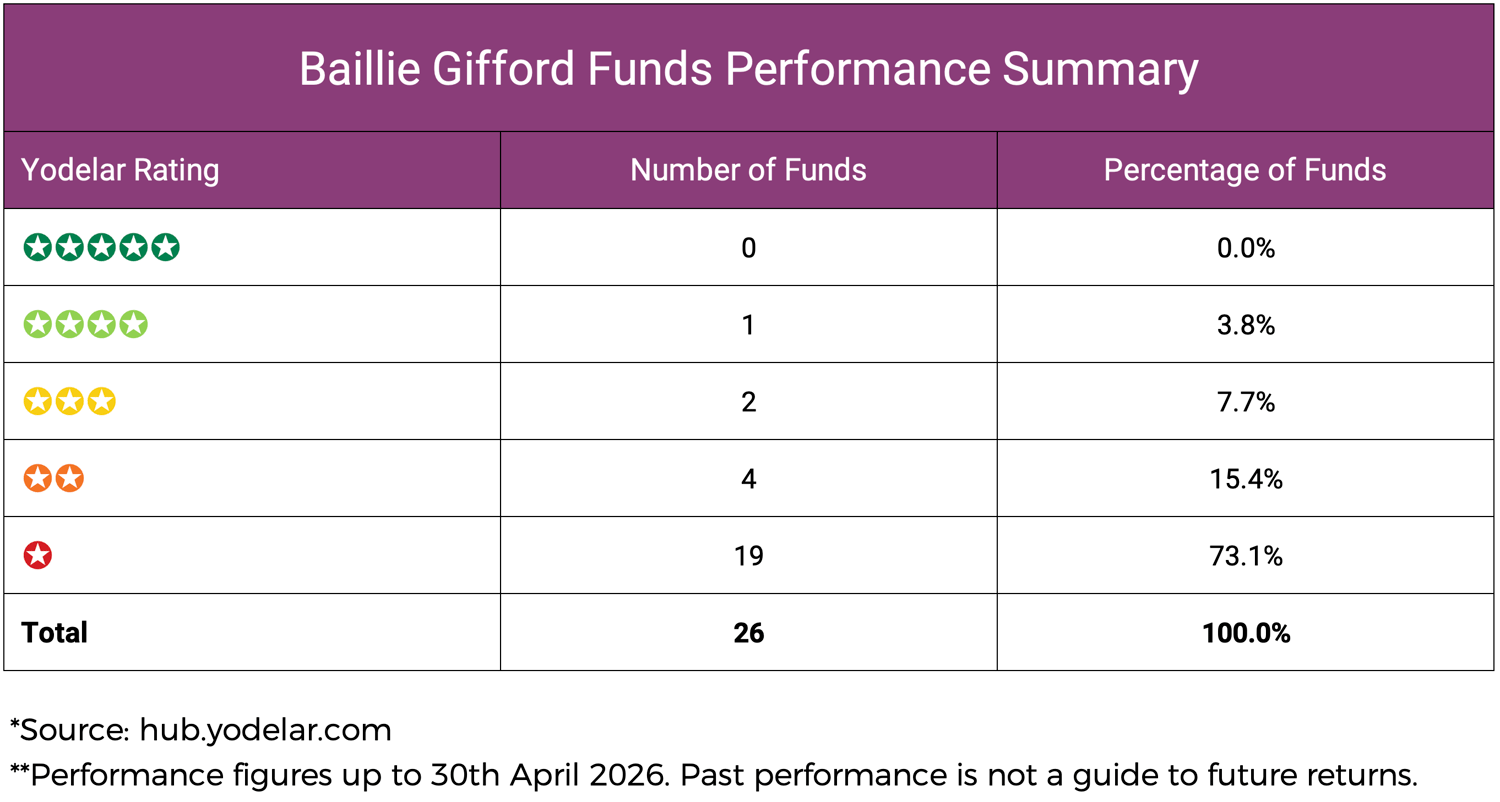
Out of 26 funds, 19 were rated 1 star, representing 73.1% of the range reviewed. A further 4 funds were rated 2 stars, meaning 23 of the 26 funds analysed received either a 1 or 2 star rating.
Only Baillie Gifford Pacific achieved a 4 star Yodelar rating. It returned 71.82% over one year, ranking 10th out of 108 funds in the IA Asia Pacific ex Japan sector, while its three year return of 78.77% ranked 7th out of 105 funds and its five year return of 39.03% ranked 33rd out of 100 funds.
That makes Baillie Gifford Pacific the clear standout within the current range. It also highlights the wider issue, which is that strong recent performance has been limited to a small number of funds while most of the range has fallen behind sector peers.
The Style That Made Baillie Gifford Stand Out
Baillie Gifford is best known for backing companies it believes have strong long term growth potential. In simple terms, this means its fund managers are often looking for businesses that could become much larger over time, rather than focusing only on companies that are already well established.
This can include companies in areas such as technology, healthcare, online services, innovation and emerging markets. These businesses can grow quickly, but their share prices can also move sharply because much of their value depends on future growth.
When markets favour this type of company, Baillie Gifford funds can perform extremely well. But when investors prefer more established companies or businesses with steadier profits, Baillie Gifford’s approach can fall behind.
That is the trade off investors need to understand. Baillie Gifford’s funds are not designed to quietly mirror the market, and this can be powerful in the right conditions but painful when markets move against their preferred style.
Why Baillie Gifford Funds Have Struggled
The main issue has been style. Many Baillie Gifford funds favour companies expected to grow strongly over the long term, but during recent years many of these companies have faced a tougher market environment.
Investors have often been less willing to pay high prices for growth expected far into the future, particularly when interest rates have been higher and markets have favoured more established companies. This has affected several of Baillie Gifford’s best known funds.
Baillie Gifford American returned 6.35% over one year, compared with a sector average of 25.12%. Over five years it fell by 23.00%, while the IA North America sector average rose by 63.54%, placing the fund 208th out of 209 funds over that period.
Baillie Gifford Global Discovery has also struggled. It returned 31.52% over one year, ahead of the IA Global sector average of 25.20%, but over three years it returned just 1.77% compared with a sector average of 43.02%, and over five years it fell by 52.79%, ranking last out of 413 funds.
Baillie Gifford Managed shows that the challenge has not been limited to the most specialist growth funds. It returned 10.70% over one year, 24.83% over three years and minus 1.52% over five years, compared with IA Mixed Investment 40 to 85% Shares sector averages of 19.21%, 33.77% and 32.49%.
Baillie Gifford Positive Change also lagged its sector average over all three main periods reviewed. It returned 17.52% over one year, 23.13% over three years and 0.51% over five years, compared with IA Global sector averages of 25.20%, 43.02% and 45.67%.
These figures show a clear pattern across the range. Some funds have shown signs of shorter term recovery, but many remain weak over five years when compared with their sectors.
Why The Longer Term Picture Is More Balanced
The current Yodelar ratings show a clear period of underperformance across much of the Baillie Gifford fund range, and that should not be ignored. However, the longer term picture is more balanced than the latest five year rankings suggest.
Baillie Gifford became well known because several of its funds delivered very strong returns during earlier periods when growth focused companies were leading markets. The 10 year figures show why many investors still associate the group with strong long term performance.
| Fund | 10 Year Fund Performance | 10 Year Sector Average |
|---|---|---|
| Baillie Gifford Pacific B Acc | 365.03% | 171.36% |
| Baillie Gifford Managed B Acc | 112.65% | 91.99% |
| Baillie Gifford American B Acc | 299.84% | 258.82% |
| Baillie Gifford Global Alpha Growth B | 199.55% | 181.38% |
**Performance figures up to 30th April 2026. Past performance is not a guide to future returns.
Baillie Gifford Pacific delivered 365.03% over 10 years, more than double its sector average of 171.36%. Baillie Gifford American returned 299.84% compared with a sector average of 258.82%, while Baillie Gifford Managed and Baillie Gifford Global Alpha Growth also remained ahead of their sector averages over 10 years.
These figures help explain why many investors still associate Baillie Gifford with strong long term returns. The issue is not that the group has never delivered strong performance, but that much of that strength was built during earlier periods while recent performance across many funds has been poor.
This is the central point. Baillie Gifford’s style can work very well when the companies it backs are in demand, but when markets move away from higher growth companies, performance can fall sharply and remain weak for several years.
Why Baillie Gifford Funds Can Still Recover
A recovery is possible, but it is not guaranteed. Baillie Gifford’s approach is built around long term company selection, and its funds often look very different from the average fund in the same sector.
That difference can work in investors’ favour when the selected companies perform strongly. It can also make performance look poor for long periods when those companies fall out of favour or fail to deliver the growth expected by the fund managers.
For performance to improve more widely, several things would likely need to happen. The companies Baillie Gifford backs would need to deliver stronger trading results, investor confidence in long term growth companies would need to improve, and market leadership would need to broaden beyond the areas that have recently dominated.
There are already some signs that selected Baillie Gifford funds can still compete. Baillie Gifford Pacific is the clearest example, with strong rankings over one and three years and a 4 star Yodelar rating, while Baillie Gifford Emerging Markets Growth delivered 64.12% over one year and 80.15% over three years, both ahead of its sector averages.
The issue is consistency. These stronger areas have not been enough to offset the wider weakness across the range, which is why investors should focus on the specific funds they hold rather than assuming the Baillie Gifford name alone is enough.
Why A Portfolio Review Matters
Many investors bought Baillie Gifford funds during periods when the group was performing strongly. Some may still hold them inside ISAs, pensions or general investment accounts without realising how far some funds have fallen behind their sector averages.
A Yodelar portfolio analysis can help bring that into focus. It reviews each fund against its sector over one, three and five years, highlighting which holdings have remained competitive, which have lagged, and whether the overall portfolio is too dependent on one fund manager, one region or one style of investing.
This is particularly important with Baillie Gifford because many of its funds share a similar long term growth approach. Holding several Baillie Gifford funds may not provide as much spread as investors expect if those funds are affected by the same market conditions.
A portfolio does not need to avoid Baillie Gifford altogether. But investors should understand how much exposure they have, how the funds compare with alternatives, and whether the overall mix still makes sense.
For investors who want a clearer view of their current holdings, a no obligation call with an FCA regulated adviser can help assess whether their portfolio remains aligned with their objectives and attitude to risk.

Conclusion
Baillie Gifford remains one of the most recognisable names in UK fund management. Its approach is clear, distinctive and built around long term growth, and the 10 year data shows that several major funds still sit ahead of their sector averages over that longer period.
The recent picture, however, is weak. Out of 26 funds analysed, none achieved a 5 star Yodelar rating and 19 were rated just 1 star, while several well known funds have lagged badly over five years.
That does not mean Baillie Gifford funds cannot recover. Some may, but recovery should not be assumed, and past reputation is not enough reason to keep holding a fund that has consistently fallen behind its sector.
For investors, the starting point is simple. Understand what you hold, how each fund compares with similar options, and whether the overall portfolio is still balanced. For those with Baillie Gifford exposure, that review is now more important than ever.