

- Asia Pacific Excluding Japan, Global Equities, Japan, and European Smaller Companies were among the strongest performing sectors across 2025.
- China and Greater China, UK Gilts, Index Linked Gilts, and Sterling Corporate Bonds remained the weakest areas over longer timeframes.
- The performance gap between top and bottom quartile funds within sectors such as IA Global, IA Global Emerging Markets, and IA UK All Companies exceeded 60% over five years.
- Sector averages alone can conceal significant dispersion, meaning investor outcomes depend heavily on fund selection rather than simple market exposure.
- Consistent long term growth requires disciplined monitoring of sector trends and fund performance, ensuring each holding continues to justify its place within the portfolio.
Different parts of the market have reacted very differently to the economic shifts of 2025. Inflation trends, interest rate expectations, and regional economic data have all been moving in varied directions, and because each sector represents a distinct set of companies and market drivers, they have not moved together. Some sectors are influenced more by global trade, others by technology demand or local economic conditions, so performance naturally diverges rather than following a single path.
This article analyses how each Investment Association sector has performed over the past 1, 3, and 5 years. It highlights the areas that have delivered strong results, those that have struggled, and where the widest performance gaps have emerged. By comparing sector averages with top and bottom quartile outcomes, the analysis shows how these differences translate into clear variations in long term portfolio results.
Understanding Sector Performance
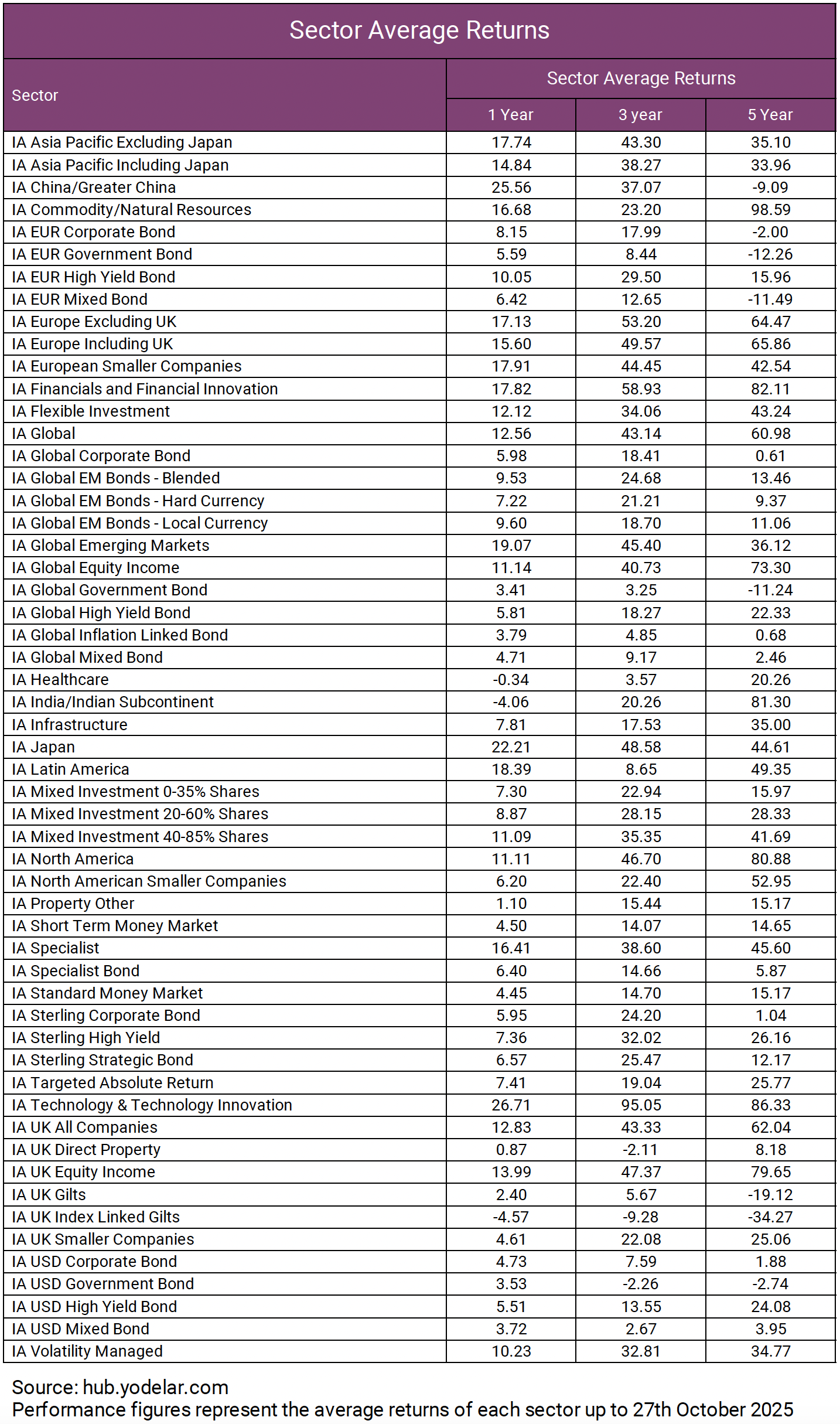
The figures in this report are based on Yodelar’s analysis of all funds within each IA sector. For every sector, we calculated the average return over 1, 3, and 5 years. These sector averages provide a clear view of how the typical fund in each area has performed over different timeframes.
Looking at sector averages helps investors understand which parts of the market have been stronger, which have struggled, and how performance has shifted over time. It also highlights how different sectors respond to changing conditions, giving investors a straightforward way to compare long term trends across the market.

Sectors That Delivered the Strongest Results
Several equity sectors delivered very strong results over the past year. Asia Pacific Excluding Japan was one of the strongest. The sector returned an average of 17.74% over 1 year, with the top quartile reaching 24.34%. Over 3 years the average return was 43.30%, and over 5 years it was 35.10%.
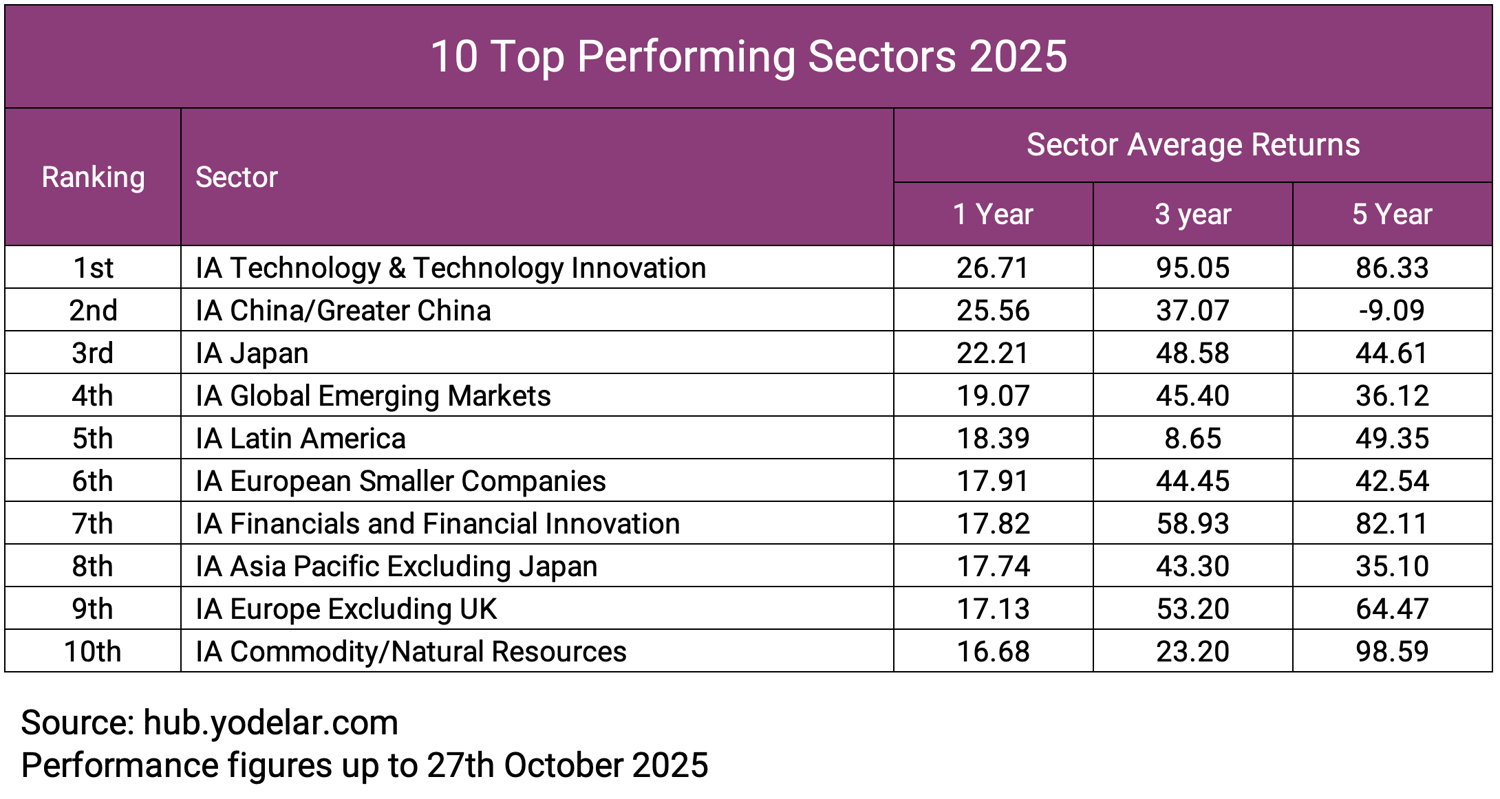
Japan also produced strong outcomes. The sector delivered an average 1 year return of 22.21%, and the top quartile reached 29.26%. Over 3 years the average return was 48.58%, and over 5 years it was 44.61%.
Global equities remained consistently competitive. The sector returned an average of 12.56% over 1 year, and the top quartile reached 32.05%. Over 3 years the average was 43.14%, and over 5 years it was 60.98%. The top quartile delivered more than 100% over 5 years, highlighting the wide gap between stronger and weaker funds in this category.
European Smaller Companies also delivered notable growth. The sector achieved an average 1 year return of 17.91%, with the top quartile reaching 28.98%. Over 5 years the top quartile returned 78.12%.
Specialist growth areas such as Technology and Innovation funds also posted strong longer term results. Demand for companies in areas such as artificial intelligence and digital services helped keep top quartile returns well ahead of wider equity markets over 5 years.
Sectors That Struggled in 2025
While some sectors delivered strong growth, others faced persistent challenges. China and Greater China remained one of the weakest areas on a longer view. The sector recorded an impressive 1 year average return of 25.56%, but this was driven by a rebound from a depressed starting point. Over 3 years the average return was -2.77%, and over 5 years -9.06%. The bottom quartile over 5 years recorded a loss of more than 22%.
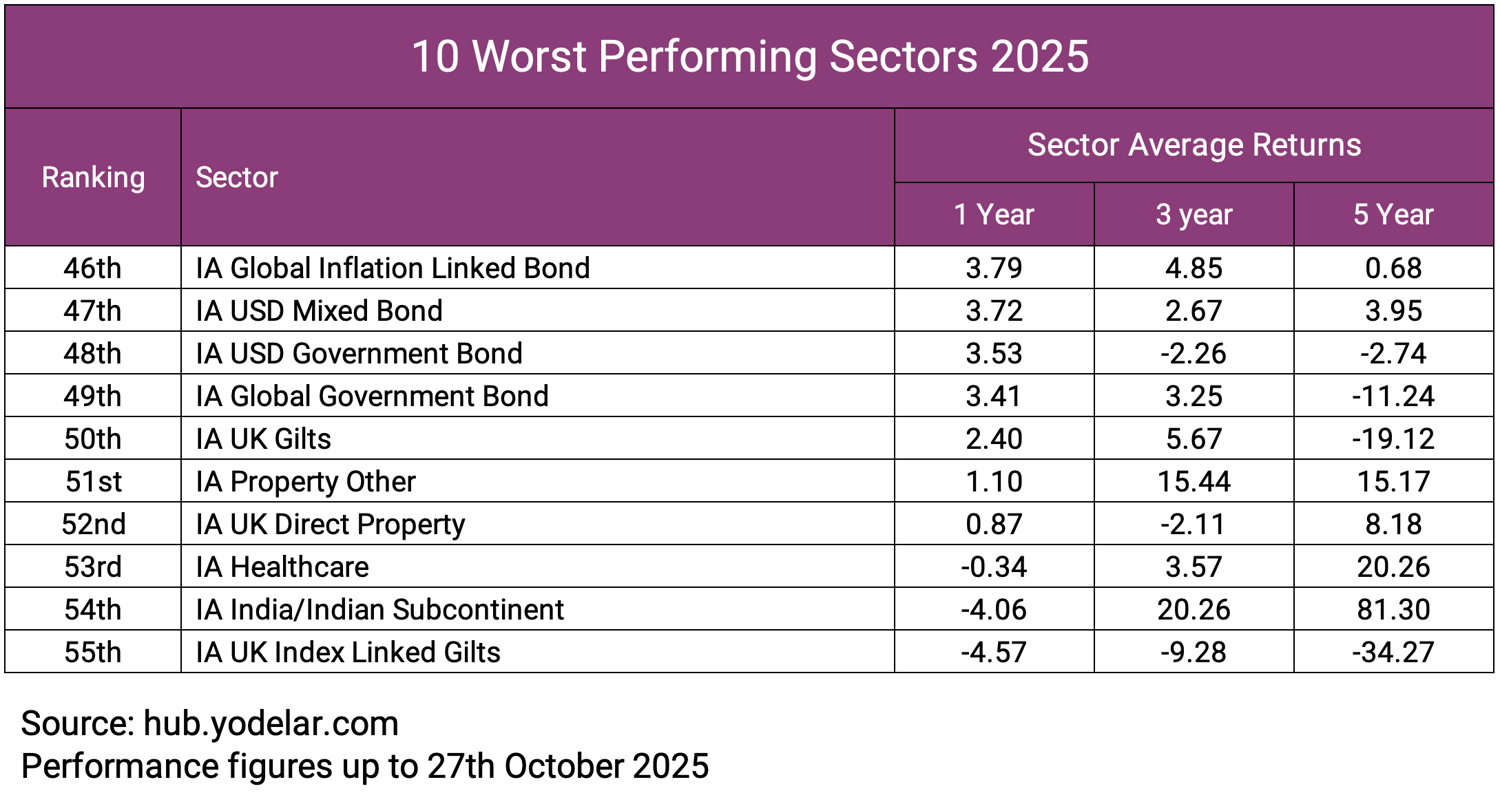
UK Gilts and UK Index Linked Gilts also remained weak because of the interest rate environment and inflation volatility. UK Gilts delivered an average 1 year return of 2.40%, and over 5 years the sector produced negative returns of -12.45%. Index Linked Gilts performed similarly poorly with an average 1 year return of -4.57% and a 5 year average of -13.95%. These figures reflect the impact of rising yields and changing expectations around monetary policy after a long period of near zero rates.
Sterling Corporate Bond funds were also broadly negative over 5 years with an average return of -0.45%. The bottom quartile returned -4.76%. Higher financing costs, slower economic growth, and weaker balance sheets contributed to this underperformance. For cautious investors who expected fixed income to provide steady positive returns, these results highlight how challenging the past rate cycle has been.
Specialist sectors delivered mixed outcomes. The IA Specialist Bond category achieved a 5 year average return of 8.58%, but the bottom quartile returned -15.67%. Outcomes varied widely depending on regional focus and thematic exposure. Highly concentrated or leveraged strategies fared poorly during periods of market stress, while more diversified specialist mandates held up better. This dispersion underlines the need to understand exactly what risk a specialist fund is taking on.
Where the Largest Performance Gaps Emerged
The sectors with the widest gaps between top and bottom quartile funds expose the hidden risks in fund selection.
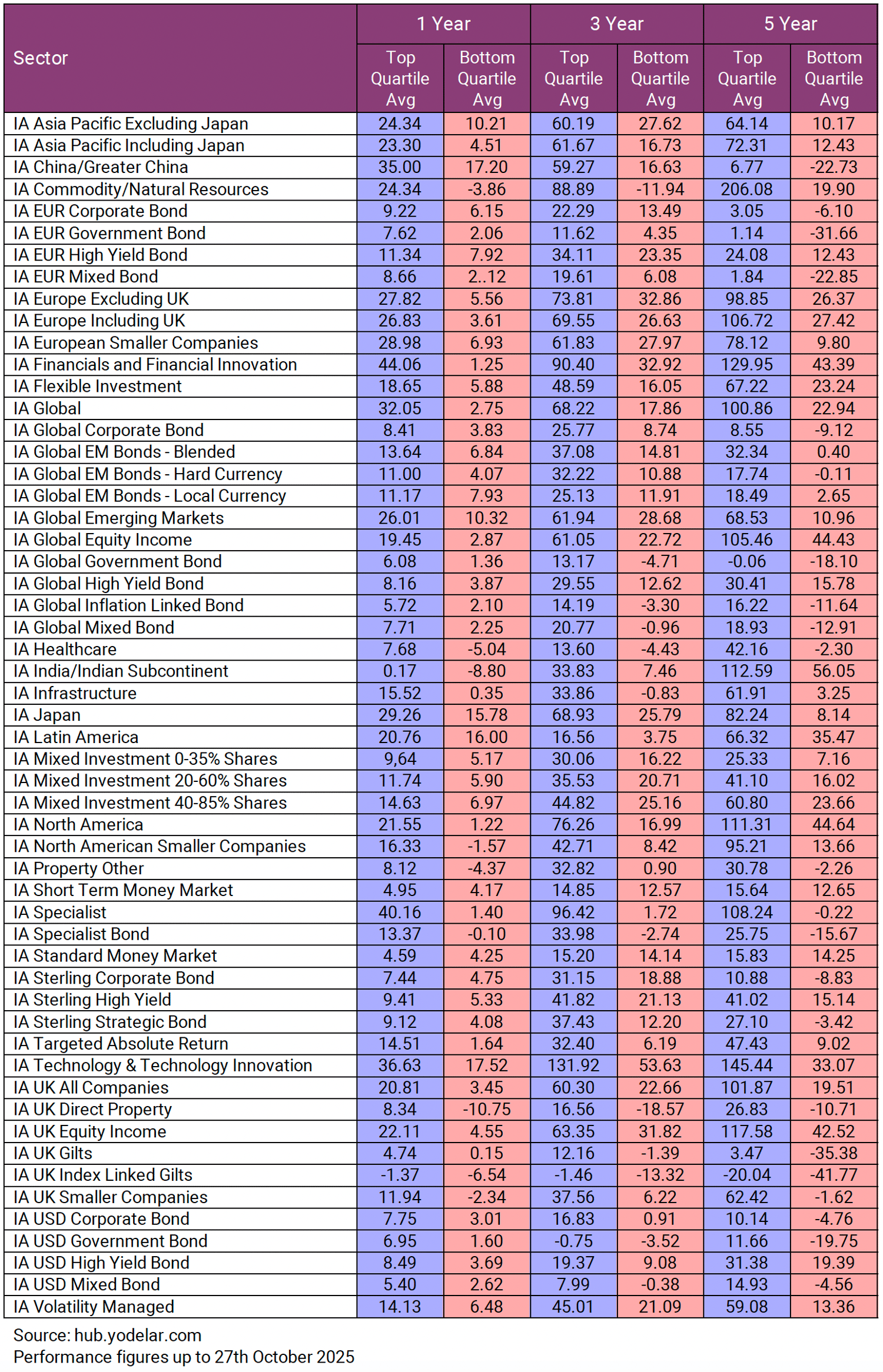
Global Emerging Markets is a clear example. Over 5 years the sector delivered an average return of 36.12%. Top quartile funds achieved 68.53%, while bottom quartile funds delivered only 10.96%. Two investors both invested in Global Emerging Markets could therefore have experienced very different outcomes depending solely on the funds they held.
The IA Global sector shows a similar pattern. Over 5 years, the top quartile returned 100.86% compared with bottom quartile returns of 22.94%. This difference reflects not only regional positioning but also the ability of fund managers to navigate market cycles, manage risk, and maintain exposure to structural growth trends without overpaying for them.
In UK focused sectors, performance dispersion has been equally notable. The IA UK All Companies sector delivered an average 5 year return of 62.04%. Top quartile funds achieved 101.87%, while bottom quartile funds achieved 22.44%. Even within a relatively unloved market, skilled managers have been able to deliver strong results, while weaker strategies have struggled to keep pace.
These gaps matter because they show that sector choice alone is not enough. A portfolio tilted towards strong sectors can still underperform if it holds persistently weak funds, while a portfolio with access to more challenged sectors can still add value through careful fund selection and diversification.

What These Trends Mean for Investors
Sector trends are a useful guide, but they also show why looking only at market direction is not enough. Even when a sector is performing well overall, individual funds within it can deliver very different results. Investors who focus on the sector alone without checking the strength and consistency of the funds they hold may not capture the returns they expect.
The data also shows that some of the strongest results in recent years have come from areas that were not immediately obvious. Japanese equities, European Smaller Companies, and Asia Pacific Excluding Japan all delivered strong outcomes during periods when sentiment did not fully reflect the improvements taking place. Investors who focused only on familiar markets may have overlooked these opportunities.
Other sectors, such as Chinese equities and UK government bonds, have struggled over longer periods. Keeping exposures like these without reviewing how they are performing can make a portfolio less efficient and create a risk profile that looks suitable at the top level but is not supported by the underlying holdings.
For diversified investors, the aim is not to chase the most recent winner. It is to ensure every part of the portfolio is backed by evidence and that each holding continues to earn its place. This means checking that sector exposure is balanced across different styles and regions, and that the funds used within each sector remain towards the stronger end of their group rather than slipping into weaker territory over time.

Conclusion
The sector performance of 2025 reinforces a clear principle. Markets rarely move in unison, and the gap between sector returns can be substantial. Within each sector, the distance between the top and bottom quartile funds is often even greater than the differences between sectors themselves, showing how strongly outcomes depend on informed and selective fund choice.
For investors, this highlights the value of regular evidence based portfolio reviews. Effective portfolios are not only aligned to the right level of risk. They are built from funds with strong and repeatable performance relative to their sector, and they are monitored so allocations continue to reflect current conditions rather than outdated assumptions.
Understanding where each sector sits in the wider market, and how each fund compares within its category, helps keep portfolios deliberate rather than passive. In an environment where dispersion is high and conditions can shift quickly, this level of oversight is essential for maintaining long term efficiency and giving portfolios the best chance of meeting their objectives.
Claim Your Free Portfolio Analysis
Even well-constructed portfolios can drift off course over time. Underperforming funds, outdated strategies and disproportionate exposure to certain regions often remain unnoticed without a detailed review. These inefficiencies can gradually affect long-term performance, even when headline returns appear stable.
A free portfolio analysis provides clear, data-driven insight into how efficiently your investments are working. Each fund is assessed against its sector over 1, 3 and 5 years, highlighting where performance has been strong — and where it may be holding your portfolio back. The review also identifies any duplication, concentration risks or opportunities to improve diversification and cost-efficiency. This process does not constitute financial advice, but it gives you a factual and unbiased evaluation of your current position.
If you want a clearer understanding of how your portfolio is performing and whether better opportunities may be available, you can request a free portfolio review today.