

-
The IA Technology & Technology Innovation sector averaged 16.08% over 6 months, 26.22% over 1 year, 84.60% over 3 years and 79.15% over 5 years.
-
The highest returning fund in the sector delivered 307.89% over 5 years, while the lowest returning fund fell by 38.96%.
-
Only 13.5% of funds in the sector achieved a top performing 4 or 5 star Yodelar Rating.
-
64.9% received a poor 1 or 2 star rating by ranking among the bottom of the sector for performance over the periods analysed.
-
Investors should review technology exposure carefully, particularly where global funds may already hold significant exposure to large technology companies.
Technology funds have attracted significant investor attention in recent years. The growth of artificial intelligence, semiconductors, cloud computing and digital infrastructure has created a strong investment story that is easy for investors to understand.
The latest performance data shows why the sector has appeal. The Investment Association (IA) Technology & Technology Innovation sector delivered strong average returns over several time periods, including 79.15% over 5 years.
But the sector average does not tell the full story.
The difference between the strongest and weakest funds was substantial. Some funds delivered exceptional returns, while others produced losses over the same period. That matters because investors do not own the sector average. They own specific funds.
For self-managed investors, the key question is not whether technology has been a strong investment theme. It is whether the specific technology fund they hold has performed well against sector peers, whether it adds something useful to the portfolio, and whether it increases concentration in areas already held elsewhere.

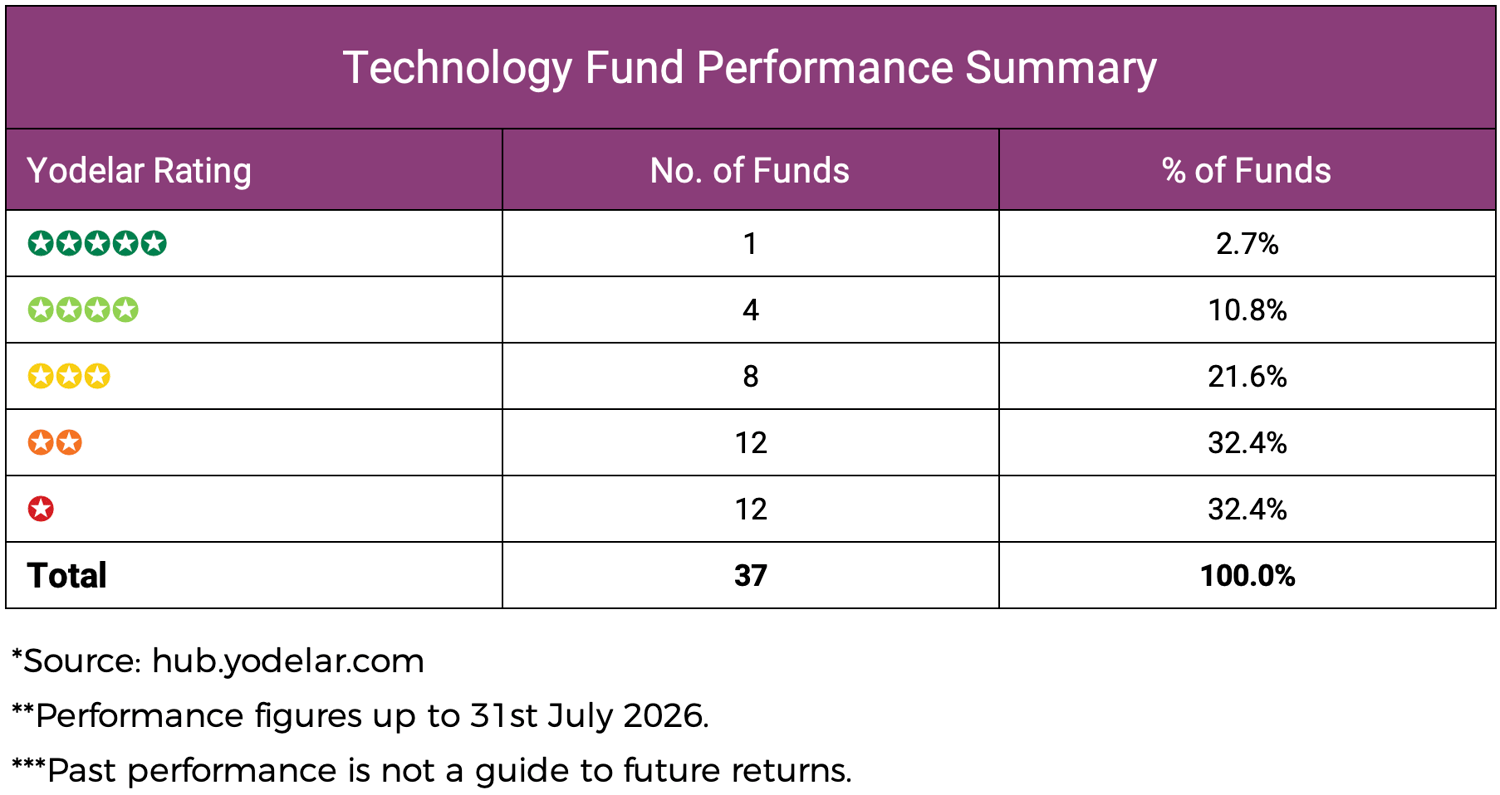
Technology Fund Performance Summary
Across the IA Technology & Technology Innovation funds reviewed, 13.5% received a top performing 4 or 5 star Yodelar Rating. In contrast, 64.9% received a poor 1 or 2 star rating by ranking among the bottom of the sector for performance over the periods analysed.
How Yodelar Rates Fund Performance
Technology Fund Performance
The IA Technology & Technology Innovation sector produced strong average returns over the periods reviewed.
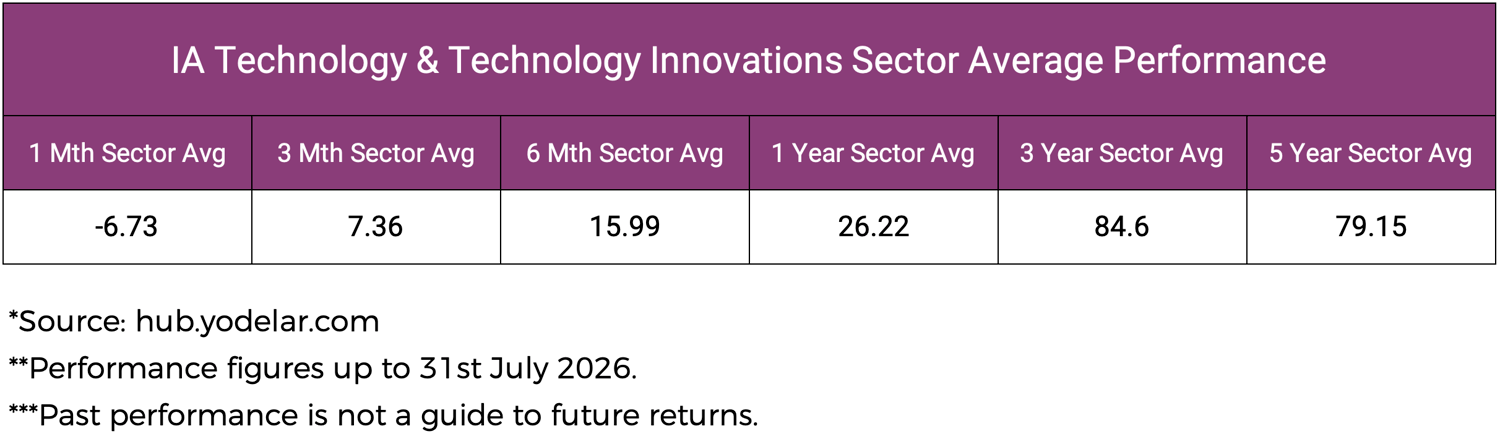
The figures show a sector with strong headline returns, but also a weak overall Yodelar Rating profile. This is important for investors because a strong sector can still contain many funds that have lagged competing funds in the same IA sector.
The performance gap was also significant. The highest returning fund delivered 307.89% over 5 years, while the lowest returning fund fell by 38.96%. That is a difference of 346.85 percentage points.
This does not mean investors should avoid technology funds. It means they should avoid assuming that the technology label is enough.
5 Top Performing Technology Funds
The table below shows five of the highest 5-year returns in the IA Technology & Technology Innovation sector. These funds are not recommendations. They are included to show where the strongest historic returns were achieved within the sector.
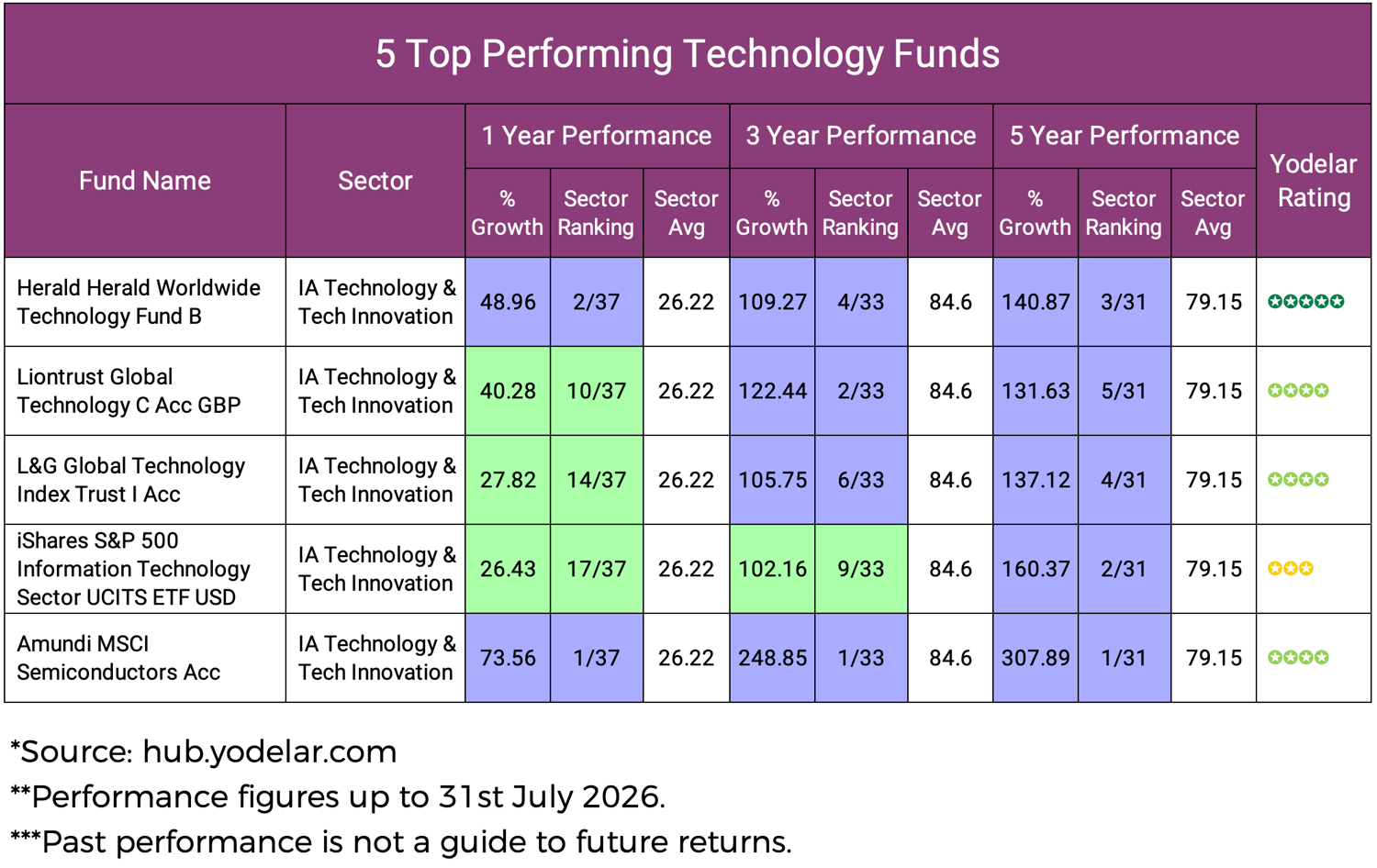
The strongest fund was Amundi MSCI Semiconductors, which returned 307.89% over 5 years and ranked 1st out of 31 funds. This shows how powerful specialist technology exposure can be when the right theme performs strongly.
However, investors should be careful not to treat all technology funds as the same. A semiconductor fund, a broad technology fund and a US information technology tracker may sit in the same IA sector, but they can behave very differently.
The table also shows why Yodelar Ratings should be read alongside performance figures. The second highest 5-year performer received a 3 star Yodelar Rating, while the third highest received a 5 star rating. This is because the Yodelar Rating considers performance consistency across several time periods, not just one return figure.
5 Lowest Returning Technology Funds
The table below shows five of the lowest 5-year returns in the IA Technology & Technology Innovation sector.
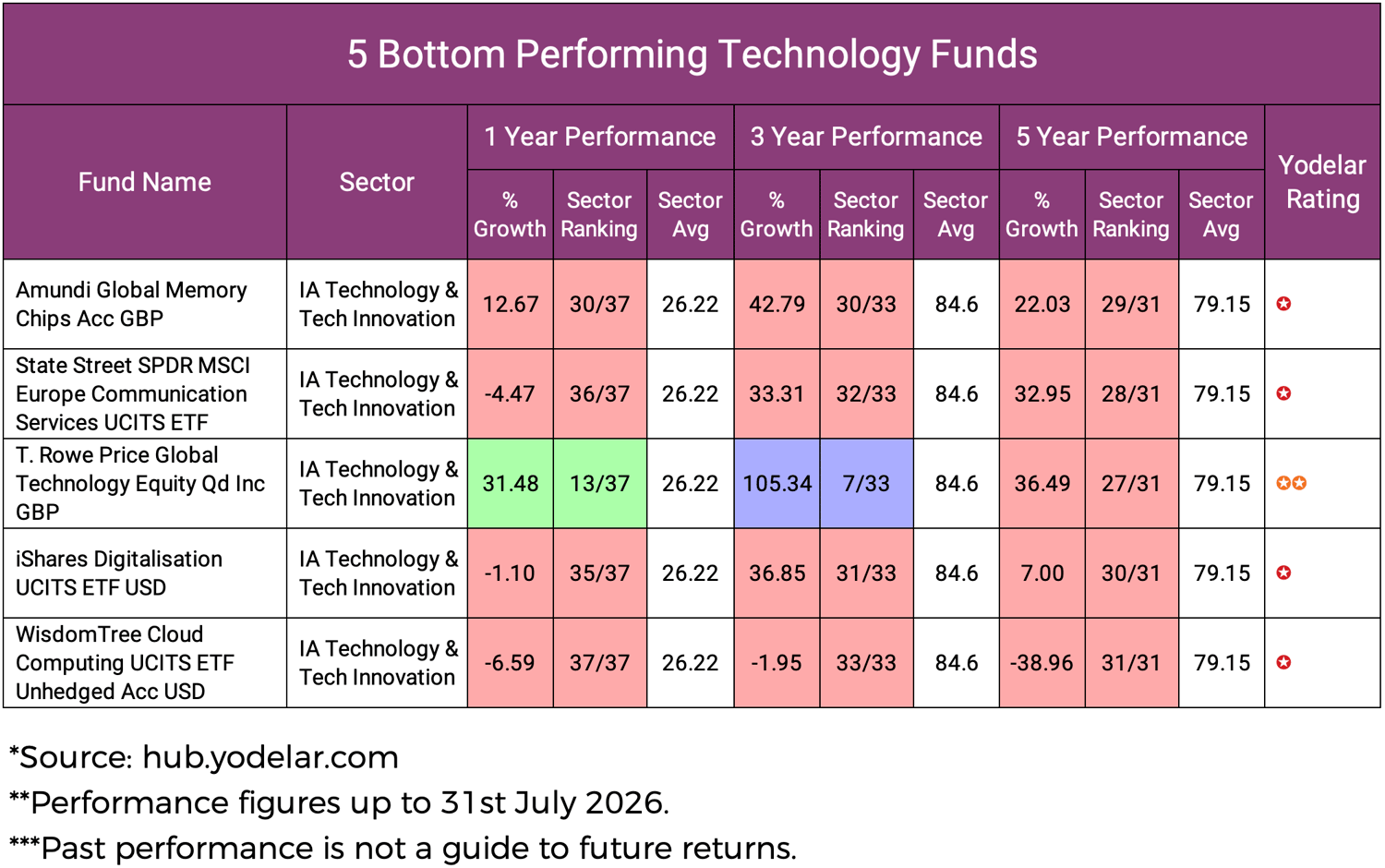
These funds show why sector labels can mislead. Several funds produced positive returns over shorter periods, but still ranked poorly over the longer period analysed.
The WisdomTree Cloud Computing fund is the clearest example. It returned 9.07% over 6 months, but fell 38.96% over 5 years and ranked last in the sector over that period.
This does not mean the funds listed are automatically unsuitable for every investor. A fund may have a specific role, or an investor may hold it for exposure to a particular theme. But funds ranking near the bottom of their sector over several periods should not be ignored.

Why Technology Funds Can Be So Different
The technology sector covers a wide range of themes.
One fund may focus on semiconductors. Another may invest in cloud computing. Another may track the information technology companies inside the S&P 500. Another may take a broader global technology approach.
These differences can have a major impact on returns.
For example, a semiconductor-focused fund may perform very strongly when demand for chips and related infrastructure is high. A cloud computing fund may behave differently if the market becomes less willing to pay high valuations for software or digital growth companies. A broad technology fund may be more diversified, but it may still be heavily influenced by the largest companies in the sector.
This is why investors should look beneath the fund name. The word “technology” does not tell investors enough about the exposure being taken, the risk involved or the role the fund should play in a portfolio.
The more useful question is whether the fund has performed competitively against sector peers and whether the type of technology exposure is suitable for the wider portfolio.

The Portfolio Risk Investors Often Miss
Many investors already have technology exposure without holding a dedicated technology fund.
Global equity funds, US equity funds, growth funds and index trackers can all include large technology companies. This means an investor may already have meaningful exposure to the sector before adding a specialist technology fund.
That matters because adding a dedicated technology fund may not improve diversification. It may increase concentration.
This can be difficult to spot from a platform statement. A portfolio may show several different fund names, but those funds may still hold many of the same large technology companies or depend on similar market trends.
A technology fund can be useful if it has a clear purpose, but it should not be added simply because the sector has performed well. Investors should first check how much technology exposure they already hold, whether the fund would duplicate existing positions and whether the extra risk is suitable.
A strong-performing sector can support portfolio returns, but too much exposure to one theme can make the portfolio more vulnerable if that theme weakens.
Get A Free Portfolio Analysis
Many investors hold technology exposure through dedicated technology funds, global funds, US funds or tracker funds without knowing how much of their portfolio depends on the same market areas.
Our free portfolio analysis reviews each fund individually, showing available 1, 3 and 5-year performance, sector ranking and Yodelar Rating. Yodelar Ratings are based on historic sector-relative performance and are not a guide to future returns.
The analysis can also help identify weaker-rated holdings, duplication, concentration, higher charges and funds that may no longer have a clear role.
It does not provide personal advice or recommend whether to buy, sell or switch any investment. It is designed to give investors a clearer view of their portfolio before deciding whether further review may be useful.

Book A No Obligation Call
For investors who want to understand whether their current portfolio remains suitable, a no obligation call with an adviser from our advice partner, MKC Wealth, can help.
The discussion can cover current holdings, portfolio analysis results, objectives, time horizon and attitude to risk. It can also explain how a more structured investment approach may compare with the portfolio currently held.
Any personal recommendation would only be made after understanding the investor’s financial position, investment objectives, time horizon and attitude to risk. Any recommendation would include a clear explanation of risks, costs and ongoing service.

Summary
Technology has been one of the strongest long-term fund sectors, but the latest data shows why investors still need to be selective.
The IA Technology & Technology Innovation sector averaged 79.15% over 5 years, but only 13.5% of funds achieved a 4 or 5 star Yodelar Rating. In contrast, 64.9% were rated 1 or 2 stars.
The gap between funds was also substantial. The strongest 5-year fund returned 307.89%, while the weakest fell by 38.96%.
For investors, the message is clear. Do not judge a fund by the technology label alone. Check how it has performed against competing funds in the same IA sector, understand what it actually holds and review whether the exposure fits the wider portfolio.
Before adding more technology exposure, investors should first check how much they already hold and whether their current funds have ranked well against sector peers.