

-
The IA Volatility Managed sector delivered steady overall returns over the past 1, 3 & 5 years, but the gap between average funds and top performers was significant.
-
The strongest funds delivered substantially higher returns over three and five years than the sector average.
-
Many funds in the sector are effectively multi-asset portfolios, but differ widely in how they manage risk, asset allocation and market exposure.
-
Higher-risk versions within provider ranges tended to deliver stronger long-term returns, despite all funds being grouped within the same sector.
Volatility managed funds are often presented as a steadier way to invest. The idea is straightforward. Stay invested, spread risk across different assets, and aim to reduce the size of the ups and downs along the way. For investors who want growth but do not want a portfolio that feels too exposed to equity market swings, that can sound like a sensible middle ground.
The difficulty is that this is not a neat, like for like sector. Funds in the Investment Association (IA) Volatility Managed sector can take very different approaches, use different levels of risk and rely on different portfolio building methods. In practice, many have multi asset characteristics, but they are not simply funds with a fixed mix of shares and bonds.
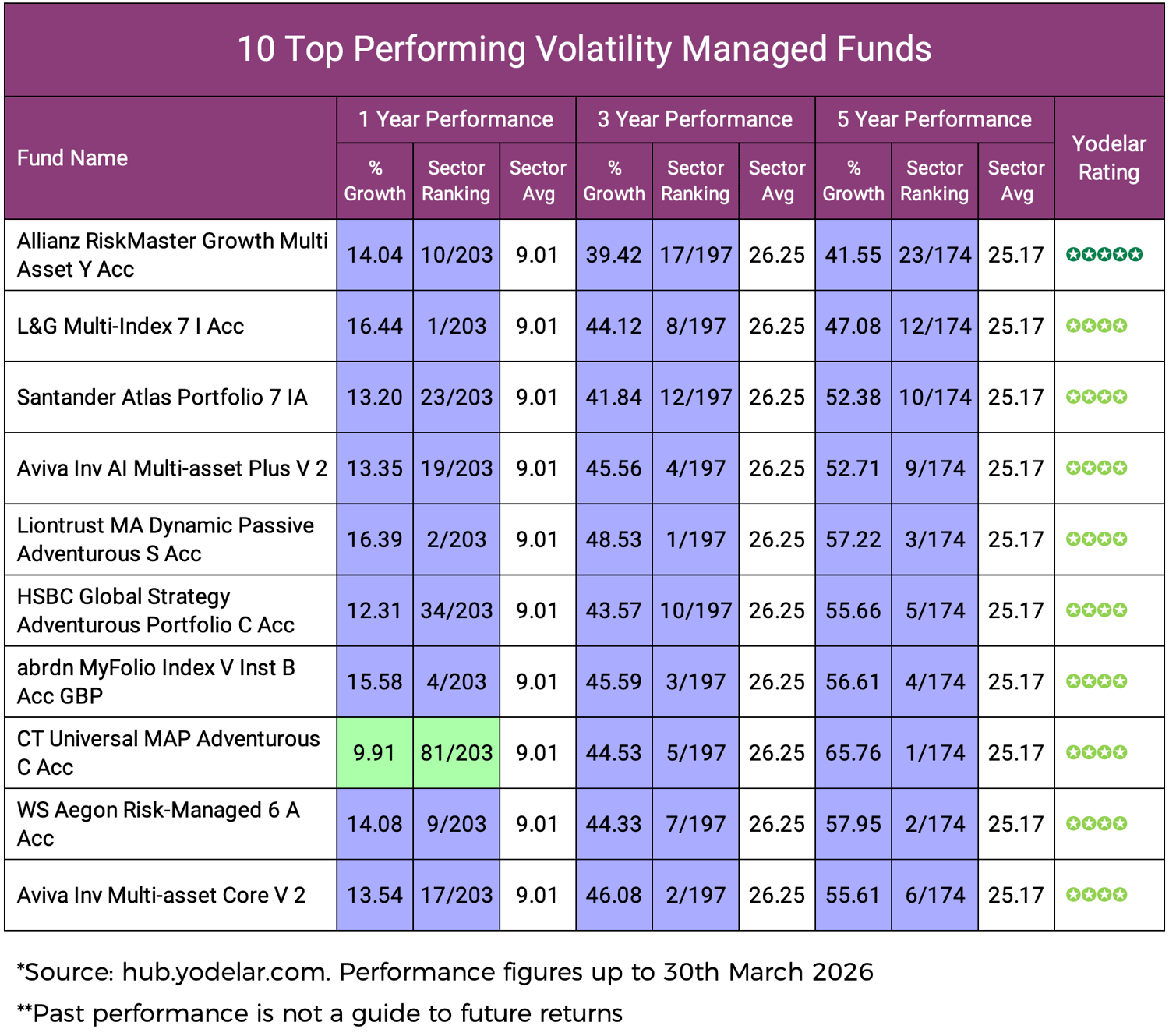
That makes the sector less straightforward than it first appears. Based on performance figures up to 30 March 2026, the average fund in the IA Volatility Managed sector returned 9.01% over one year, 26.25% over three years and 25.17% over five years. The strongest five year return in the sector was 65.76%. Even in a sector built around risk control, the gap between average and leading funds has been wide.
To keep the review focused, the 10 funds below were chosen because they combine 4 or 5 star Yodelar ratings with some of the stronger three and five year rankings in the sector. In a sector like this, a single strong year can distort the picture. Funds that remain competitive over more than one period usually provide more useful context.

What Makes These Funds Different?
Although they sit in the same sector, these funds do not all behave in the same way. Some rely mainly on passive building blocks. Some are more actively managed. Some sit at the higher risk end of a provider’s wider range, while others operate within a narrower risk framework.
That variety helps explain why sector comparisons need care. A sector label can be useful, but it does not mean the funds are directly comparable in every respect.
Even so, the performance tables still provide useful insight. They show which funds have remained more competitive than others within this broad group, and which ones have held up better across more than one time period.
Download The Full Volatility Managed Funds Performance Review
10 Funds That Have Stood Out
The funds below have been selected based on how they ranked within the IA Volatility Managed sector across the periods analysed. Each of these funds delivered returns above the sector averages of 9.01% over one year, 26.25% over three years and 25.17% over five years.
CT Universal MAP Adventurous Fund
This fund sits at the adventurous end of Columbia Threadneedle’s Universal MAP range. The provider says it aims to deliver growth, combining capital and income over at least five years, with exposure to a range of global asset classes and no fixed constraint on geography, sector or industry. That flexibility has translated into the strongest five-year return in the sector. It returned 9.91% over one year, 44.53% over three years and 65.76% over five years, compared with sector averages of 9.01%, 26.25% and 25.17%.
WS Aegon Risk Managed 6 Fund
WS Aegon Risk Managed 6 returned 14.08% over one year, 44.33% over three years and 57.95% over five years, ranking 9th, 7th and 2nd in the sector. This is a good example of a fund that has remained highly competitive over the medium and longer term without needing to lead every period.
abrdn MyFolio Index V Institutional B Fund
abrdn MyFolio Index V returned 15.58% over one year, 45.59% over three years and 56.61% over five years, ranking 4th, 3rd and 4th. It has been one of the most consistent all round performers in the review, with strong rankings across each of the main periods.
Aviva Investors Multi asset Core Fund V
Aviva Investors Multi asset Core Fund V returned 13.54% over one year, 46.08% over three years and 55.61% over five years. Those figures ranked 17th, 2nd and 6th in the sector. The one year number is less eye catching, but the three and five year rankings place it firmly among the stronger funds in the sector.
HSBC Global Strategy Adventurous Portfolio C Fund
HSBC Global Strategy Adventurous returned 12.31% over one year, 43.57% over three years and 55.66% over five years, ranking 34th, 10th and 5th. The most recent 12 month period was less exceptional than some peers, but the medium and longer term record remains strong.
Liontrust MA Dynamic Passive Adventurous S Fund
Liontrust MA Dynamic Passive Adventurous has been one of the clearest standouts in the sector. It returned 16.39% over one year, 48.53% over three years and 57.22% over five years, ranking 2nd, 1st and 3rd. In other words, it has not just delivered one strong spell. It has remained near the front of the sector across all the key periods.
Santander Atlas Portfolio 7 Fund
Santander Atlas Portfolio 7 returned 13.20% over one year, 41.84% over three years and 52.38% over five years, ranking 23rd, 12th and 10th. It may not have posted the very highest return in the sector, but it has remained consistently competitive across the main periods.
Aviva Investors Multi asset Plus Fund V
Aviva Investors Multi asset Plus Fund V returned 13.35% over one year, 45.56% over three years and 52.71% over five years, ranking 19th, 4th and 9th. It is another example of a fund whose strength becomes clearer on a longer view than on the latest 12 month snapshot.
L&G Multi Index 7 Fund
L&G Multi Index 7 returned 16.44% over one year, 44.12% over three years and 47.08% over five years, ranking 1st, 8th and 12th. It delivered the strongest one year return in the sector and still remained within the stronger group over the three and five year periods.
Allianz RiskMaster Growth Multi Asset Fund
Allianz RiskMaster Growth Multi Asset returned 14.04% over one year, 39.42% over three years and 41.55% over five years, ranking 10th, 17th and 23rd. Its five year position is less striking than some of the funds above, but it has remained above sector average across all the main periods and continues to hold a 5 star Yodelar rating.

What The Stronger Funds Had In Common
The obvious pattern is that many of the stronger funds came from the higher risk end of their own provider ranges. That should not be ignored. These were often not the most cautious options in the sector. They were usually the more adventurous or growth focused versions, which helps explain why their longer term returns were so much stronger than the sector averages.
The second pattern is that many of the better performers were clearly structured as diversified, ready made portfolios rather than narrow, single theme solutions. They spread money across multiple asset classes, different regions and a range of underlying funds or passive exposures. In practical terms, many of the stronger funds still look like broadly diversified multi asset portfolios.

How Investors Can Use This Sector More Effectively
The biggest mistake with IA Volatility Managed funds is assuming they are directly comparable just because they share a sector label. They are not. Some target relatively high volatility, some much lower. Some are built mainly from passive holdings, while others use active funds, tactical changes or other risk management tools. That means a fund can rank near the top of the sector and still be the wrong fit for a particular investor's portfolio.
That is why this sector is usually more useful when viewed as part of a portfolio decision rather than as a simple performance league table. A good volatility managed fund can help with diversification and risk control. But a fund that already contains a broad mix of assets can also duplicate parts of a portfolio if the investor adds other holdings that quietly do the same job.
In practice, the question is not only whether the fund has ranked well, but whether it is genuinely adding something useful to the wider portfolio.

Conclusion
The IA Volatility Managed sector is built around a sensible idea, but it is not a simple one. These funds are usually multi asset in practice, yet they differ widely in how much risk they take, how they build portfolios and how they manage volatility. That helps explain why the gap between average and standout funds has been so wide.
The 10 funds featured here have stood out because they have been more competitive than most of their peers over the periods analysed, particularly over three and five years. But the main lesson is not that one provider has solved the sector or that volatility management automatically produces better returns. It is that fund selection still matters, and that even risk managed funds need to be judged in the context of the wider portfolio.
For investors already using one of these funds, or considering one, the more useful next step may not be another performance table. It may be asking whether the portfolio around it is still built in a way that makes sense.