

- Market volatility should not trigger panic selling or rushed portfolio changes.
- For a well-structured portfolio, staying invested can be the right response.
- But periods of uncertainty can expose weak fund selection, hidden overlap and poor balance, which can significantly impact long-term outcomes.
- Holding cash may reduce short-term volatility, but it can limit growth and reflect delayed decision-making.
- Strong portfolios rely on clear structure, genuine diversification and ongoing review.
Recent headlines have given investors plenty to think about. Markets have been reacting to the conflict involving Iran, higher energy prices and shifting policy signals from the United States. Reuters reported that investors were weighing outcomes ranging from de-escalation to renewed escalation, while the Bank of England has said that the war in the Middle East has disrupted the transport and supply of energy, pushing inflation higher than previously expected in the short term.
That backdrop helps explain why many investors feel cautious. In many cases, resisting the urge to react is sensible. Panic selling during periods of uncertainty can do lasting damage, particularly if it leaves investors out of the market when recoveries begin.
But uncertainty can also be useful. It can expose weaknesses that were already present in a portfolio but were easier to overlook in calmer conditions. It does not improve poor fund selection, remove hidden overlap or correct an unbalanced asset allocation. Nor does it turn large, long-term cash positions into an efficient strategy for investors who still want growth.
That is the real issue. Current events are not a reason to panic, and they are not a reason to ignore visible problems. For a sound portfolio, staying invested may be the right course. For a weaker one, volatility is a reason to review it properly.
Doing Nothing Can Be Sensible, But It Should Be A Deliberate Choice
It is easy to view delay as the safe option. Sometimes it is. Investors who continually alter portfolios in response to headlines often do more harm than good.
The important distinction is between disciplined patience and passive neglect. Doing nothing can be the right response when a portfolio is well diversified, aligned to the investor’s objectives and built to cope with volatility. But when a portfolio already has structural weaknesses, inaction simply preserves them.
Many investors find themselves somewhere in between. They are not necessarily confident in their current mix of holdings, but they are wary of making changes while markets feel unsettled. As a result, decisions are postponed and portfolios drift.
Over time, that can widen the gap between what the portfolio delivers and what it could have delivered with a clearer structure. The sensible next step is not a rushed decision. It is an honest review of whether the current portfolio still makes sense.

A Weak Fund Does Not Become A Strong Holding Just Because Markets Are Unsettled
The clearest factual argument for reviewing a portfolio comes from fund performance itself.
Yodelar’s recent review of 4,199 Investment Association (IA) sector-classified funds found that the average five-year return for top-quartile funds was 63.14%, compared with 7.12% for bottom-quartile funds, a gap of 56.02% within the same sectors. In IA Global, the spread between top- and bottom-quartile funds was 78.85% over five years, while in IA UK All Companies it was 80.62%.
That does not mean the strongest recent funds will be the strongest in future. Past performance is not a reliable guide to future results. It does, however, show something important: poor fund selection is not a minor issue. Over time, it can create a very large difference in outcomes.
This is where many investors get trapped. They assume that because they are invested for the long term, time alone will smooth out weak fund performance. In reality, if a fund has consistently ranked badly against its own sector peers, and there is no clear reason it still deserves its place in the portfolio, then keeping it simply because markets are unsettled may be less about discipline and more about inertia.
A long-term approach only works properly when the portfolio itself is built on sound foundations.
Related Article: What a Review of 4,000 Funds Reveals About Portfolio Performance
More Funds Do Not Automatically Mean More Diversification
Another common weakness is false diversification.
Yodelar’s portfolio analysis work has repeatedly highlighted that portfolios can appear diversified while being heavily concentrated underneath. Different funds can hold many of the same underlying companies, regions or sector themes, meaning investors can end up with repeated exposure without realising it. Overlap, below-sector-average performance and overreliance on specific regions or currencies are recurring issues.
This is especially important after periods when a narrow group of sectors has led returns. When one area of the market has done particularly well, investors often add more of what has already been working. Over time, that can create a portfolio that looks broad on the surface but is actually leaning on a surprisingly small number of drivers.
That is not diversification. It is concentration dressed up as diversification.
A genuinely well-balanced portfolio should spread risk across different asset classes, sectors, regions and investment styles. It should also make sure that each fund has a clear role to play. If two or three holdings are effectively giving the same exposure, the portfolio may be carrying more risk than the investor thinks.
That sort of weakness matters in all market conditions, but it becomes more visible when uncertainty rises. When markets become more selective, portfolios that are more concentrated than they appear tend to feel it sooner.
Holding Cash Can Be Sensible, But It Should Be Intentional
The increase in cash holdings seen recently is not difficult to understand. For many investors, it is a direct response to uncertainty. Ongoing geopolitical tension, unpredictable political messaging and concern over how markets may react next have created an environment where stepping back can feel like the most sensible option.
In that context, cash is not just a portfolio decision. It is also a behavioural one. Holding cash can reduce short-term volatility, but it does not address the underlying quality of the portfolio. It does not improve fund selection, fix concentration or rebalance risk. It simply reduces market exposure while leaving the original weakness unchanged.
This is where some investors become stuck. They are not necessarily choosing cash believing, for them, it is the most efficient long-term strategy, but because it allows them to delay dealing with a portfolio they are no longer fully confident in.
For investors who still want long-term growth, that can create a mismatch between intention and positioning. The portfolio may be partly invested, partly held in cash and no longer aligned to a defined strategy. Cash has a role, particularly for short-term needs or for investors with a lower tolerance for risk. But when it becomes a holding place for uncertainty rather than a deliberate allocation, it can limit the portfolio’s ability to move forward.

The Bigger Risk Is Reacting Emotionally Or Waiting For Perfect Clarity
One of the most damaging habits in investing is the belief that it is better to wait until the outlook becomes clearer.
It rarely does.
Morningstar has noted that missing just the 10 best market days over the past 25 years would have cut cumulative returns by more than half. It has also highlighted that the market’s best and worst days often cluster together, which makes it very difficult to step out and back in at the right time. Separately, its research has shown that investors who trade more tend to achieve worse results than those who trade less.
The lesson is not that investors should ignore risk. It is that they should focus on the right risk.
The wrong risk to focus on is whether the next few weeks may be volatile. They probably will be. The right risk is whether the portfolio is built sensibly enough to live through volatility without depending on luck, one favoured sector or one favourable market phase.
That is why the aim should not be to force a decision in response to headlines. It should be to understand whether the portfolio is robust enough to stay invested through uncertainty, or whether it contains weaknesses that calmer markets may have hidden.
What Stronger Portfolio Construction Looks Like
A stronger portfolio does not need to be clever. It needs to be deliberate.
First, the fund selection needs to be defensible. Each holding should be there for a reason, and that reason should be stronger than “it has been there for years” or “it did well once”. Looking at how funds rank against their own sector averages over one, three and five years is not a forecast, but it is a useful discipline for identifying whether a holding has consistently added value relative to similar options.
Second, the diversification needs to be genuine. Investors should know where their money is actually invested, not just how many fund names appear on a platform statement. Hidden duplication across funds can quietly increase concentration and reduce the benefit of spreading risk.
Third, the asset allocation needs to match the investor rather than the news cycle. The balance between growth assets, defensive assets and cash should reflect time horizon, objectives and comfort with risk, rather than being influenced by short-term headlines.
Fourth, the portfolio needs ongoing oversight. Portfolios drift over time. Strong-performing areas can become overrepresented, while weaker holdings can remain in place simply because they have not been reviewed. Without regular reassessment, even sensible portfolios can become inefficient.
This is why disciplined investors do not just ask whether a portfolio has grown. They ask whether it is still structured in a way that remains aligned to its purpose.

What Makes A Strong Portfolio
One of the consistent differences between weaker portfolios and more robust ones is how decisions are made and maintained over time. Many underperforming portfolios are not the result of a single poor decision, but a series of decisions made at different points, often without a clear overarching structure. Over time, this can lead to a mix of funds that no longer work well together, unintended concentration in certain areas, and a level of risk that drifts away from what was originally intended.
A more structured approach typically starts with defining a clear risk level and building the portfolio around that, rather than allowing the mix of holdings to evolve organically. From there, fund selection becomes more deliberate, with access to the whole of the market rather than being limited to a narrow range of providers. This allows for a broader and more flexible selection of funds, helping reduce reliance on any single style, region or investment theme.
This is the approach used in structured discretionary solutions such as MKC Invest, where portfolios are constructed using funds selected from across the market and aligned to clearly defined risk levels from the outset. Rather than relying on a static mix of holdings, portfolios are managed on an ongoing basis, allowing for rebalancing, replacement of persistently weak funds, and adjustments to asset allocation as conditions evolve.
This structure helps address several of the issues that tend to appear in weaker portfolios. It reduces the likelihood of outdated holdings remaining in place, limits unintended overlap between funds, and keeps the portfolio aligned with its intended level of risk rather than allowing it to drift.
It does not remove risk or guarantee stronger outcomes. However, it provides a more consistent and forward-looking framework, where decisions are made within a defined process rather than reacting to short-term movements or being left unchanged for long periods.
When viewed in that context, the difference is less about predicting what markets will do next and more about ensuring the portfolio is built and maintained in a way that is balanced, adaptable and fit for purpose over the long term.

Clarity Starts With Understanding Your Portfolio
Not every portfolio needs to be changed. Some will be well diversified, appropriately balanced and fully capable of riding through volatility without intervention. But portfolios with visible weaknesses do need to be reviewed honestly.
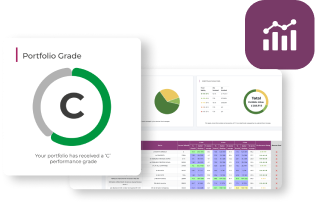
That is where Yodelar’s portfolio analysis service fits well. The analysis compares each fund against its sector peers, highlights rankings, identifies overlap and looks at how the overall portfolio is working together. In a market like this, that kind of review matters not because investors should react to every headline, but because it helps distinguish between a portfolio built to cope with uncertainty and one with issues that uncertainty has exposed.
The key message is straightforward. Market volatility is not a reason to panic, sell impulsively or overhaul a portfolio without a plan. Equally, it is not a reason to ignore poor fund selection, concentration, imbalance or long-term cash drag. The sensible response is to review the evidence, understand what you own and decide whether the current structure is still fit for purpose.
For some investors, that review will confirm that staying put is the right course. For others, it may highlight areas worth improving, either within the existing portfolio or through a more structured, risk-matched solution available through MKC Wealth and MKC Invest. Either way, uncertainty should encourage clarity, not reactive decision-making.

Sources
-
Reuters – Deal, delay or strike? Investors on edge as Trump’s Iran deadline nears https://www.reuters.com/world/middle-east/deal-delay-or-strike-investors-edge-trumps-iran-deadline-nears-2026-04-07
-
Bank of England – Interest rates and Bank Rate: our latest decision https://www.bankofengland.co.uk/monetary-policy/the-interest-rate-bank-rate
-
Morningstar – You Can Beat the Stock Market by Avoiding Its Worst Days. But You Won’t https://www.morningstar.com/funds/you-can-beat-stock-market-by-avoiding-its-worst-days-you-wont
Important Risk Warning
This article is not personal advice. This article gives information as to past performance of investments. Past performance is not a reliable indicator of future performance. Always seek personal advice from an FCA regulated adviser. The value of investments will rise and fall, so you could get less than what you put in.