

- Strong market performance can make portfolios appear healthier than they are, masking inefficiencies that only become visible through relative analysis.
- Positive absolute returns do not always indicate efficient outcomes, particularly when compared against relevant sector averages over different timeframes.
- Performance dispersion within sectors remains wide even during favourable market conditions, highlighting the impact of fund selection on long-term results.
- Rising markets can reduce the visibility of overlapping exposure, cost drag, and unintended changes in portfolio risk.
- Periods of sustained growth may delay portfolio reviews, allowing structural issues to persist unnoticed.
Over the past five years, many equity-focused Investment Association sectors have delivered strong cumulative growth. Despite periods of volatility along the way, sustained upward market movements have resulted in positive outcomes across a wide range of funds and strategies. In several cases, sector-level growth has exceeded 50% over this period.
For many investors, these conditions have provided reassurance. Portfolio values have risen, long-term figures appear healthy, and periods of market weakness have been outweighed by subsequent recoveries. However, while strong markets can support portfolio growth, they can also make it more difficult to identify areas where outcomes may have been less efficient than they could have been.
Strong market conditions do not remove the need for careful assessment. In some respects, they increase the importance of understanding what has driven returns and whether portfolios remain aligned with their original objectives.

Why Rising Markets Can Create a Sense of Comfort
When markets are delivering broadly positive returns, it is natural for investors to feel more comfortable with their portfolios. Growth provides reassurance, volatility often feels manageable, and short-term concerns tend to fade into the background.
In this environment, performance is often viewed in absolute terms. If a portfolio has grown over time, it may reasonably be perceived as having delivered a positive outcome. However, absolute growth alone does not always provide a complete picture of how efficiently a portfolio has performed.
Strong markets can reduce the visibility of differences between stronger and weaker fund choices. While most assets may rise together, the degree to which individual funds capture that growth can vary considerably.
The Importance of Performance Context
A portfolio that has grown by 60% over five years may appear to have delivered a strong result. However, viewed in isolation, that figure does not indicate how the portfolio performed relative to similar investments over the same period.
Sector averages provide useful context by showing how a broad range of comparable funds has performed. Comparing portfolio outcomes against relevant sector averages can help investors understand whether returns have been broadly in line with the wider market or whether they have differed meaningfully from comparable options.
This type of comparison is particularly important during strong market phases, when positive absolute returns can make relative differences less obvious.
How Fund Performance Can Vary Within Strong Markets
Even during extended periods of market growth, performance dispersion within sectors can be significant. Some funds capture a larger share of market upside, while others consistently lag behind their peers.
Strong markets can make this variation less apparent. Funds that underperform their sector averages may still deliver positive returns, which can reduce the perceived need for review. Over time, however, consistent relative underperformance can lead to a growing gap between what was achieved and what was achievable within the same sector and risk profile.
Assessing fund performance relative to sector averages over meaningful timeframes can help identify whether outcomes have been driven by effective fund selection or broader market movements.

Understanding Performance Dispersion Across Sectors
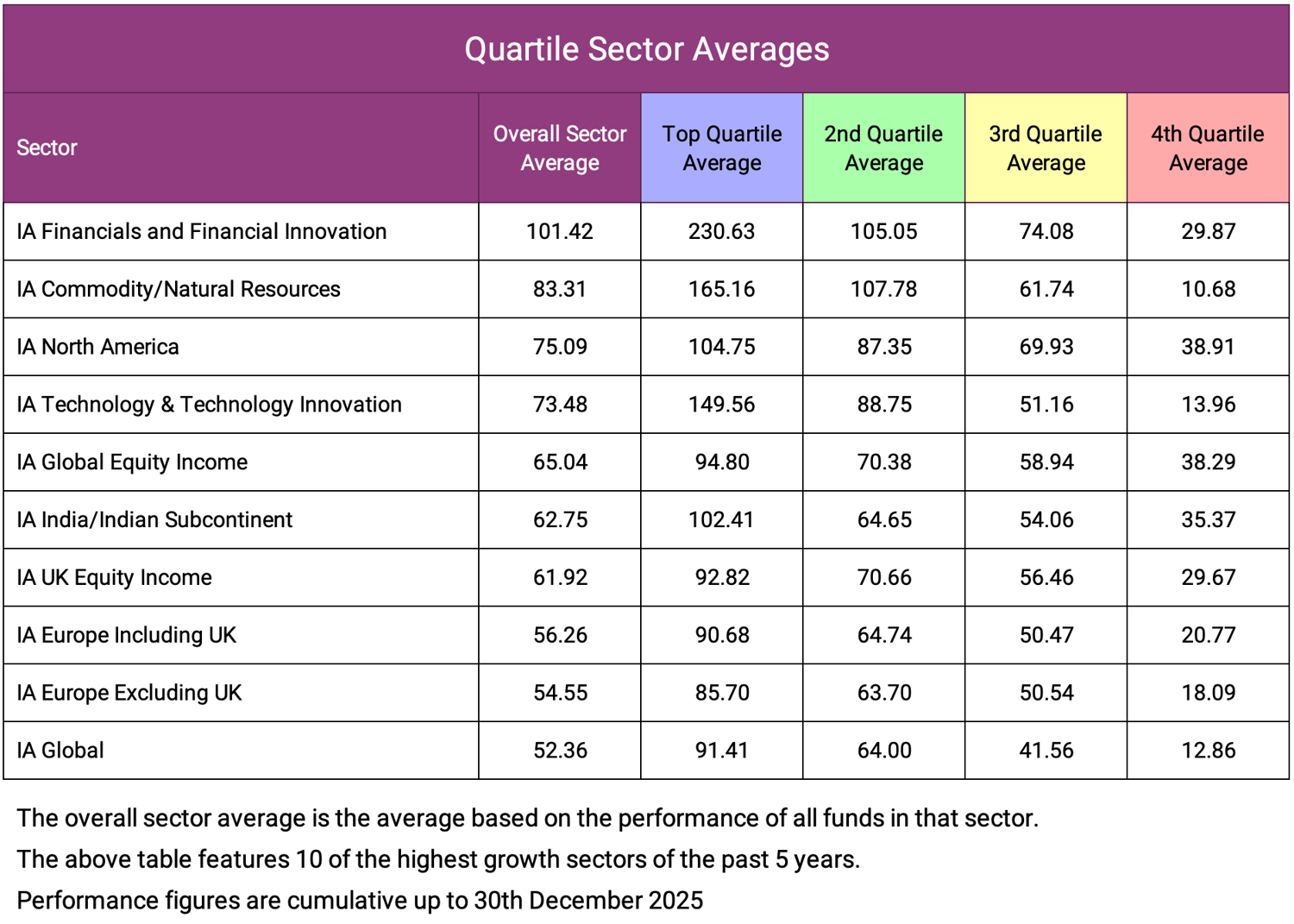
Analysis of five-year cumulative performance across multiple Investment Association sectors highlights the range of outcomes available to investors. In several sectors, funds in the top quartile have delivered returns significantly higher than the overall sector average. At the same time, funds in the bottom quartile have produced materially lower outcomes.
This dispersion illustrates that investor experience within the same sector can differ substantially depending on fund selection. During strong market periods, these differences may feel less pronounced, as positive returns dominate the overall narrative. However, over longer timeframes, they can have a meaningful impact on portfolio outcomes.
Diversification and Overlapping Exposure
Strong markets can also make it harder to identify overlapping exposure within portfolios. Investors may hold multiple funds that appear diversified but are influenced by similar underlying drivers, such as geographic focus, sector exposure, or investment style.
When markets are rising, correlated assets often move in the same direction, reinforcing the impression of diversification. However, overlapping exposure can reduce portfolio efficiency by increasing concentration without providing additional diversification benefits.
Understanding how different holdings interact within a portfolio can help clarify whether diversification is being achieved in practice, rather than assumed based on fund labels alone.
Why Costs Can Be Overlooked During Periods of Growth
During periods of strong performance, ongoing charges often receive less attention. When returns are positive, differences in cost can feel less material in the short term.
However, costs compound over time in the same way as returns. Funds with higher charges need to deliver stronger relative performance to offset that cost. Where this does not occur, higher charges can contribute to lower net outcomes over longer periods, even when markets are supportive.
Reviewing costs alongside performance, rather than in isolation, can help provide a clearer picture of overall efficiency.

Portfolio Drift in Rising Markets
Market strength can also contribute to gradual changes in portfolio structure. As certain assets outperform, they naturally grow to represent a larger proportion of the portfolio. This process occurs even when no active changes are made.
Over time, this can alter the portfolio’s risk profile or concentration levels relative to its original design. While rising markets may make these changes feel positive, they can result in portfolios becoming less aligned with an investor’s intended level of risk.
Regular review can help identify whether such drift has occurred and whether adjustments are appropriate.
Behavioural Factors and Decision-Making
Strong markets can influence investor behaviour in subtle ways. Positive recent performance can shape expectations, reinforce confidence in existing holdings, and reduce the perceived urgency to review portfolios.
These responses are understandable, but they can also contribute to periods of inactivity during which underlying changes go unnoticed. Over time, this can allow inefficiencies to persist, particularly when portfolios are not reviewed in a structured and comparative way.

Missed Opportunity and Long-Term Outcomes
When portfolios underperform relative to comparable alternatives, the impact is often expressed as missed opportunity rather than loss. This difference can make the effect harder to recognise, particularly in positive market environments.
Over longer periods, however, consistent relative differences in performance can compound into meaningful gaps in outcomes. Identifying and understanding these gaps requires context, comparison, and time-frame discipline.
Why Strong Markets Demand Better Portfolio Oversight
Strong markets are often mistaken for proof that a portfolio is working well. In reality, they are one of the most revealing environments for assessing efficiency, discipline, and fund quality. When returns are broadly positive, the difference between portfolios that are simply benefiting from market conditions and those that are genuinely well constructed becomes clearer, not less important. This is precisely when weak fund selection, duplication, cost drag, and unintended risk drift can be identified and addressed with the least disruption.
At Yodelar, our free portfolio analysis service consistently shows that portfolios rarely underperform because markets have been unkind. More often, they fall short because inefficiencies are allowed to persist unchallenged, particularly during periods of strong growth. Getting outcomes right is not about reacting to market movements, but about maintaining a structure that remains aligned with an investor’s objectives, risk tolerance, and long-term plan as conditions evolve.
This is where the way a portfolio is managed matters as much as what it holds. Following Yodelar’s merger with MKC Wealth, clients can benefit from portfolios managed on a discretionary basis by MKC Invest. This structure allows portfolios to be reviewed continuously and adjusted efficiently when evidence warrants change, rather than waiting for infrequent reviews or periods of market stress. Fund selection, diversification, and risk alignment are treated as ongoing processes, not static decisions.
Strong markets should be used to test whether a portfolio is genuinely efficient, not to assume that positive returns tell the full story. If you are unsure whether your portfolio has kept pace with its sector, whether drift has altered its risk profile, or whether fund selection could be improved, a portfolio analysis can provide valuable clarity. Understanding what a strong market may be hiding is often the first step towards building a more resilient and effective investment strategy for the long term.