

-
Mixed investment funds offer a simple, ready-made approach, but funds within the same sector can deliver very different results.
-
Sector classification reflects risk level, not quality, with significant gaps between top-performing funds and the sector average.
-
Using a single mixed investment fund can limit diversification by relying on one manager and one asset allocation approach.
-
Holding multiple funds can improve diversification, but only if overlap and concentration are properly managed.
-
A portfolio analysis helps identify how funds perform together, where duplication exists, and whether the overall structure remains aligned to the intended level of risk.
Mixed investment funds are often bought for convenience. One fund, one decision, and a built-in mix of shares, bonds and cash. For many investors, they are used as a ready-made portfolio, and seen as a simple way to invest without having to choose and manage several separate funds.
That convenience has obvious appeal, but it can also hide an important weakness. When one fund is expected to do everything, the investor becomes heavily reliant on a single manager, a single asset allocation process and a single interpretation of risk. The latest sector figures show why that matters. Funds operating in the same mixed investment sectors, and often aimed at investors with similar risk profiles, have produced very different results. That gap raises a more useful question than simply which sector to choose. It asks whether convenience alone is enough, or whether stronger long-term outcomes often depend on better fund selection, broader diversification and a clearer understanding of how holdings work together.
How The Mixed Investment Sectors Work
Mixed investment funds are grouped by the Investment Association (IA) according to how much they can hold in shares. That matters because the equity range shapes both the growth potential of a fund and the level of short-term movement investors are likely to experience. In simple terms, the higher the share allocation, the greater the scope for growth, but also the greater the chance of sharper rises and falls in value.
IA Mixed Investment 0-35% Shares Sector
The IA Mixed Investment 0-35% Shares sector is the most cautious of the three. Funds can hold up to 35% in shares, while at least 45% must be invested in bonds and/or cash. These funds are generally aimed at investors who want some exposure to growth, but with more emphasis on stability and a lower level of risk. Based on performance figures up to 28 February 2026, the sector average was 9.12% over one year, 21.54% over three years and 17.02% over five years.
IA Mixed Investment 20-60% Shares Sector
The IA Mixed Investment 20-60% Shares sector sits in the middle. Funds must hold between 20% and 60% in shares and at least 30% in bonds and/or cash. This is the area of the market often used by investors looking for a balance between growth and limiting losses during market falls. It gives managers more flexibility than the cautious sector, but still retains a meaningful allocation to more defensive assets. Over the same periods, the sector average was 11.81% over one year, 26.75% over three years and 27.67% over five years.
IA Mixed Investment 40-85% Shares Sector
The IA Mixed Investment 40-85% Shares sector has the strongest growth bias of the three. Funds can hold between 40% and 85% in shares, and there is no minimum requirement for bonds or cash. These funds can still be diversified, but they will usually be more exposed to stock market movements and can show a wider spread of outcomes. Based on performance figures up to 28 February 2026, the sector average was 13.93% over one year, 33.58% over three years and 40.27% over five years.
The broad pattern is not surprising. Over time, the sectors with the higher equity ranges delivered stronger average returns. But that is only part of the story. The more revealing point is the gap between the sector averages and the strongest funds within each sector. The sector label gives a guide to broad risk level. It does not tell investors which funds have been more competitive, more consistent, or better positioned within that peer group.
Top Performing Funds in The IA Mixed Investment 0-35% Shares Sector
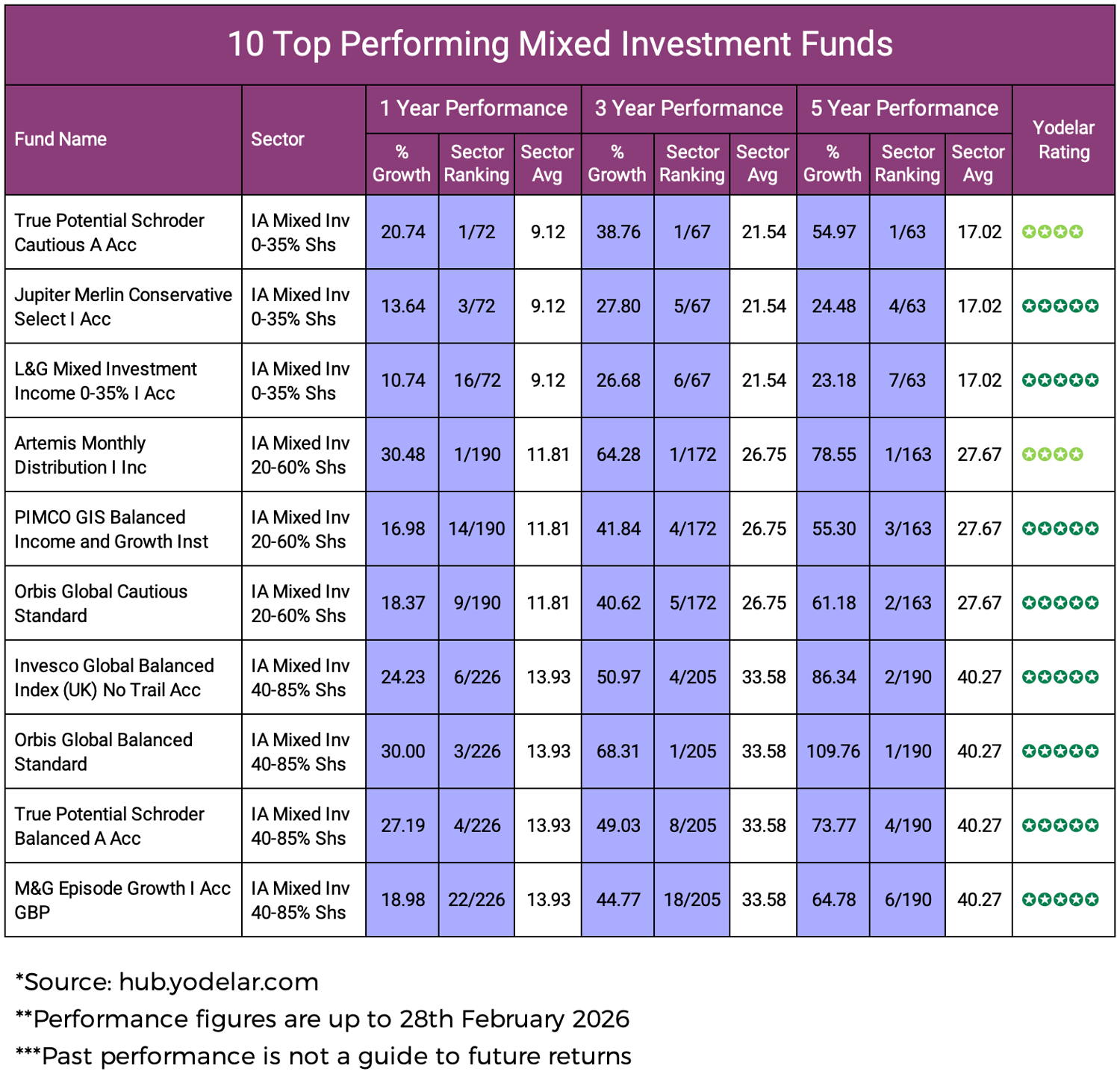
The funds below stand out not because of one strong spell, but because they have remained relatively competitive within the cautious sector over one, three and five years.
True Potential Schroder Cautious A Acc has been the clearest standout. It ranked first over one, three and five years, returning 20.74% over one year against a sector average of 9.12%, 38.76% over three years against 21.54%, and 54.97% over five years against 17.02%. In a lower-risk sector, those are unusually wide gaps and they highlight just how far some funds can move ahead of their peers.
Jupiter Merlin Conservative Select I Acc is another strong example of consistency. It returned 13.64% over one year, ranking 3rd out of 72 funds, 27.80% over three years, ranking 5th out of 67, and 24.48% over five years, ranking 4th out of 63. What stands out here is not just the return level, but the repeatability of those rankings across more than one period.
L&G Mixed Investment Income 0-35% I Acc shows that a more cautious, income-focused approach does not have to mean settling for average results. It returned 10.74% over one year against a sector average of 9.12%, 26.68% over three years against 21.54%, and 23.18% over five years, ranking 7th out of 63 funds. That makes it a good example of a lower-risk fund that has remained competitive without straying too far from its more cautious profile.

Three Standout Funds From IA Mixed Investment 20-60% Shares Sector
This is the middle ground of the mixed investment market, so consistency matters as much as headline returns. These funds are often chosen by investors who want one core holding to do a large part of the portfolio job for them.
Artemis Monthly Distribution I Inc has been the strongest all-round performer in the sector. It ranked first over one, three and five years, returning 30.48% over one year against a sector average of 11.81%, 64.28% over three years against 26.75%, and 78.55% over five years against 27.67%. That places it well ahead of its peers across every main period analysed.
PIMCO GIS Balanced Income and Growth Institutional has also remained firmly in the stronger part of the sector. It returned 16.98% over one year, 41.84% over three years and 55.30% over five years, ranking 14th, 4th and 3rd respectively. It did not top every period, but it has shown the kind of medium and longer-term consistency that matters more than a short-lived spike in performance.
Orbis Global Cautious Standard has also compared strongly against its peers. It returned 18.37% over one year against a sector average of 11.81%, 40.62% over three years against 26.75%, and 61.18% over five years against 27.67%, ranking 2nd out of 163 funds over five years. It is a useful example of how a balanced mixed investment fund can still deliver results that are well above the sector average when the underlying asset allocation is working effectively.
Top Performing Funds in The IA Mixed Investment 40-85% Shares Sector
This is the most growth-oriented of the three mixed investment sectors, so wider differences in results are to be expected. Even so, the spread between average funds and the strongest names has been striking.
Orbis Global Balanced Standard has been the standout long-term performer in the sector. It returned 30.00% over one year against a sector average of 13.93%, 68.31% over three years against 33.58%, and 109.76% over five years against 40.27%, ranking first over both three and five years. That is one of the clearest examples in the article of how wide the gap can become within a single sector.
Invesco Global Balanced Index (UK) No Trail Acc shows that an index-led approach can still rank very highly within a more growth-focused mixed sector. It returned 24.23% over one year, ranking 6th out of 226 funds, 50.97% over three years, ranking 4th out of 205, and 86.34% over five years, ranking 2nd out of 190. Against a five-year sector average of 40.27%, that is a sizeable difference.
True Potential Schroder Balanced A Acc has also remained competitive across all the main periods measured. It returned 27.19% over one year against a sector average of 13.93%, 49.03% over three years against 33.58%, and 73.77% over five years against 40.27%, ranking 4th out of 190 funds over five years. Rather than standing out because of one isolated period, it has maintained relatively strong peer group rankings over time.
M&G Episode Growth I Acc GBP rounds out the list. It returned 18.98% over one year, 44.77% over three years and 64.78% over five years, ranking 22nd, 18th and 6th in the sector respectively. Those rankings are less dramatic than the strongest names above, but they still place the fund comfortably ahead of the sector average over the periods analysed and reinforce the point that competitive funds can take different forms within the same sector.

The Limits Of A Ready-Made Portfolio
For many investors, a mixed investment fund is bought to solve the portfolio problem in one step. That is understandable. A single fund feels simpler, cleaner and easier to monitor than holding several separate funds.
The difficulty is that a ready-made fund is still only one solution built around one process. The manager decides how much sits in shares, bonds and cash, which regions to favour, which assets to hold and how much risk to take. If those decisions are strong, the simplicity can work well. If they are not, the whole portfolio feels the impact. There is no second layer of diversification to offset a weak asset allocation decision, an overly cautious stance or a concentration in areas that have fallen behind.
A thoughtfully built portfolio of several funds can offer more flexibility. It can spread exposure across different managers, regions and investment styles, and it allows individual holdings to be reviewed, reduced or replaced without altering the entire structure. That can make it easier to manage overall risk and avoid relying too heavily on one fund manager or one investment approach.
However, holding more funds does not automatically create better diversification. This is where many portfolios fall short. An investor can hold five or six funds and still have significant overlap in the same companies, sectors or markets. Real diversification comes from how the holdings interact, not simply from how many appear on the statement. That is why portfolio structure matters just as much as fund selection.
Why A Yodelar Portfolio Analysis Can Help
Looking at a fund in isolation can be useful, but it rarely shows how a portfolio is working as a whole. Most investors do not hold one fund. They hold a mix of funds that may complement each other, overlap more than expected, or expose the portfolio to a different level of risk than intended. Our portfolio analysis is designed to bring that wider picture into focus.
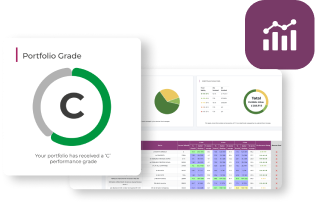
It shows the 1, 3 and 5-year performance of each fund, how each holding has ranked within its sector, and the Yodelar rating for every fund in the portfolio. It also highlights how much of the portfolio sits in funds with more competitive and less competitive sector rankings over time, and compares the overall portfolio with similar risk-rated model portfolios. An overall portfolio grade then brings those findings together into a clear summary. The aim is not to add more complexity, but to make it easier to see how the portfolio has behaved and whether its structure is doing the job it is meant to do.
Get Your Free Portfolio Analysis

Why Ongoing Portfolio Oversight Matters
Even a well-constructed portfolio will not stand still. Markets move, asset allocations change, and funds that once looked well placed can lose ground or begin to overlap with other holdings in ways that are not immediately obvious. Over time, that can leave a portfolio carrying a different mix of risk from the one the investor originally intended.
That is why ongoing oversight matters. In practice, the issue is rarely one fund on its own. It is how the portfolio evolves as markets move, and whether it continues to remain diversified, balanced and aligned to its objective. For investors who do not want to manage that process themselves, a discretionary approach such as MKC Invest’s allows portfolios to be reviewed and adjusted within an agreed mandate, without waiting for approval each time a change is needed. The focus is not on reacting to every headline or trying to predict short-term market moves, but on maintaining discipline, reviewing fund selection, managing allocation drift and keeping the portfolio aligned with its intended level of risk.
For those who want to understand how that works in practice, there is the option to book a no obligation call to discuss the findings of a portfolio analysis and explore how portfolios can be structured and maintained over time.

Conclusion
Mixed investment funds can still play a useful role within a portfolio. They offer a straightforward way to access a spread of assets and a defined risk range, and for many investors that simplicity has clear appeal. However, the analysis in this article, based on performance figures up to 28 February 2026, shows that funds within the same sector can deliver very different results.
Past performance can help provide context, particularly when it is used to assess consistency of sector ranking over time, but it does not tell the whole story. The more important question is whether the funds held within a portfolio work well together, whether there is genuine diversification, and whether the overall structure remains aligned with the investor’s objectives and intended level of risk. That is why looking beyond a fund’s headline return, and reviewing the portfolio as a whole, is often where the more useful answers are found.