

-
The sector delivered strong headline growth, with average returns of 17.15% over one year and 75.48% over five years, but most funds still ranked in the lower Yodelar rating bands, showing that strong markets do not guarantee consistent results.
-
The strongest funds, such as Amundi MSCI Semiconductors (258.63% over five years) and Polar Capital Global Technology (142.82%), significantly outperformed the sector average, highlighting how much fund selection can influence outcomes.
-
Several technology funds produced weak results despite operating in a strong sector, with some delivering negative returns over one year and lagging far behind the five-year sector average.
-
Funds labelled “technology” can behave very differently, ranging from broad global portfolios to highly concentrated themes such as semiconductors or cloud computing, leading to very different performance outcomes.
-
A fund that appears strong in isolation may still increase risk or duplication within a portfolio, making it important to assess how technology holdings fit within the wider investment structure.
Technology funds remain one of the most popular ways for investors to target growth. The appeal is easy to understand. Technology sits behind many of the biggest changes in the global economy, from artificial intelligence and semiconductors to cloud services and digital payments. For investors, that creates the sense that owning a technology fund is a straightforward way to back the future.
The difficulty is that “technology fund” can mean very different things. Some funds spread money across large, established technology businesses around the world. Others focus on a much narrower theme, such as semiconductors, cloud computing, robotics or cybersecurity. On the surface they may sit in the same sector, but in practice they can behave very differently.
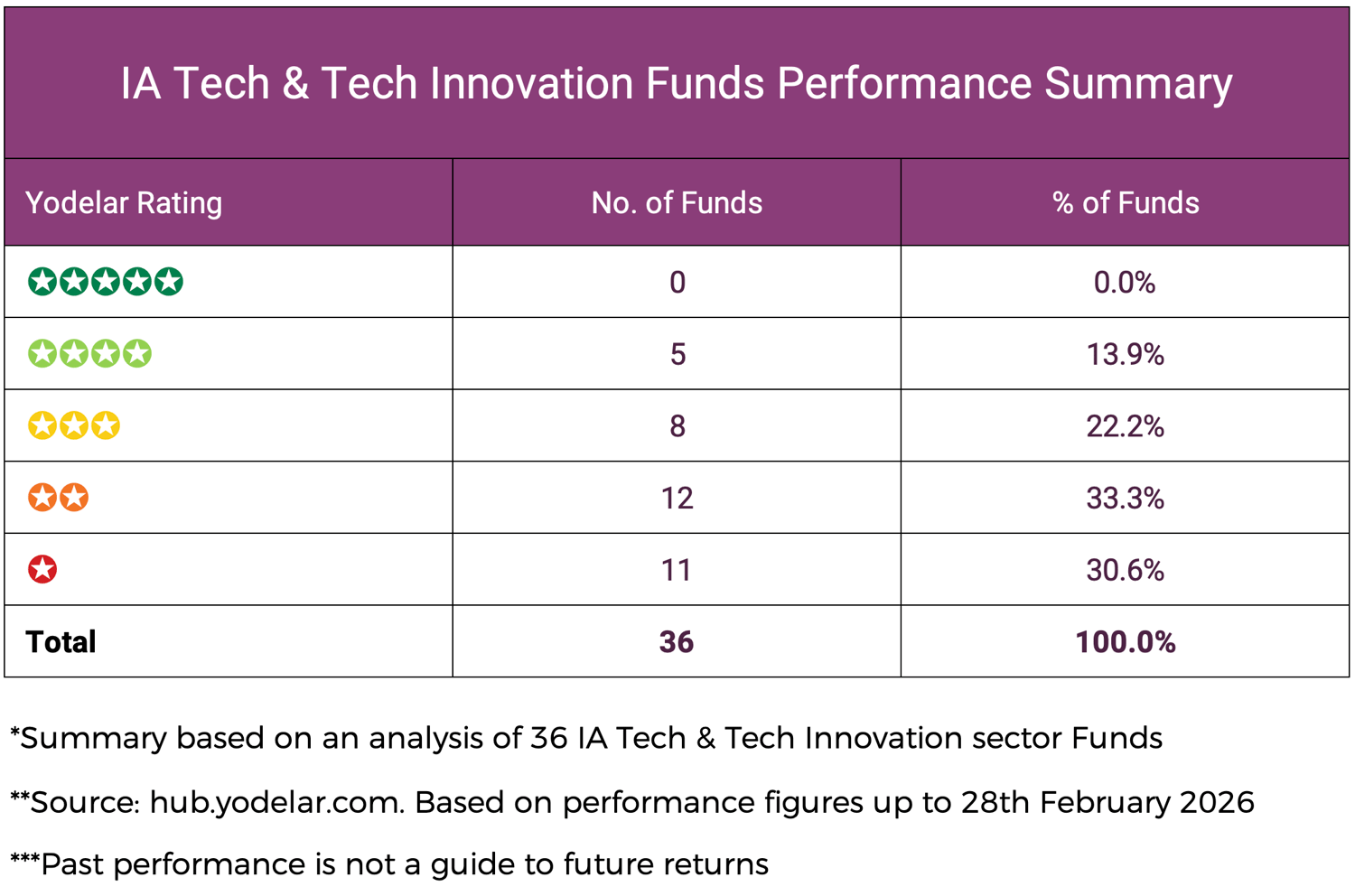
That is exactly what the latest figures show. The attached summary of the 36 funds in the Investment Association (IA) Technology & Technology Innovation sector shows that none achieved a 5-star Yodelar rating, only five were rated 4 stars, and most were rated 1 or 2 stars. In a sector known for strong growth, that is a useful reminder that excitement and consistency are not the same thing.

Technology Has Been Strong As A Sector, But The Gaps Have Been Wide
This has not been a weak area of the market overall. Based on performance figures up to 28 February 2026, the average fund in the IA Technology & Technology Innovation sector returned 17.15% over one year, 88.56% over three years and 75.48% over five years. Those are strong headline returns. But they also hide a more important point: some funds were far ahead of those averages, while others were nowhere near them.
That matters because a weak fund choice can be harder to spot in a strong sector. A fund can still show a positive return on paper and yet leave an investor a long way behind the sector average. Technology has been a good example of that. The sector has produced strong overall numbers, but not every investor in a technology fund would have felt the same benefit.
Past performance is not a guide to future returns, but it can still be useful in showing which funds have been more competitive than others within the same part of the market. It can also highlight when a fund’s label says “technology” but the results tell a very different story.
5 Technology Funds That Stood Out
Amundi MSCI Semiconductors Acc
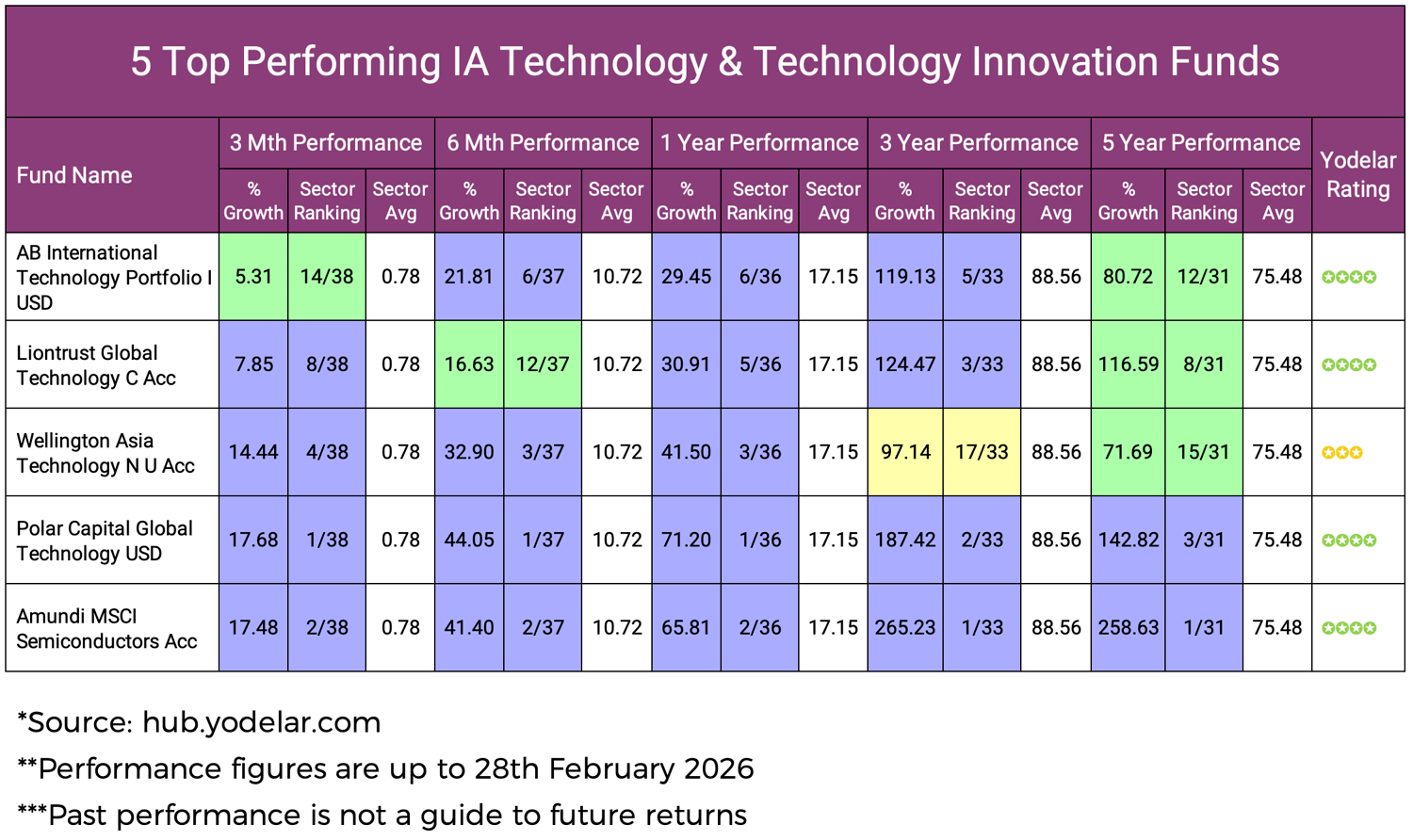
This was the clearest standout in the sector. Rather than trying to own the whole technology universe, it focuses on semiconductor companies, the businesses that design and make the chips used across everything from phones and laptops to data centres and AI systems. That narrower focus brought much stronger swings, but it also delivered the strongest results. It returned 65.81% over one year against a sector average of 17.15%, 265.23% over three years against 88.56%, and 258.63% over five years against 75.48%. It ranked first in the sector over both three and five years.
Polar Capital Global Technology USD
Polar Capital Global Technology has been one of the strongest broad technology funds in the sector. Unlike the semiconductor fund above, this is not a narrow single-theme product. It invests across the global technology market, which gives it wider exposure while still keeping a strong growth tilt. That broader approach has worked very well. The fund returned 71.20% over one year, 187.42% over three years and 142.82% over five years, with sector rankings of 1st, 2nd and 3rd respectively. For investors who wanted strong technology exposure without narrowing down to just one specialist area, it has been one of the strongest choices.
Liontrust Global Technology C Acc GBP
Liontrust Global Technology is another example of a broader global technology fund that has remained highly competitive over time. It returned 30.91% over one year against the sector average of 17.15%, 124.47% over three years against 88.56%, and 116.59% over five years against 75.48%. Its rankings of 5th, 3rd and 8th show a level of consistency that is often more useful than a single eye-catching number. In simple terms, this has been a fund that stayed near the front of the sector rather than jumping there briefly.
AB International Technology Portfolio I USD
AB International Technology Portfolio has also stayed in the stronger half of the sector over all the main periods. It returned 29.45% over one year, 119.13% over three years and 80.72% over five years, all ahead of the sector averages of 17.15%, 88.56% and 75.48%. Its rankings of 6th, 5th and 12th are not quite as strong as the very best funds above, but they still place it among the more competitive options in the sector over time. That makes it a good example of a fund that has been solidly above average without needing to top every table.
Wellington Asia Technology N U Acc GBP
Wellington Asia Technology shows why investors need to look beyond a simple sector label. This is a technology fund, but its regional focus makes it very different from a global technology product. It invests in Asian technology businesses, which gives it exposure to a different part of the market. That helped it stand out over one year, where it returned 41.50% against the sector average of 17.15% and ranked 3rd out of 36 funds. Over three and five years, though, its rankings slipped to 17th and 15th, with returns of 97.14% and 71.69%. Still respectable, but a reminder that strong recent performance does not always mean the strongest longer-term consistency.

Five Highlighted Funds That Fell Behind
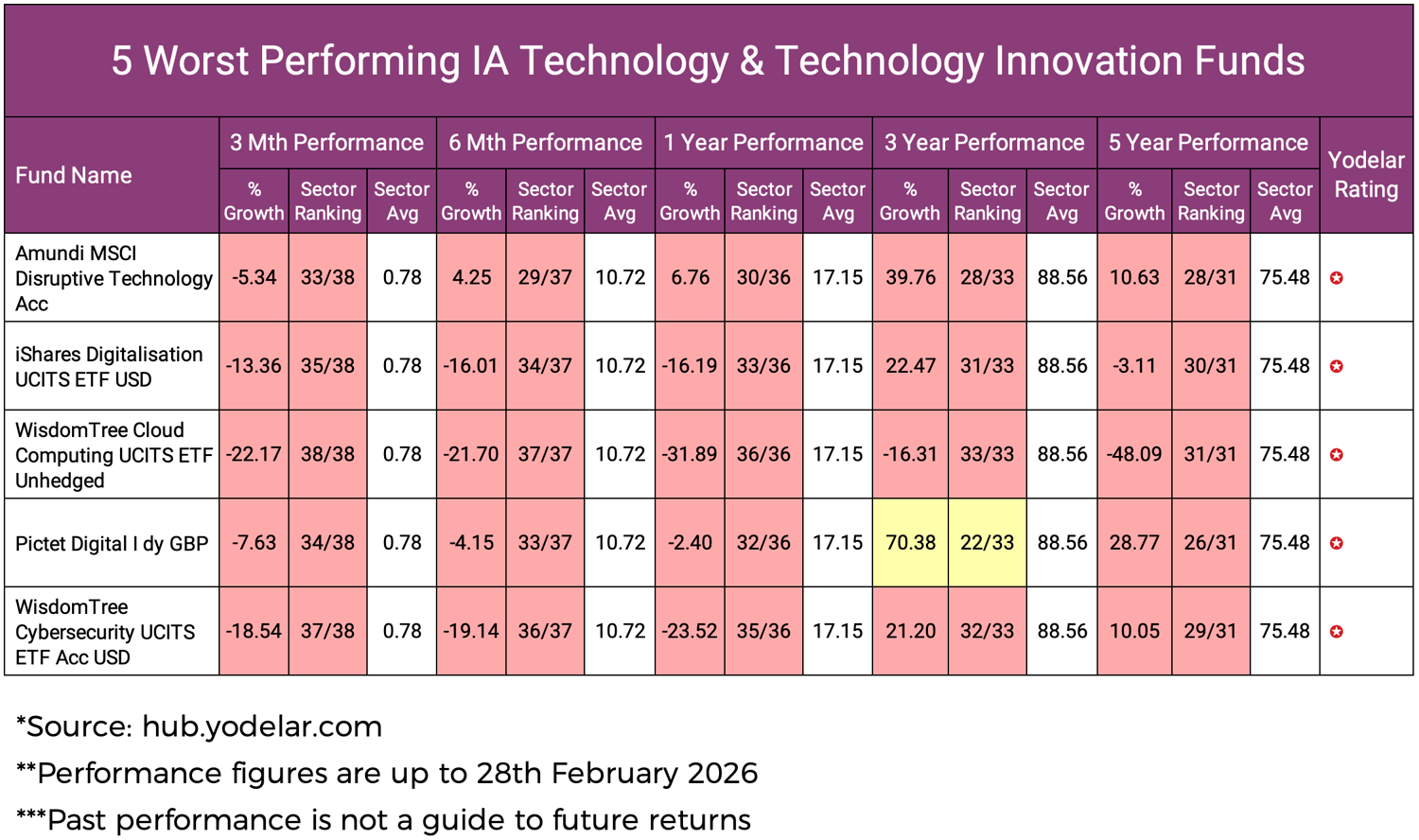
WisdomTree Cloud Computing UCITS ETF Unhedged Acc USD
This was the weakest highlighted fund and the clearest example of how painful narrow thematic exposure can be when the theme falls out of favour. The fund returned -31.89% over one year, -16.31% over three years and -48.09% over five years, ranking last in the sector over all three periods. In a sector where the average fund still returned 75.48% over five years, that is a huge gap. It shows how costly it can be when a technology holding becomes too tightly tied to one theme.
WisdomTree Cybersecurity UCITS ETF Acc USD
Cybersecurity is often viewed as a long-term growth area, but that has not guaranteed strong fund returns. WisdomTree Cybersecurity returned -23.52% over one year, 21.20% over three years and 10.05% over five years, ranking 35th, 32nd and 29th in the sector. Those five-year returns were still positive, but in the context of a 75.48% sector average they look far weaker. This is an important reminder that a strong story and a strong investment result are not always the same thing.
iShares Digitalisation UCITS ETF USD
This fund also struggled badly relative to the rest of the sector. It returned -16.19% over one year, 22.47% over three years and -3.11% over five years, ranking 33rd, 31st and 30th. That combination is especially important because it shows how weak a fund can look even when the wider sector has done well. Investors could have owned a technology fund, believed they were positioned in a strong area of the market, and still ended up with results that were barely positive or even negative over the longer term.
Amundi MSCI Disruptive Technology Acc GBP
Amundi MSCI Disruptive Technology was another fund that lagged badly. It returned 6.76% over one year, 39.76% over three years and 10.63% over five years, ranking 30th, 28th and 28th. These are not all negative numbers, but that is exactly the point. In a sector where the average fund returned 17.15%, 88.56% and 75.48% over those same periods, these results were weak. It is a good example of how disappointing returns can hide inside a sector that looks strong overall.
Pictet Digital I dy GBP
Pictet Digital rounds out the weaker highlighted names. It returned -2.40% over one year, 70.38% over three years and 28.77% over five years, ranking 32nd, 22nd and 26th. Again, this is a good reminder that “worst performers” in a strong sector do not always mean losses across every period. A five-year gain of 28.77% may look acceptable at first glance, but it was still well behind a sector average of 75.48% and a top fund return of 258.63%. That is the opportunity cost investors need to pay attention to.

What The Results Really Show
The most useful lesson from this sector is that technology is not one simple trade. A broad global technology fund, a semiconductor fund, an Asia technology fund and a cloud computing ETF may all sit in the same sector, but they are not delivering the same kind of exposure. Some are spread more widely. Some are heavily concentrated in one theme. Some are much more sensitive to changes in market sentiment than others.
That is why buying “a tech fund” is not enough of a decision on its own. Investors need to look at what part of technology the fund is actually exposed to, how narrow that exposure is, and how consistently it has competed against other funds in the same sector. In this case, the highlighted best and worst names show just how wide that gap can be.
Why The Wider Portfolio Still Matters
A strong technology fund can still be the wrong fit inside a portfolio. It may duplicate holdings already owned elsewhere, increase exposure to one area of the market more than intended, or add a level of risk that sits awkwardly with the rest of the investments.
That is why the wider portfolio matters just as much as the individual fund. Looking at returns in isolation can be useful, but it does not show whether the fund adds something genuinely useful to the portfolio or simply creates more overlap. A Yodelar portfolio analysis can help bring that into focus by showing how each fund has performed, how it ranks in its sector, and whether the wider portfolio has issues such as concentration or poor diversification.

When Speaking To An Adviser Can Help
Once the wider portfolio has been reviewed, the next question is usually what, if anything, should change. In some cases the analysis simply confirms that the current holdings are doing the job they were meant to do. In others, it may highlight overlap, a heavier technology weighting than expected, or a level of risk that no longer fits comfortably with the rest of the portfolio. That is often the point where speaking to an adviser becomes useful, because it helps turn the analysis into a clearer decision-making process rather than leaving it as a list of observations.
For investors who would rather not manage those decisions alone, it can also be helpful to understand how MKC Invest approaches portfolio management. MKC describes itself as a discretionary portfolio manager, which in simple terms means it can make day-to-day investment decisions within an agreed mandate without needing approval each time. Its model portfolios are built using a mix of investment funds, spread across different asset classes, sectors and regions, and managed to stated objectives and risk levels. MKC says it reviews and changes funds when it believes that gives the portfolio a better chance of remaining aligned with its mandate, and that its portfolios are available through professional financial planners.
That will not be the right route for everyone, but for some investors it can provide a more structured way to deal with portfolio drift, changing market conditions and the challenge of keeping holdings properly diversified over time. If you would like to discuss what your portfolio analysis may be showing, or simply want to understand how a discretionary approach works in practice, you can book a no obligation call with our advice team.

Conclusion
Technology funds can still play an important role within a portfolio. The sector has produced strong overall returns, and some funds have delivered exceptional results. But the latest figures also show how wide the gap has been between stronger and weaker options.
That is why fund selection matters so much in this part of the market. A technology fund’s label may sound exciting, but what really matters is where it invests, how concentrated it is, and how competitive it has been against others in the same sector. Past performance helps provide useful context, but it should be the starting point for better questions, not the final answer.
The more useful test is whether the fund is genuinely adding something useful to the wider portfolio. That is where many of the best investment decisions are made.