

- The UK Equity Income sector averaged returns of 12.9% over the past one year and 49.29% over five years
- The Vanguard FTSE UK Equity Income Index returned 97.87% over five years, ranking 1st out of 63 funds
- UBS UK Equity Income delivered 87.45% over five years, ranking 2nd out of 63 funds
- VT Munro UK Equity Income and Redwheel UK Equity Income ranked consistently near the top across the periods analysed
- Some funds within the IA UK Equity Income sector returned well below the 49.29% five-year sector average despite sharing similar objectives.
UK equity income funds remain a core holding for many British investors. The appeal is straightforward. They provide exposure to UK shares while also aiming to deliver dividend income, which can be useful for investors drawing an income or reinvesting for growth over time.
But sector data shows that simply holding a UK equity income fund is not enough. Performance across this sector varies far more than many investors realise.
The Investment Association (IA) UK Equity Income sector contains 65 funds in the data reviewed. The average one year return was 12.9%, while the average five year return was 49.29%. On the surface, those are respectable sector averages. But the strongest funds delivered returns far ahead of those figures, while weaker funds fell well short. The top performing fund returned 97.87% over five years, almost double the sector average.
That is what makes this sector worth reviewing closely. Two funds can sit in the same sector, follow a similar income objective, and still produce very different results for investors.

The Sector In Numbers
All 65 funds in the IA UK Equity Income sector invest in UK companies and aim to deliver some level of dividend income. But that broad description still covers a wide range of approaches.
Some funds track an index and simply hold a basket of higher yielding UK shares. Others are actively managed and rely on a fund manager’s judgement to choose companies they believe can provide both income and growth. Some funds are more diversified, while others are more concentrated. Some focus heavily on large, established dividend payers, while others move further down the market in search of opportunities.
These differences matter because they have led to a wide spread in returns. The one year sector average of 12.9% and the five year average of 49.29% provide useful context, but they do not show how wide the gap is between the stronger and weaker funds. That gap is the real story, and it is why sector averages alone are not enough.
Five Top Performing UK Equity Income Funds
Fund performance across the UK Equity Income sector has varied widely, with only a small number of funds consistently near the top of the rankings. The following five funds have been among the strongest performers over the periods analysed. These figures are historic and should not be taken as a guide to future returns.
Vanguard FTSE UK Equity Income Index A Acc GBP
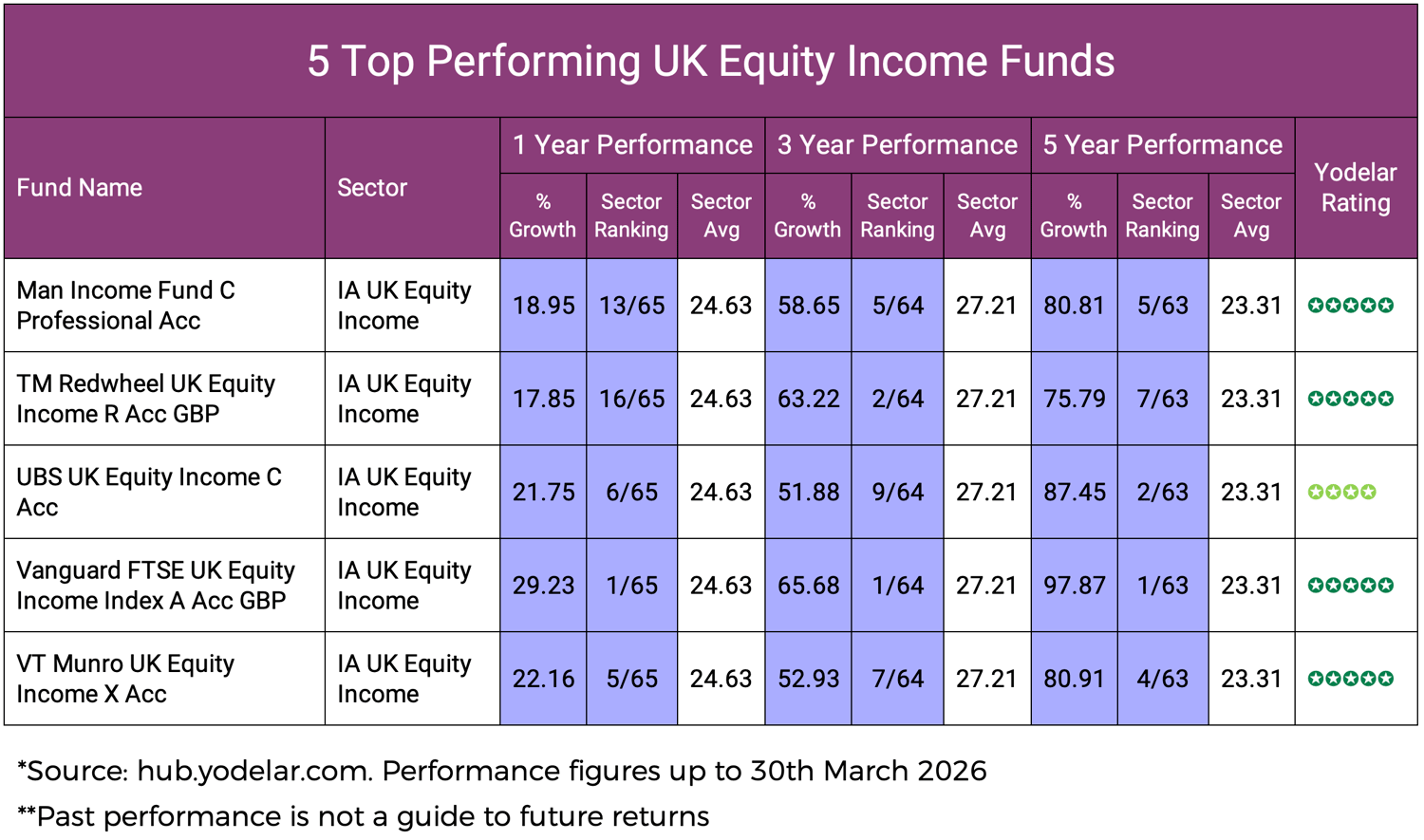
This was the clearest standout in the sector. It returned 29.23% over one year, ranking first out of 65 funds, and 97.87% over five years, again ranking first out of 63. It also held a 5 star Yodelar rating.
What makes that result particularly notable is that this is a passive fund. Rather than relying on a fund manager to pick stocks, it tracks the FTSE UK Equity Income Index, which focuses on higher yielding UK companies. In a sector where active managers often argue that stock selection is critical, this fund shows that a low cost, well constructed index approach has been highly competitive over multiple time periods.
UBS UK Equity Income C Acc
UBS UK Equity Income is not always one of the first names mentioned in this sector, but its performance record deserves attention. It returned 21.75% over one year, ranking sixth out of 65 funds, and 87.45% over five years, ranking second out of 63. Its three-year return of 51.88% ranked ninth in sector.
What stands out here is the consistency. This was not a fund that relied on one particularly strong period. It stayed in the top quartile across the main periods reviewed, which is exactly the type of record investors should look for when assessing whether a fund has been genuinely competitive.
VT Munro UK Equity Income X Acc
VT Munro UK Equity Income also delivered strong results across all the main time periods. It returned 22.16% over one year, ranking fifth out of 65 funds, 52.93% over three years, ranking seventh, and 80.91% over five years, ranking fourth. It held a 5-star Yodelar rating.
Its strength lies in the fact that it has stayed near the front of the sector rather than moving sharply up and down the rankings. In practical terms, that means investors have not had to rely on one short-lived period of strength. The fund has maintained a solid position across both medium and longer-term periods.
TM Redwheel UK Equity Income R Acc GBP
Redwheel UK Equity Income built one of the stronger medium-term records in the sector. It returned 17.85% over one year and 63.22% over three years, which was the second-highest three-year return in the sector. Over five years it returned 75.79%, ranking seventh. It also held a 5-star Yodelar rating.
The three-year result is particularly important here. While some funds show a good long-term number but weaker recent competitiveness, Redwheel remained firmly near the top of the sector over the medium term. That gives it a slightly different profile from some of the other leading funds and strengthens the case that its performance has been more than a one-off result.
Man Income Fund C Professional Acc
Man Income Fund may not be the best-known fund in this sector, but the numbers place it comfortably among the stronger performers. It returned 18.95% over one year, 58.65% over three years and 80.81% over five years, ranking fifth in sector over the five-year period. It also carried a 5-star Yodelar rating.
This fund is a good example of active management delivering competitive results in a sector where passive options have also done well. In other words, the lesson is not that one approach always wins. It is that investors still need to look at actual outcomes rather than assumptions about whether active or passive should perform better.

Why The Sector Label Is Not Enough
The data in this sector makes a simple point. Holding a UK equity income fund does not tell you much on its own. What matters is how that specific fund has performed against others with the same broad objective.
This is where many investors can be caught out. A fund can show positive returns and still be a weak option relative to its peers. For example, a five year return of 40% may sound reasonable in isolation, but it looks very different when the sector average was 49.29% and the top fund returned 97.87%.
That difference is not marginal. Over time, it can translate into a meaningful difference in both portfolio growth and the level of income it may be able to generate. This is why it is not enough to ask whether a fund has made money. The more useful question is how it compares within its sector and whether it still fits the role it is meant to play within the wider portfolio.
Why A Yodelar Portfolio Analysis Can Help
Most investors know which funds they hold. Far fewer know how those funds have ranked within their sectors or how well they work together inside the wider portfolio.
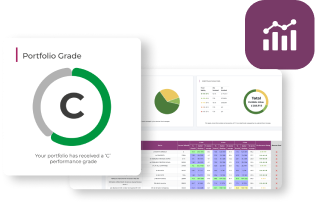
A Yodelar portfolio analysis is designed to bring that into clearer focus. It compares each fund against its sector over 1, 3 and 5 years, showing where returns have been above or below the sector average. It also looks beyond individual holdings to assess how the portfolio is structured as a whole.
This is where problems often become clearer. A portfolio can appear well spread on the surface but still contain overlapping holdings, inconsistent fund quality, or too much dependence on one sector, style or provider. These issues are not always obvious without a structured comparison against sector data.
A Yodelar portfolio analysis provides a straightforward, evidence based view of how a portfolio has performed and how it is currently positioned. For investors holding UK equity income funds alongside other investments, it can help show whether those funds are supporting the wider portfolio or whether there may be stronger alternatives elsewhere.

Could A Broader Portfolio Approach Help?
A review like this also highlights a wider portfolio point. UK equity income funds can play a useful role, but they are only one part of the broader investment market.
For many investors, the challenge is not simply choosing a fund in one sector. It is making sure the portfolio as a whole is properly diversified, aligned to its intended level of risk, and not restricted by too narrow a range of fund choices.
A professionally managed portfolio may help address that. The MKC Invest portfolios, available through MKC Wealth’s regulated advice team, are built using funds selected from across the market rather than being tied to one sector or one provider. Each portfolio is aligned to a defined risk level, reviewed on an ongoing basis, and adjusted where the evidence supports change.
This does not remove risk or guarantee better performance. It can, however, provide a more structured framework for managing a portfolio and reduce unnecessary reliance on any one area of the market.
For investors who want to understand how their current portfolio compares, or what a broader market approach might look like in practice, a no obligation call with an FCA regulated adviser can provide further clarity.

Summary
The UK Equity Income sector has delivered some very strong returns over the periods reviewed, but it has also shown how wide the performance gap within the sector can be.
Vanguard FTSE UK Equity Income Index, UBS UK Equity Income, VT Munro UK Equity Income, TM Redwheel UK Equity Income and Man Income Fund all produced returns that placed them near the front of the sector across multiple time periods. They show that strong performance has been available within this part of the market.
But the wider lesson is not just about the funds that led the sector. It is about the size of the gap between stronger and weaker options. In a sector where many funds aim to do broadly the same job, investors can still see very different levels of growth and income depending on the fund they hold.
Whether UK equity income funds form a small part of a portfolio or a larger core holding, the starting point is the same. Understand what is being held, how it compares with its sector, and whether it is genuinely contributing to the wider portfolio.