

-
Of the 99 Smaller Companies funds reviewed, only 20 earned a 4 or 5-star Yodelar rating, while more than 60% were rated just 1 or 2 stars.
-
In Europe, Mirabaud Discovery Europe ex-UK was the standout, returning 80.87% over five years against the IA European Smaller Companies average of 32.6%.
-
In North America, Artemis US Smaller Companies returned 50.87% over three years versus a sector average of 25.06%.
-
The UK sector was much weaker overall, with a five-year average of just 4.64%, yet Fidelity UK Smaller Companies returned 56.01%.
-
Smaller companies funds can add more risk, overlap and concentration than investors realise, which is why they should be judged by how they fit within the wider portfolio, not just where they sit in a performance table.
Smaller companies funds can be appealing because they give investors access to businesses that may still have plenty of room to grow. These are not the household names that dominate the biggest stock market indices. They are often earlier in their journey, more focused on specific niches, and in some cases better placed to grow quickly if conditions are supportive.
That potential is what makes this area of the market interesting. It is also what makes it harder to navigate. Smaller companies can be more sensitive to changes in the economy, more exposed to swings in investor confidence, and much less consistent than larger company funds. The gap between strong and weak funds can therefore be much wider.
That is exactly what the latest Yodelar analysis found. Out of 99 smaller companies funds across the Investment Associations (IA) European Smaller Companies, North American Smaller Companies and UK Smaller Companies sectors, only 20 received a 4 or 5-star Yodelar rating, while more than 60% were rated just 1 or 2 stars. In other words, this is an area where fund selection can make a real difference.

Smaller Companies Funds Performance Summary
Our analysis of 99 Smaller Companies funds highlights a wide variation in performance across the IA European Smaller Companies, IA North American Smaller Companies and IA UK Smaller Companies sectors.
Only 5 funds achieved a top 5-star Yodelar rating based on results across multiple timeframes, with a further 15 funds receiving a 4-star rating for above-average returns.
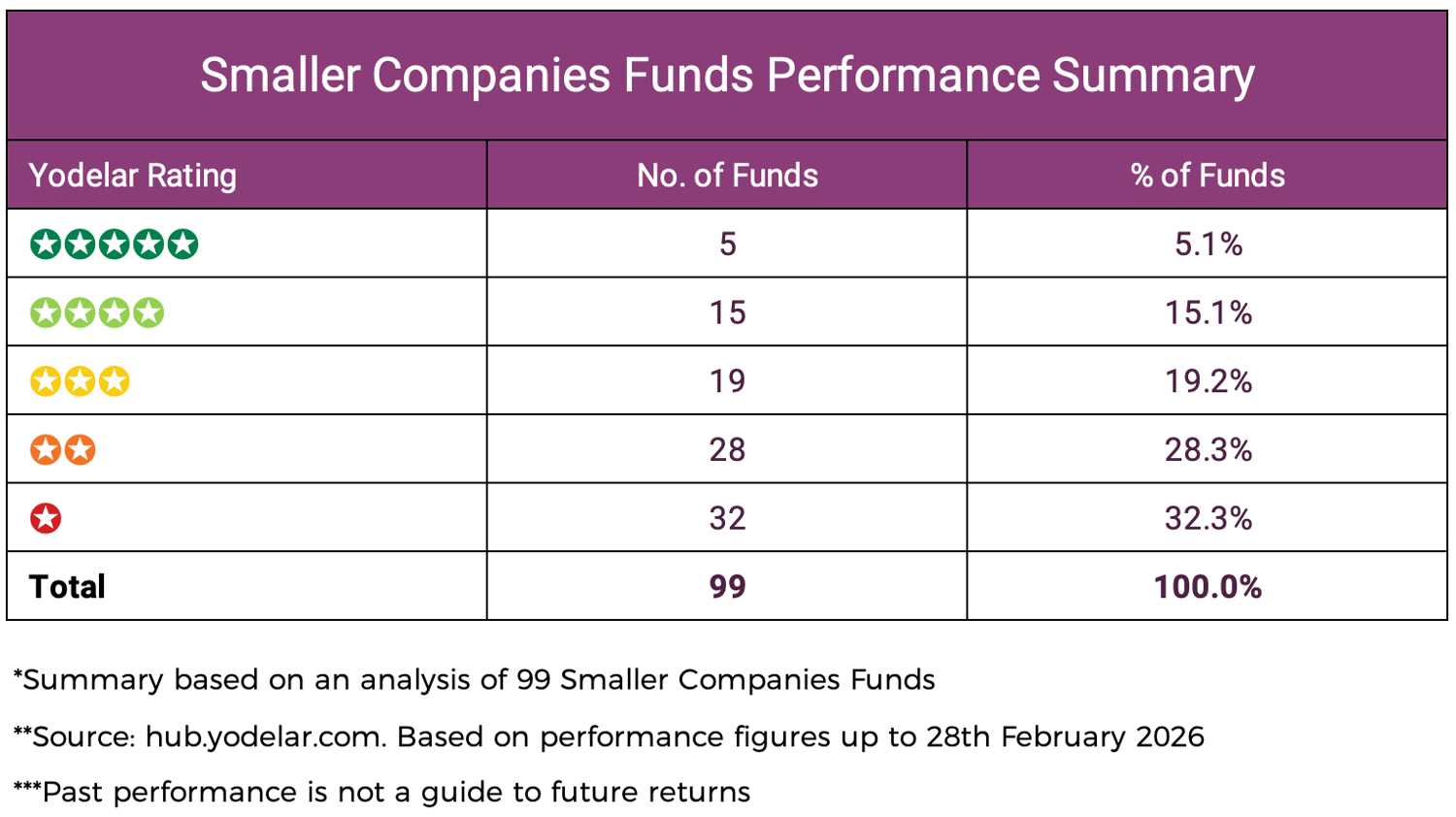
At the other end of the scale, more than 60% of funds were rated 1 or 2 stars, reflecting a pattern of below-average performance relative to their peers.
How Yodelar Rates Fund Performance
Why Smaller Companies Funds Can Be So Different
Smaller companies funds invest in businesses that are much smaller than the large multinational firms that dominate most mainstream equity sectors. That gives them a different profile. They can offer stronger growth potential, but they can also be more volatile and less predictable. Returns can vary widely depending on the manager’s approach, the types of businesses held, and the region the fund invests in.
Another key difference is that smaller businesses tend to receive less analyst coverage than larger firms. That can create opportunities for skilled managers to uncover companies that are being overlooked, but it also means results can vary sharply from one fund to another. That is why this part of the market often rewards careful fund selection more than simple sector exposure.
Top Performing Smaller Companies Funds
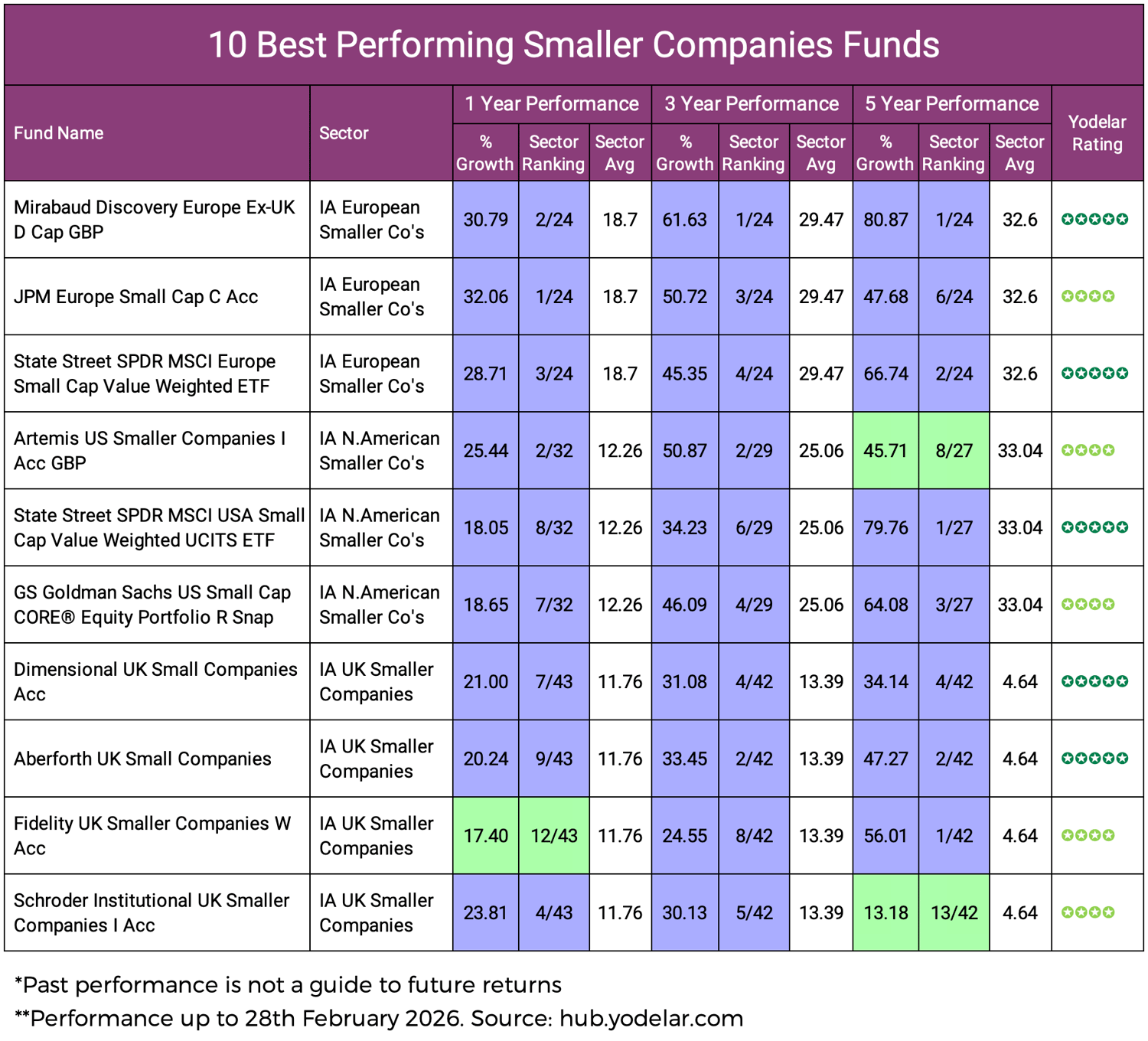
While overall results across the smaller companies sectors have been mixed, a small number of funds have delivered strong and consistent performance across multiple timeframes. The table below highlights 10 of the best performers based on their 1 year, 3 year and 5 year returns.
European Smaller Companies: Three Funds That Have Stood Out
Mirabaud Discovery Europe ex-UK D Cap GBP
The Mirabaud Discovery Europe ex-UK fund has been the clearest standout in the IA European Smaller Companies sector. It runs a relatively focused portfolio of smaller businesses across Europe outside the UK, looking for companies that still have meaningful room to grow. That approach has translated into very strong sector positions. The fund returned 30.79% over one year against a sector average of 18.7%, 61.63% over three years against 29.47%, and 80.87% over five years against 32.6%. It ranked 2nd over one year and 1st over both three and five years.
JPM Europe Small Cap C Acc
The JPM Europe Small Cap fund has also remained consistently competitive. Rather than concentrating too heavily in one area, it spreads its holdings across smaller European companies in different countries and sectors. That broader approach has still produced strong results, with returns of 32.06% over one year, 50.72% over three years and 47.68% over five years, all ahead of the sector averages of 18.7%, 29.47% and 32.6%. It ranked 1st over one year, 3rd over three years and 6th over five years.
State Street SPDR MSCI Europe Small Cap Value Weighted UCITS ETF
The State Street SPDR MSCI Europe Small Cap Value Weighted UCITS ETF shows that strong results in smaller companies do not always require an active manager. This ETF follows an index, but it does not simply give the biggest companies the largest weightings. Instead, it gives more room to businesses that look cheaper on measures such as sales, profits, cash flow and book value. That approach has worked well, with returns of 28.71% over one year, 45.35% over three years and 66.74% over five years, again well ahead of the sector averages. It ranked 3rd, 4th and 2nd over those periods.

North American Smaller Companies: Three Strong Performers
Artemis US Smaller Companies I Acc GBP
The Artemis US Smaller Companies fund has been one of the strongest funds in the IA North American Smaller Companies sector over the short and medium term. It backs smaller American businesses that the manager believes still have room to expand. That approach helped it return 25.44% over one year against a sector average of 12.26%, 50.87% over three years against 25.06%, and 45.71% over five years against 33.04%. It ranked 2nd over one and three years, and 8th over five years.
State Street SPDR MSCI USA Small Cap Value Weighted UCITS ETF
The State Street SPDR MSCI USA Small Cap Value Weighted UCITS ETF has been the standout long-term name in this sector. Like its European sister fund, it uses a rules-based approach that favours cheaper smaller companies rather than simply the largest firms in the smaller companies universe. Over one year it returned 18.05% against a sector average of 12.26%, over three years 34.23% against 25.06%, and over five years 79.76% against 33.04%. That five-year number was the highest in the sector, ranking 1st out of 27 funds.
GS Goldman Sachs US Small Cap CORE Equity Portfolio R Snap GBP
The GS Goldman Sachs US Small Cap CORE Equity Portfolio fund takes a different route. It uses a structured stock selection process to look for smaller US companies with a mix of attractive characteristics, rather than leaning too heavily towards one style. That has helped it stay competitive across every main period. It returned 18.65% over one year, 46.09% over three years and 64.08% over five years, compared with sector averages of 12.26%, 25.06% and 33.04%. It ranked 7th over one year, 4th over three years and 3rd over five years.

UK Smaller Companies: Four Funds That Have Compared Strongly
The UK smaller companies sector has been a tougher area overall. The five-year sector average was just 4.64%, which makes the stronger funds stand out even more clearly.
Dimensional UK Small Companies Acc
The Dimensional UK Small Companies fund has been one of the more consistent names in the sector. It uses a disciplined, rules-based approach, looking for smaller UK companies that appear attractively valued and financially sound. That combination has worked well, with returns of 21.00% over one year against a sector average of 11.76%, 31.08% over three years against 13.39%, and 34.14% over five years against 4.64%. It ranked 7th, 4th and 4th over those periods.
Aberforth UK Small Companies
The Aberforth UK Small Companies has a long history in this part of the market and follows a clear value-led approach, buying smaller UK businesses it believes are priced below their longer-term worth. That discipline has helped it stay near the front of the sector. It returned 20.24% over one year, 33.45% over three years and 47.27% over five years, all comfortably ahead of the sector averages of 11.76%, 13.39% and 4.64%. It ranked 9th, 2nd and 2nd respectively.
Fidelity UK Smaller Companies W Acc
The Fidelity UK Smaller Companies fund has delivered the strongest five-year return in the sector. It invests mainly in the smallest quoted UK businesses and looks for companies that are either undervalued or have strong recovery and growth potential. While its shorter-term rankings were solid rather than dominant, the long-term result was striking. The fund returned 17.40% over one year, 24.55% over three years and 56.01% over five years, compared with sector averages of 11.76%, 13.39% and 4.64%. That five-year return ranked 1st out of 42 funds.
Schroder Institutional UK Smaller Companies I Acc
The Schroder Institutional UK Smaller Companies fund rounds out the list. It focuses on smaller UK businesses with strong finances and avoids companies the manager believes are priced too highly. Its long-term result was more mixed than some of the other funds here, but it still stayed competitive across the main periods. It returned 23.81% over one year against a sector average of 11.76%, 30.13% over three years against 13.39%, and 13.18% over five years against 4.64%. It ranked 4th over one year, 5th over three years and 13th over five years.
What The Fund Table Does Not Tell You
The strongest funds in this review have delivered clearly better results than their sector averages. But performance tables still only tell part of the story. A smaller companies fund may have done well because it was focused on the right part of the market at the right time, because it leaned more towards value or growth, or because it took on more risk than its sector peers. That does not make it a bad fund, but it does mean the wider portfolio context matters.
This is particularly important with smaller companies funds because they can be more sensitive to changing market conditions. Their returns can move around more sharply, and they may respond differently depending on how concentrated the fund is, how much it leans towards one style of investing, and how exposed it is to one region or part of the economy. That means a strong smaller companies fund can add value to a portfolio, but it should usually be judged by how it fits alongside other holdings rather than by its return table position alone.

Why The Wider Portfolio Still Matters
This is where many investors can run into trouble. A fund may be strong on its own, but still be the wrong fit inside a wider portfolio. It may duplicate holdings already owned elsewhere, increase exposure to one region more than intended, or add a level of risk that does not sit comfortably with the rest of the portfolio.
That is why it makes sense to look beyond headline returns and think about the role each fund is playing. Our portfolio analysis is designed to do exactly that. It shows how each fund has performed, how it ranks in its sector and where the wider portfolio may have weaknesses such as overlap, concentration or poor diversification. Find out more on how to get your portfolio analysed by visiting https://www.yodelar.com/portfolio-analysis.

Conclusion
Smaller companies funds can bring something useful to a portfolio. They offer access to businesses that may still be earlier in their growth cycle and can provide a different return profile from larger company funds. But they are also one of the clearest examples of why fund selection matters.
The latest analysis shows a wide gap between stronger and weaker funds, with only a small minority delivering the kind of consistent sector rankings that stand out over time. Past performance helps provide context, but it is not enough on its own. The more useful question is how a fund invests, how much risk it is taking, and how it fits alongside the rest of the portfolio.
That is where the strongest decisions are usually made. Not by looking for the most eye-catching return number, but by understanding whether the fund is genuinely adding something useful to the wider portfolio.

This article is provided for information only and does not constitute personal advice. It reflects the past performance of investments, which is not a reliable guide to future returns. The value of investments can fall as well as rise, and you may receive less than you originally invested. You should consider seeking advice from an FCA regulated adviser before making any investment decisions.