

-
Yodelar reviewed 68 Investment Association (IA) Targeted Absolute Return funds with available 1-year performance data, based on fund information as at 30 April 2026.
-
The sector average return was 7.82% over 1 year, 19.65% over 3 years and 25.07% over 5 years, based on funds with available data for each period.
-
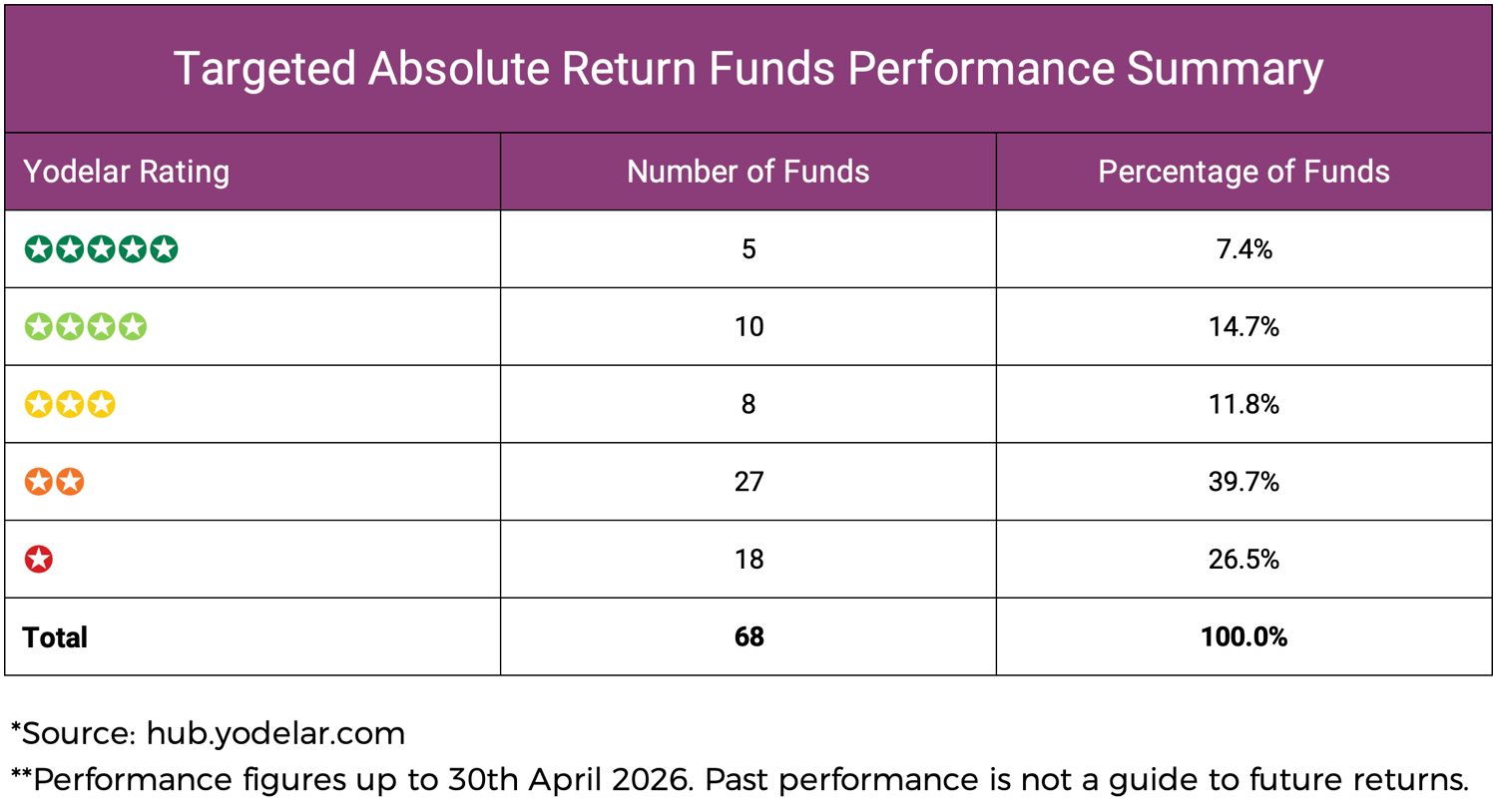
Only 15 of the 68 funds, equal to 22.1%, achieved a 4 or 5 star Yodelar Rating.
-
45 funds, equal to 66.2%, were rated 1 or 2 stars, placing them in the weaker Yodelar Rating bands.
-
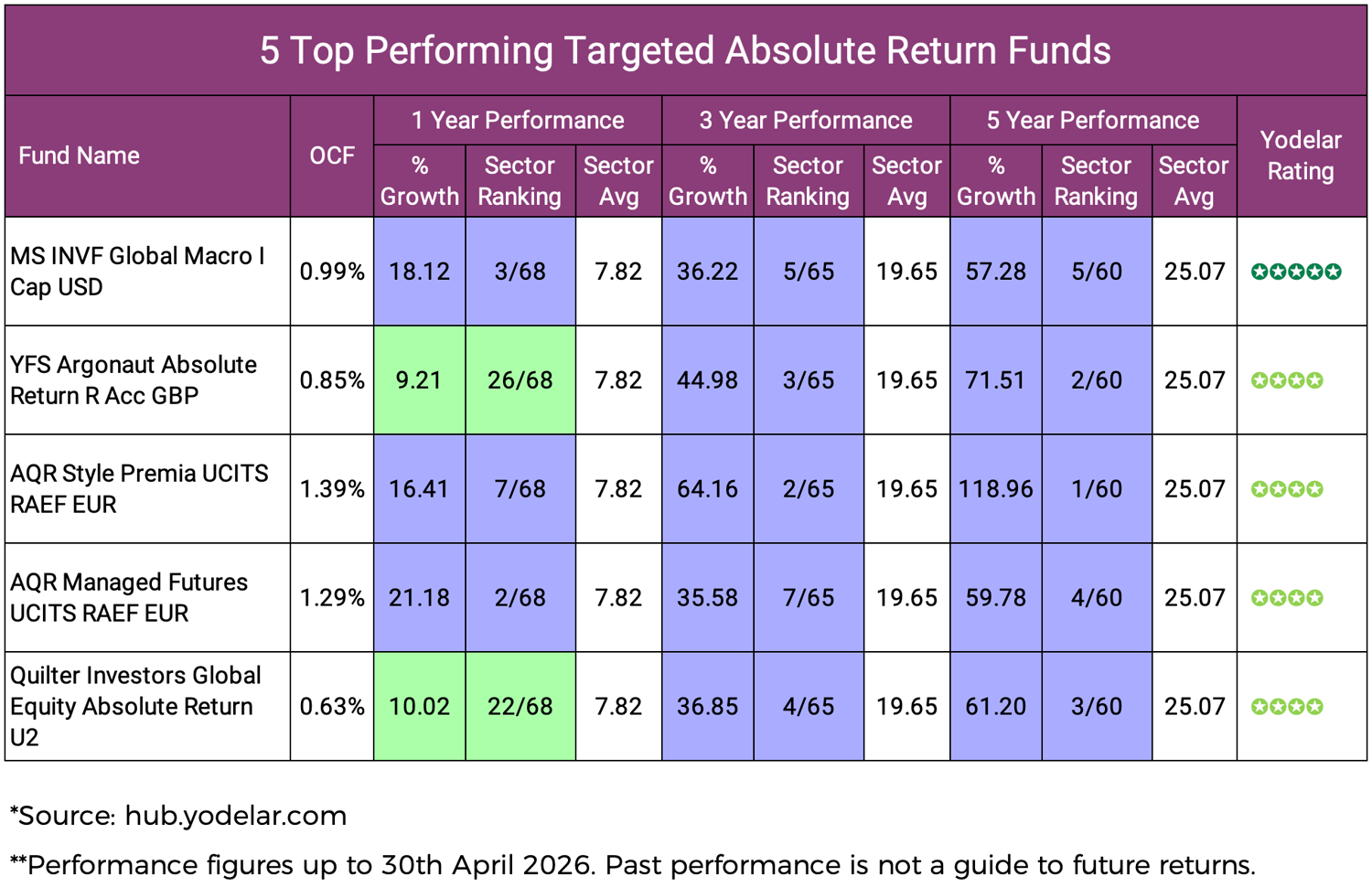
Among the 60 funds with at least 5-year performance data, the strongest fund returned 118.96%, while the weakest returned -3.09%.
Targeted Absolute Return funds are often held to play a specific role in a portfolio. Some investors use them to reduce reliance on stock markets, some use them for diversification, and others expect them to provide a more balanced return profile.
The sector name can sound reassuring, but it should not be treated as evidence of consistency or protection. These funds aim to deliver positive returns in different market conditions, but that outcome is not guaranteed.
The latest Yodelar analysis shows that average returns across the sector were positive, but the difference between funds was wide. For investors, the key question is whether the specific fund they hold has delivered against the role it was expected to play.
What Targeted Absolute Return Funds Aim To Do
Targeted Absolute Return funds aim to produce positive returns across different market conditions. They are not usually selected simply to follow the direction of stock markets, which is why many investors use them for a more specific purpose within a portfolio.
That purpose may be to add diversification, reduce reliance on equities, or provide a return profile that behaves differently from other investments. However, the sector includes a broad range of strategies, and funds can vary significantly in how they attempt to achieve their objectives.
Some funds invest in bonds, some use equities, some hold cash or cash-like assets, and others use more complex investment techniques. This means two funds in the same IA sector can have very different risk levels, return patterns and outcomes.
For this reason, the sector label should not be treated as a measure of quality, consistency or suitability. A Targeted Absolute Return fund still needs to be assessed on what it has delivered, how it has ranked against similar funds, and whether it continues to support the investor’s wider portfolio.
IA Targeted Absolute Return Performance
Across the sector, average returns were positive over each period reviewed. Based on an analysis of 68 IA Targeted Absolute Return sector funds, the average return was 7.82% over 1 year, 19.65% over 3 years and 25.07% over 5 years.
At first glance, that may look reasonable. However, averages can hide a lot, particularly in a sector where funds use very different strategies.
The Yodelar Rating profile gives a clearer view of how many funds have performed strongly or weakly compared with peers. Only 22.1% of funds were rated 4 or 5 stars, while 66.2% were rated 1 or 2 stars.
The data does not suggest that the whole sector has performed poorly. It does show that a large proportion of funds have sat in the weaker Yodelar Rating bands based on historic sector-relative performance.
For investors, this makes fund selection important. Holding a fund in this sector is not enough on its own. The specific fund selected can make a meaningful difference to the outcome.

How The Yodelar Ratings Should Be Read
Yodelar Ratings are used in this article to help summarise how funds have performed historically compared with other funds in the same Investment Association (IA) sector. They are not a forecast and they do not show whether a fund is personally suitable for an investor.
How Yodelar Rates Fund Performance
The Strongest 5-Year Performers
The table below shows five of the strongest 5-year performers from the funds analysed. These are not recommendations, but illustrate the range of returns achieved by the highest-performing funds in the sector.
The Weakest 5-Year Performers
The weakest performers are just as important for investors to review. They show how different outcomes can be within the same IA Targeted Absolute Return sector.
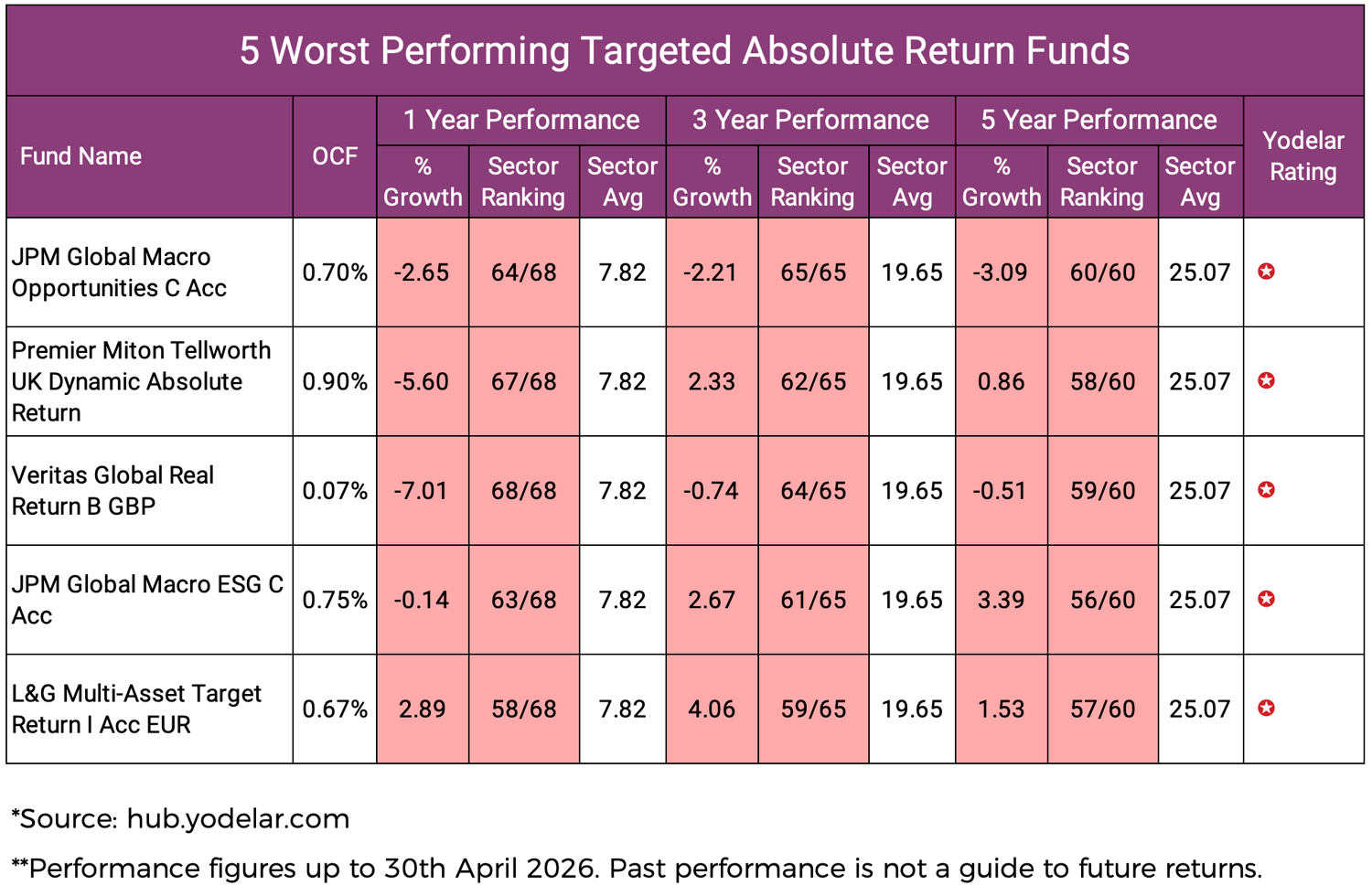
These figures do not mean the funds listed are automatically unsuitable for every investor. There may be specific reasons why a fund is held, including risk management, portfolio balance or exposure to a particular strategy.
However, the figures do show why investors should review funds that rank near the bottom of the sector over several periods. A fund should not remain in a portfolio only because it has a cautious-sounding objective or because it has been held for many years.

Sector Performance Gap
Among funds with available 5-year data, the strongest performer returned 118.96%, while the weakest returned -3.09%. This created a gap of 122.05% between the top and bottom 5-year performers.
This range is important because it shows that funds in the same IA sector can deliver very different outcomes. Although these funds share a broad objective, their strategies, risk levels and performance records can vary significantly.
For investors, the sector name is not enough. A Targeted Absolute Return fund should be assessed using the evidence of what it has delivered, where it ranks against similar funds, and whether it still adds value within the wider portfolio.
A fund does not need to be the highest performer in the sector to justify its place. However, there should be a clear reason for holding it, and that reason should still be supported by the fund’s performance record, risk profile and portfolio role.
Positive Returns Need Context
A fund can produce a positive return and still compare poorly with similar funds. This is particularly relevant in the IA Targeted Absolute Return sector, where investors may focus mainly on whether the fund has avoided a loss.
For example, a fund that returned 3% over 5 years may appear to have delivered a positive outcome. However, if the sector average over the same period was above 25%, the result needs to be reviewed in context.
This does not mean the fund has automatically failed. It may have taken less risk, behaved differently from other holdings, or served a specific purpose in the portfolio. However, investors should understand whether the lower return was consistent with the fund’s intended role or whether it reflects weaker sector-relative performance.
Sector ranking helps provide that context. It allows investors to see whether a fund has performed strongly, poorly or broadly in line with funds with similar objectives.
Download The Full Fund Rankings
The tables in this article highlight the strongest and lowest 5-year performers, but they do not show every fund in the sector. Some funds have stronger shorter-term records, some do not yet have 5-year performance data, and others sit closer to the sector average.
The full Yodelar download provides the fund name, performance figures, sector ranking and Yodelar Rating for all 68 IA Targeted Absolute Return funds reviewed.
Investors can use the download to check how a fund has performed over 1, 3 and 5 years, where data is available. It also shows where each fund ranks within the IA Targeted Absolute Return sector and whether it has a stronger or weaker Yodelar Rating.
The download is designed as a research tool. It does not provide personal financial advice and does not recommend whether to buy, sell or switch any investment.
Download The IA Targeted Absolute Return Fund Table
Summary
Targeted Absolute Return funds can have a role in some portfolios, but the sector should not be treated as automatic protection or a guaranteed source of positive returns.
Based on fund information as at 30 April 2026, the IA Targeted Absolute Return sector delivered positive average returns over 1, 3 and 5 years. However, only 22.1% of funds achieved a 4 or 5 star Yodelar Rating, while 66.2% were rated 1 or 2 stars.
The performance gap was also wide. Among the 60 funds with available 5-year data, the strongest fund returned 118.96%, while the weakest returned -3.09%.
For investors, the main point is that the individual fund matters. A Targeted Absolute Return fund should be reviewed against the role it is expected to play. If it has ranked poorly, has a weak rating profile, or no longer adds something distinct to the portfolio, it may warrant closer review.