

The 20 Best Performing Funds In The First Half Of 2026
-
Yodelar reviewed 4,236 Investment Association (IA) sector-classified funds with performance data to 30 June 2026.
-
The top 20 funds delivered 6-month returns between 55.87% and 128.83%.
-
Korean equity funds dominated the top of the table, with the first six positions all held by Korea-focused funds.
-
The strongest IA sector averages over the first half of 2026 were Asia Pacific Excluding Japan, Global Emerging Markets and Technology & Technology Innovation.
-
Investors should not chase short-term performance without first reviewing whether their current portfolio is diversified, suitably positioned and aligned with their objectives.
The first half of 2026 produced strong returns across much of the fund universe, but the biggest gains were not spread evenly.
The strongest performers were heavily concentrated in a small number of areas, particularly Korea, Taiwan, broader Asian and emerging market funds, and technology-linked strategies. Some of the top funds delivered returns of more than 100% in just six months.
That level of performance can attract attention, but it also needs context. A fund appearing near the top of a short-term performance table does not automatically make it suitable for an investor’s portfolio. Strong short-term returns can come from concentrated exposure to one region, sector or theme, and those same areas can also move sharply in the opposite direction.
Yodelar analysed 4,236 Investment Association sector-classified funds using performance data to 30 June 2026. The 20 highest-growth funds over the first six months of 2026 are shown below, alongside their 1-month, 3-month and 6-month returns.

What The Data Shows
Across the 4,236 funds reviewed, the average 6-month return was 8.22%, while the median fund returned 6.14%. More than 90% of funds produced a positive return over the six months to 30 June 2026.
However, the top of the market was far stronger than the average. The 20 highest-growth funds had an average 6-month return of 82.45%, with a median return of 73.60%.
This shows two important points for investors. First, the first half of 2026 was broadly positive across many fund sectors. Second, the strongest returns came from a relatively narrow group of funds exposed to specific regions and themes.
That distinction matters. A portfolio may have performed well in the first half of 2026, but investors should understand where those returns came from and whether they are relying too heavily on one area of the market.
The 20 Highest Growth Funds
The table below shows the 20 highest-growth funds in the dataset over the first six months of 2026. These are not recommendations. They are included to show which funds delivered the strongest historic returns over the period reviewed.
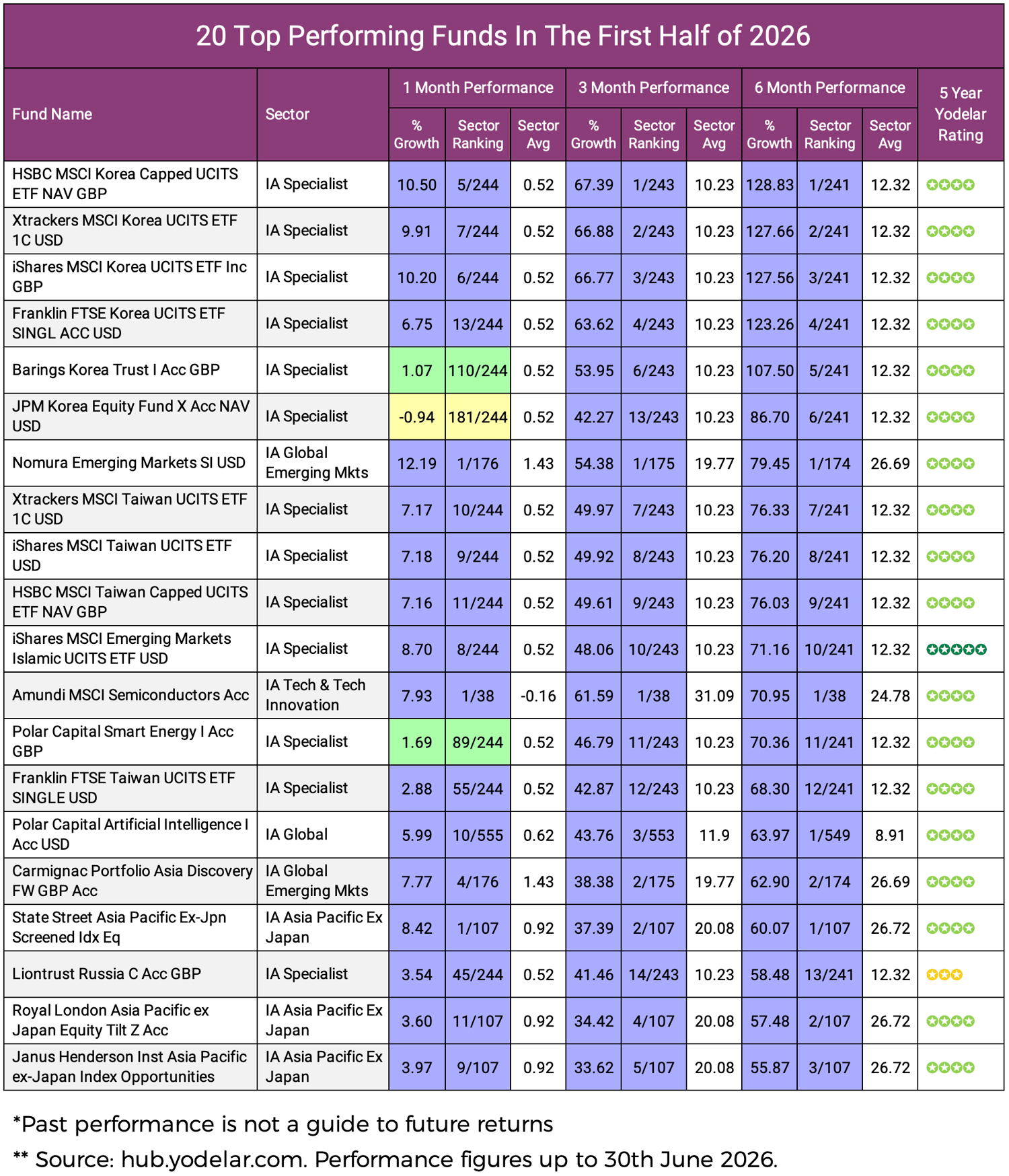
Yodelar Ratings are based on historic sector-relative fund performance. They are not a recommendation, do not assess personal suitability and should not be treated as a guide to future returns.
How Yodelar Rates Fund Performance
What The Top Funds Had In Common
The strongest performers were not spread evenly across the fund universe. They were heavily concentrated in a few areas.
The most obvious theme was Korea. The top six funds were all Korea-focused, with returns ranging from 86.70% to 128.83% over the six-month period. Several Taiwan funds also featured strongly, with four Taiwan-focused funds appearing in the top 14.
Broader Asian and emerging market funds were also prominent. The list included funds from the IA Global Emerging Markets and IA Asia Pacific Excluding Japan sectors, as well as specialist emerging market and Asia-focused strategies.
Technology-linked exposure also played a major role. Funds focused on semiconductors, artificial intelligence and smart energy all appeared in the top 20. This suggests that some of the strongest results were linked to more concentrated growth themes rather than broad, balanced market exposure.
For investors, this is important. The top performers show where the strongest short-term returns were generated, but they also show how concentrated those returns were. A fund can deliver exceptional short-term growth, but that does not mean it should automatically become part of an investor’s portfolio.

The Strongest IA Sectors In The First Half Of 2026
The table below shows the strongest IA sectors by average 6-month return, using sectors with at least 20 funds in the dataset.
|
IA sector |
Funds analysed |
Average 1-month return |
Average 3-month return |
Average 6-month return |
|---|---|---|---|---|
|
IA Asia Pacific Excluding Japan |
107 |
0.92% |
20.08% |
26.72% |
|
IA Global Emerging Markets |
171 |
1.40% |
19.79% |
26.55% |
|
IA Technology & Technology Innovation |
38 |
-0.16% |
31.09% |
24.78% |
|
IA North American Smaller Companies |
33 |
6.99% |
20.67% |
20.25% |
|
IA Japan |
97 |
2.02% |
12.86% |
17.69% |
|
IA Infrastructure |
36 |
1.34% |
5.39% |
13.41% |
|
IA Specialist |
237 |
0.52% |
10.30% |
12.44% |
|
IA Listed Property |
41 |
2.55% |
10.58% |
10.76% |
|
IA Commodity / Natural Resources |
34 |
-6.16% |
-2.48% |
10.59% |
|
IA Global Equity Income |
58 |
0.90% |
9.92% |
9.75% |
This sector data gives a clearer view of the wider market pattern. Asia Pacific Excluding Japan and Global Emerging Markets were the strongest sectors on average, both returning more than 26% over the first half of 2026.
Technology & Technology Innovation also produced a strong average return of 24.78%, but the 1-month average was slightly negative. This shows why investors should not judge a sector only by its latest short-term figure. Returns can be strong over six months, but momentum can still change quickly.
North American Smaller Companies and Japan also performed strongly, while Commodity / Natural Resources produced a positive 6-month average despite weaker 1-month and 3-month figures. This highlights how different sectors can perform strongly over one period but lose momentum over another.
Short-Term Performance Needs Context
The top 20 funds delivered exceptional returns, but short-term performance tables can be misleading if they are used in isolation.
Several of the highest-ranked funds achieved most of their gains over the 3-month period, while the latest 1-month returns were more mixed. For example, JPM Korea Equity Fund was the sixth highest-growth fund over six months, but it returned -0.94% over the latest month. Barings Korea Trust returned 107.50% over six months, but only 1.07% over the latest month.
This does not make those funds weak. It simply shows that performance can change quickly, particularly in more concentrated regional or thematic funds.
Investors should also consider the role of each fund. A Korea fund, Taiwan fund, semiconductor fund or artificial intelligence fund may provide exposure to a strong-performing area, but it may also increase concentration and risk if the investor already holds similar exposure elsewhere.
The key question is not whether the fund has performed well recently. It is whether the fund is suitable for the investor’s objectives, time horizon, attitude to risk and wider portfolio.

What This Means For Investors
The first half of 2026 shows why investors should look beneath the headline return.
If a portfolio had exposure to Korea, Taiwan, broader Asian equities, emerging markets or technology-linked strategies, it may have benefited from some of the strongest market trends. If it did not, that does not automatically mean the portfolio was poorly positioned.
A portfolio should not be judged only by whether it held the latest winning funds. It should be judged by whether it is built to achieve the investor’s objectives at an appropriate level of risk.
The danger is chasing performance after it has already happened. Investors who buy into the strongest recent funds without reviewing their existing portfolio may increase exposure to areas that have already risen sharply. That can create duplication, concentration or a level of risk that does not match their circumstances.
The more useful approach is to review what the portfolio already holds. Investors should understand which funds have performed competitively, which have lagged their sector peers, whether the portfolio is overly exposed to one area and whether each fund still has a clear role.
Check Your Portfolio Before Chasing Winners
Many investors are tempted to act when they see funds delivering large short-term gains. That is understandable, but it is not the best starting point.
Before adding a top-performing fund, investors should first ask:
|
Review question |
Why it matters |
|---|---|
|
Do I already hold exposure to this area? |
Several funds may already provide similar regional or sector exposure. |
|
Has my current fund performed competitively? |
A fund may have made money but still lagged its sector peers. |
|
Would this increase concentration? |
Adding a recent winner can increase reliance on one market or theme. |
|
Does the fund match my risk level? |
Strong short-term returns can come with higher volatility. |
|
What role would the fund play? |
Every holding should support the wider portfolio objective. |
This type of review helps investors avoid making decisions based only on recent performance. It also helps identify whether the issue is fund selection, portfolio structure, risk exposure or simply unrealistic comparisons.

Start With A Free Portfolio Analysis
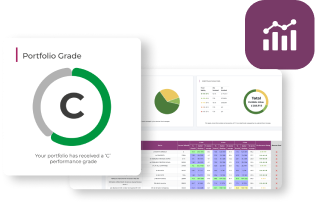
Our free portfolio analysis is designed to help investors understand what they already hold before making new investment decisions.
The analysis reviews each fund individually, showing 1, 3 and 5-year performance, sector ranking and Yodelar Rating, where data is available. It can also help identify weaker-rated holdings, duplication, concentration, higher charges and funds that may no longer have a clear role.
Where appropriate, the analysis can also compare backdated portfolio performance with a similar-risk MKC Invest model. This is a historic comparison only. It does not provide personal advice, is not a recommendation to invest in an MKC portfolio and should not be treated as a guide to future performance.
For investors reviewing the strongest funds of 2026 so far, the first step should not be chasing the top of the table. It should be checking whether their current portfolio is already positioned effectively and whether any changes would genuinely improve the overall structure.

Speak To An Adviser
For investors who want to understand whether their current portfolio remains suitable, a no obligation call with an adviser from our advice partner, MKC Wealth, can help.
The discussion can cover the investor’s current holdings, portfolio analysis results, long-term objectives, time horizon and attitude to risk. It can also explain how a more structured investment approach may compare with the portfolio currently held.
Any personal recommendation would only be made after understanding the investor’s financial position, investment objectives, time horizon and attitude to risk. Any recommendation would include a clear explanation of risks, costs and ongoing service.

Summary
The first half of 2026 produced strong returns across much of the IA fund universe, but the biggest gains were concentrated in a small number of regions and themes.
Korea-focused funds dominated the top of the table, Taiwan funds also performed strongly, and broader Asian, emerging market and technology-linked strategies featured heavily among the highest-growth funds.
The strongest IA sectors by average 6-month return were Asia Pacific Excluding Japan, Global Emerging Markets and Technology & Technology Innovation. This shows that the first half of 2026 was not simply about broad market growth. It was a period where specific sectors and regions delivered much stronger results than the wider fund universe.
For investors, the lesson is not to chase the latest winners. The lesson is to understand what is already inside the portfolio.
A fund that performed well over six months may still be unsuitable. A portfolio that missed the top-performing areas may still be appropriate. What matters is whether each fund has performed competitively, whether the portfolio is properly diversified and whether the current holdings still support the investor’s objectives.
Before making changes based on the best-performing funds of 2026 so far, investors should first review their own portfolio.

Source and Methodology
Source: Yodelar analysis of 4,236 Investment Association sector-classified funds using performance data to 30 June 2026.
The 20 highest-growth funds were selected by 6-month percentage growth over the first half of 2026. Sector averages are based on funds with available 1-month, 3-month and 6-month performance data. Sectors shown in the sector table include only sectors with at least 20 funds in the dataset. Figures are rounded.
Yodelar Ratings are based on historic fund performance relative to funds in the same Investment Association sector. Past performance is not a reliable guide to future returns.