

-
The IA Flexible Investment sector gives fund managers wide freedom over where they invest, but the results show that flexibility alone does not determine fund quality.
-
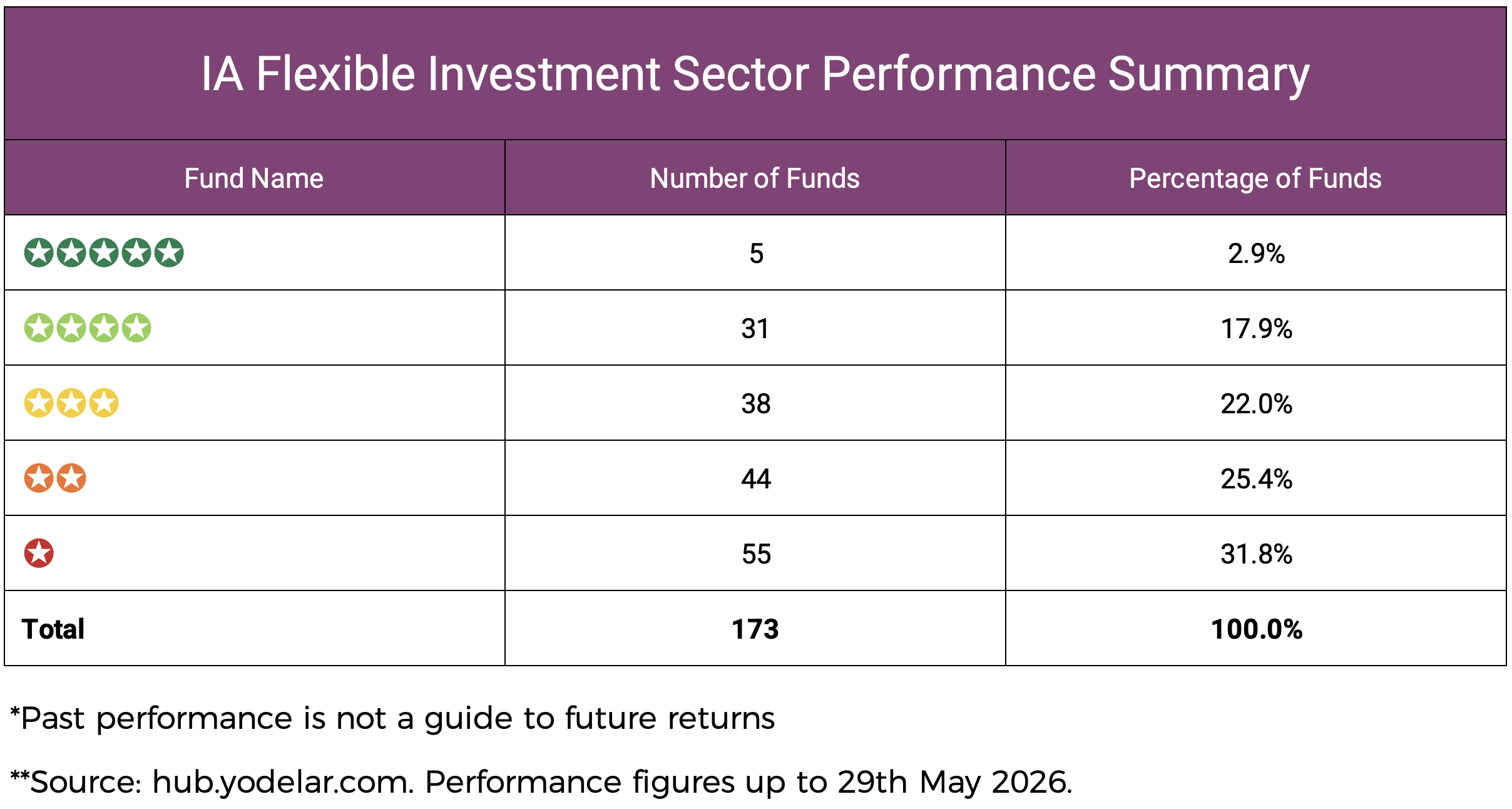
Of the 173 funds analysed, only 5 achieved a 5 star Yodelar rating, while 55 received 1 star.
-
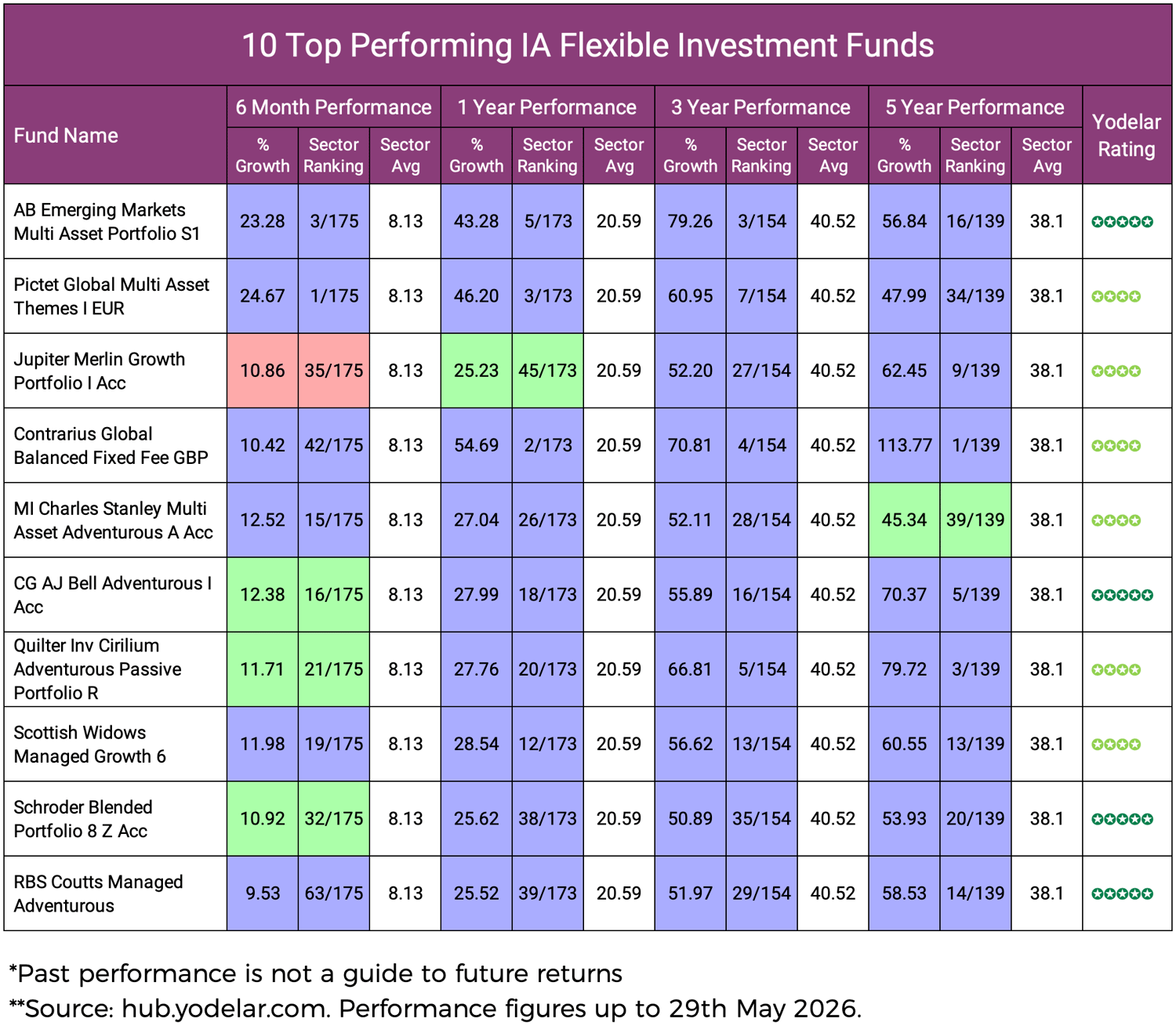
The strongest five year return came from Contrarius Global Balanced, which returned 113.77% compared with a sector average of 38.10%.
-
Several featured funds, including CG AJ Bell Adventurous, Quilter Cirilium Adventurous Passive and Scottish Widows Managed Growth 6, delivered returns ahead of the sector average across the main periods analysed.
-
Flexible investment funds can play a useful role, but investors still need to understand how each fund fits within the wider portfolio.
Flexible investment funds sound attractive because they give fund managers room to move. They are not tied to a strict split between shares, bonds and cash, and they can adjust their approach depending on where they see risks or opportunities.
For self managed investors, that can sound like a practical solution. One fund, broad flexibility and the potential to adapt as markets change.
But flexibility is only useful when it is used well.
The latest analysis of 173 funds in the Investment Association (IA) Flexible Investment sector shows a wide gap between funds that have delivered strong sector rankings and those that have struggled to keep pace. Only 5 funds achieved a 5 star Yodelar rating, while 55 funds received 1 star. More than half of the sector was rated either 1 or 2 stars.
That matters because many investors use flexible investment funds as core holdings. Some see them as ready made portfolios. Others use them alongside global equity funds, income funds or specialist holdings. Either way, the data highlights an important point. A flexible mandate does not remove the need for careful fund selection, proper diversification and regular review.

What Is The IA Flexible Investment Sector?
The IA Flexible Investment sector is one of the broadest fund sectors. Unlike the mixed investment sectors, where funds must stay within set share ranges, flexible investment funds have more freedom over how they invest.
In practice, many funds in this sector are multi asset portfolios. They may hold shares, bonds, cash, commodities, property related investments or other assets. Some are built for adventurous growth, some aim to provide a smoother investment journey, and others focus on more specialist areas such as emerging markets or real assets.
This means two funds can sit in the same sector but behave very differently.
One fund may hold a high level of shares and move more like an equity portfolio. Another may hold a wider mix of assets and aim for steadier returns. A third may focus heavily on one region or investment theme.
That makes the sector useful, but also difficult to compare. Investors should not assume that funds in this sector are automatically similar simply because they appear under the same IA heading.
The average fund in the sector returned 20.59% over one year, 40.52% over three years and 38.10% over five years. The strongest five year fund returned 113.77%, while the weakest returned 2.47%. That is a wide difference inside one sector.
IA Flexible Investment Sector Performance Summary
Our analysis of 173 IA Flexible Sector funds identified that 57.2% had a Yodelar rating of 1 or 2 stars with 20.8% receiving top performing 4 or 5 star rating.
How Yodelar Rates Fund Performance
10 Flexible Investment Funds That Have Stood Out
The 10 funds below were selected because they ranked strongly within the IA Flexible Investment sector and achieved either a 4 or 5 star Yodelar rating. They are not recommendations. They provide a snapshot of funds that have been more competitive over the periods analysed.
Contrarius Global Balanced Fixed Fee
Contrarius Global Balanced was the strongest five year performer in the review. It returned 54.69% over one year, 70.81% over three years and 113.77% over five years. That placed the fund 2nd out of 173 funds over one year, 4th out of 154 over three years and 1st out of 139 over five years.
Those returns were significantly ahead of the sector averages of 20.59%, 40.52% and 38.10%. The five year gap is particularly large, with the fund returning almost three times the sector average.
The fund’s ranking shows how strongly it has compared with peers over the main periods analysed. However, investors should also consider the level of risk taken to achieve those results and whether the fund’s style fits with the rest of their portfolio.

Quilter Investors Cirilium Adventurous Passive Portfolio
Quilter Investors Cirilium Adventurous Passive Portfolio was one of the strongest longer term funds in the sector. It returned 27.76% over one year, 66.81% over three years and 79.72% over five years. Its rankings were 20th out of 173 funds over one year, 5th out of 154 over three years and 3rd out of 139 over five years.
The fund was comfortably ahead of the sector average across all three periods. Its five year return of 79.72% was more than double the sector average of 38.10%.
This is a strong example of a fund that did not need to top the one year table to stand out. Its three and five year rankings show that it has remained highly competitive over the more meaningful periods analysed.
CG AJ Bell Adventurous
CG AJ Bell Adventurous returned 27.99% over one year, 55.89% over three years and 70.37% over five years. It ranked 18th out of 173 funds over one year, 16th out of 154 over three years and 5th out of 139 over five years. It also achieved a 5 star Yodelar rating.
The fund was ahead of the sector average across all three main periods. Its five year return was 70.37%, compared with the sector average of 38.10%.
This is the type of fund that may appeal to investors looking for growth, but the word “Adventurous” is important. The fund’s strong returns need to be viewed alongside its higher risk profile. It may have a role in a growth focused portfolio, but it should not be judged on return figures alone.
Jupiter Merlin Growth Portfolio
Jupiter Merlin Growth Portfolio delivered 25.23% over one year, 52.20% over three years and 62.45% over five years. It ranked 45th out of 173 funds over one year, 27th out of 154 over three years and 9th out of 139 over five years.
The fund’s five year ranking is the strongest part of its record. A return of 62.45% was well ahead of the sector average of 38.10%, placing it inside the top 10 over five years.
Its shorter term rankings were less dominant, which makes it a useful example of why investors should look across more than one period. A fund may not lead the sector over one year but can still show strong longer term relative performance.
Scottish Widows Managed Growth 6
Scottish Widows Managed Growth 6 delivered one of the more consistent profiles in the review. It returned 28.54% over one year, 56.62% over three years and 60.55% over five years. Its rankings were 12th out of 173 funds over one year, 13th out of 154 over three years and 13th out of 139 over five years.
That consistency is what makes the fund stand out. It did not top any of the three main periods, but it stayed close to the front across all of them.
The fund also had an ongoing charge of 0.10%, which was notably lower than many of the other featured funds. Cost should not be viewed in isolation, but where a fund has delivered competitive performance with a low charge, it is worth noting.
RBS Coutts Managed Adventurous
RBS Coutts Managed Adventurous returned 25.52% over one year, 51.97% over three years and 58.53% over five years. It ranked 39th out of 173 funds over one year, 29th out of 154 over three years and 14th out of 139 over five years. It achieved a 5 star Yodelar rating.
The fund was ahead of the sector average over all three periods. Its strongest relative position was over five years, where it ranked 14th and returned 58.53% compared with the sector average of 38.10%.
This fund sits in the adventurous part of the market, so investors should view the performance in that context. It may add growth potential, but it can also increase the overall risk level of a portfolio if similar exposure already exists elsewhere.

AB Emerging Markets Multi Asset Portfolio
AB Emerging Markets Multi Asset Portfolio produced particularly strong one and three year results. It returned 43.28% over one year, ranking 5th out of 173 funds, and 79.26% over three years, ranking 3rd out of 154. Over five years it returned 56.84%, ranking 16th out of 139.
The fund was well ahead of the sector average across all three periods. Its three year return was almost double the sector average of 40.52%.
This fund is different from many others in the sector because of its emerging markets focus. That has helped it stand out over the periods analysed, but it also means investors should not treat it as a direct alternative to a broad global multi asset fund. Emerging market exposure can behave differently and may add regional risk.
Schroder Blended Portfolio 8
Schroder Blended Portfolio 8 returned 25.62% over one year, 50.89% over three years and 53.93% over five years. It ranked 38th out of 173 funds over one year, 35th out of 154 over three years and 20th out of 139 over five years. It also achieved a 5 star Yodelar rating.
The fund was ahead of the sector average across all three periods. Its returns were not as eye catching as some of the highest ranked funds, but it remained competitive over one, three and five years.
That matters because not every strong fund needs to sit at the very top of the table. A fund that consistently stays ahead of the sector average can still be valuable, depending on the role it plays within a portfolio.
Pictet Global Multi Asset Themes
Pictet Global Multi Asset Themes was strongest over the shorter periods analysed. It returned 46.20% over one year, ranking 3rd out of 173 funds, and 60.95% over three years, ranking 7th out of 154. Over five years it returned 47.99%, ranking 34th out of 139.
The fund was significantly ahead of the sector average over one and three years. Its five year return was also ahead of the sector average, although its ranking was less prominent than its shorter term numbers.
This shows why investors should separate strong recent performance from longer term consistency. The fund has clearly performed well over the periods analysed, but its strongest relative results came over one and three years rather than five.
MI Charles Stanley Multi Asset Adventurous
MI Charles Stanley Multi Asset Adventurous returned 27.04% over one year, 52.11% over three years and 45.34% over five years. It ranked 26th out of 173 funds over one year, 28th out of 154 over three years and 39th out of 139 over five years.
The fund was ahead of the sector average across all three periods, although it was not among the very strongest five year performers.
Its one and three year rankings were stronger than its five year ranking, which suggests investors should look carefully at how the fund has performed over different periods. It may be competitive, but the wider portfolio context still matters.

What The Stronger Funds Had In Common
The stronger funds in this review were not all built in the same way. Some were broad global multi asset funds. Some had a clear adventurous growth tilt. One had a strong emerging markets focus. Others used passive or blended fund structures.
The first common feature was that many had meaningful exposure to shares or growth assets. That helped during periods when equity markets were supportive. It also means investors should not assume that a Flexible Investment fund is automatically lower risk simply because it holds more than one type of asset.
The second common feature was clearer purpose. The stronger funds generally had an identifiable role, such as adventurous growth, broad market exposure or specialist emerging market exposure. That makes them easier to assess. A flexible fund with no clear role can be difficult to judge inside a portfolio.
For self managed investors, this is an important point. A fund may have performed well, but that does not automatically mean it is right for every portfolio.
Why Flexible Investment Funds Need Extra Care
The appeal of flexible investment funds is also what makes them harder to assess. A manager can move between assets, regions and investment styles. That can be helpful when decisions are effective, but it can also lead to very different outcomes.
A fund might rank highly because it took more equity risk. Another might benefit from exposure to one region or theme. Another may have performed well because the manager made strong allocation decisions during a specific period.
Those are very different reasons for outperformance.
That is why investors should avoid treating the sector as a simple league table. A fund with strong returns may still be unsuitable if it overlaps with existing holdings, increases risk more than intended, or shifts the portfolio too heavily towards one region or asset type.
The more useful question is not just which fund has performed well. It is what role the fund plays inside the wider portfolio.
When A Portfolio Review Becomes Useful
Many self managed investors are comfortable selecting funds. They read performance tables, compare charges and look for funds with strong results. That can be useful, but it does not always show whether the portfolio is properly structured.
The issue is often not one fund. It is how the funds work together.
A portfolio can hold several strong individual funds and still be poorly diversified. It can have too much exposure to the same markets, the same investment style or the same underlying companies. It can also drift away from its original risk level as markets move.
This is where a portfolio analysis can provide useful clarity. It can show how each fund has performed, how it ranks within its sector, how much of the portfolio is held in stronger and weaker funds, and whether there are potential issues with overlap, diversification or structure.
For investors who want to go further, speaking with an adviser can help turn that analysis into a clearer plan. This does not mean every portfolio needs major changes. In some cases, the analysis may confirm that the structure is already suitable. In others, it may highlight areas that need closer attention.

Where Professional Portfolio Management Can Help
Managing a portfolio properly is not just about choosing funds. It is also about ongoing review, risk control and making sure the portfolio remains aligned with the investor’s objectives.
This is where professionally managed portfolios, such as those from MKC Invest, can be useful for some investors. MKC Invest portfolios are managed within a defined risk framework and use research, fund analysis and ongoing oversight to help maintain the structure of each portfolio over time.
Because MKC Invest operates with discretionary permissions, portfolio changes can be made within an agreed mandate without needing to ask the client for approval each time. This can help portfolios remain more responsive when markets change, when fund quality shifts, or when better opportunities are identified.
This does not guarantee better returns and it will not be suitable for everyone. But for investors who do not want to manage every fund decision themselves, it can provide a more structured way to keep a portfolio reviewed, diversified and aligned to its long term purpose.
The right starting point is often simple. Understand what you currently hold, how it has performed, how it fits together, and whether the overall structure still makes sense.
Conclusion
The IA Flexible Investment sector is built around freedom. Managers can move across different assets and take very different approaches. That makes the sector appealing, but it also makes it harder to compare funds fairly.
The data shows a wide gap between stronger and weaker funds. Only 5 of 173 funds achieved a 5 star Yodelar rating, while 55 were rated just 1 star. That tells investors something important. Flexibility does not automatically lead to better results. It depends on how that flexibility is used.
The 10 funds featured in this review stood out because they ranked well over the periods analysed, particularly over three and five years. But past performance should be used as context, not as a decision on its own.
For investors already holding flexible investment funds, the next step is not simply to look for the highest return. It is to understand what role each fund plays, how much risk it adds, whether it overlaps with other holdings, and whether the wider portfolio is still structured in a way that supports the investor’s objectives.
That is often where the most valuable insight sits. Not in the performance of one fund, but in how the whole portfolio works together.