

-
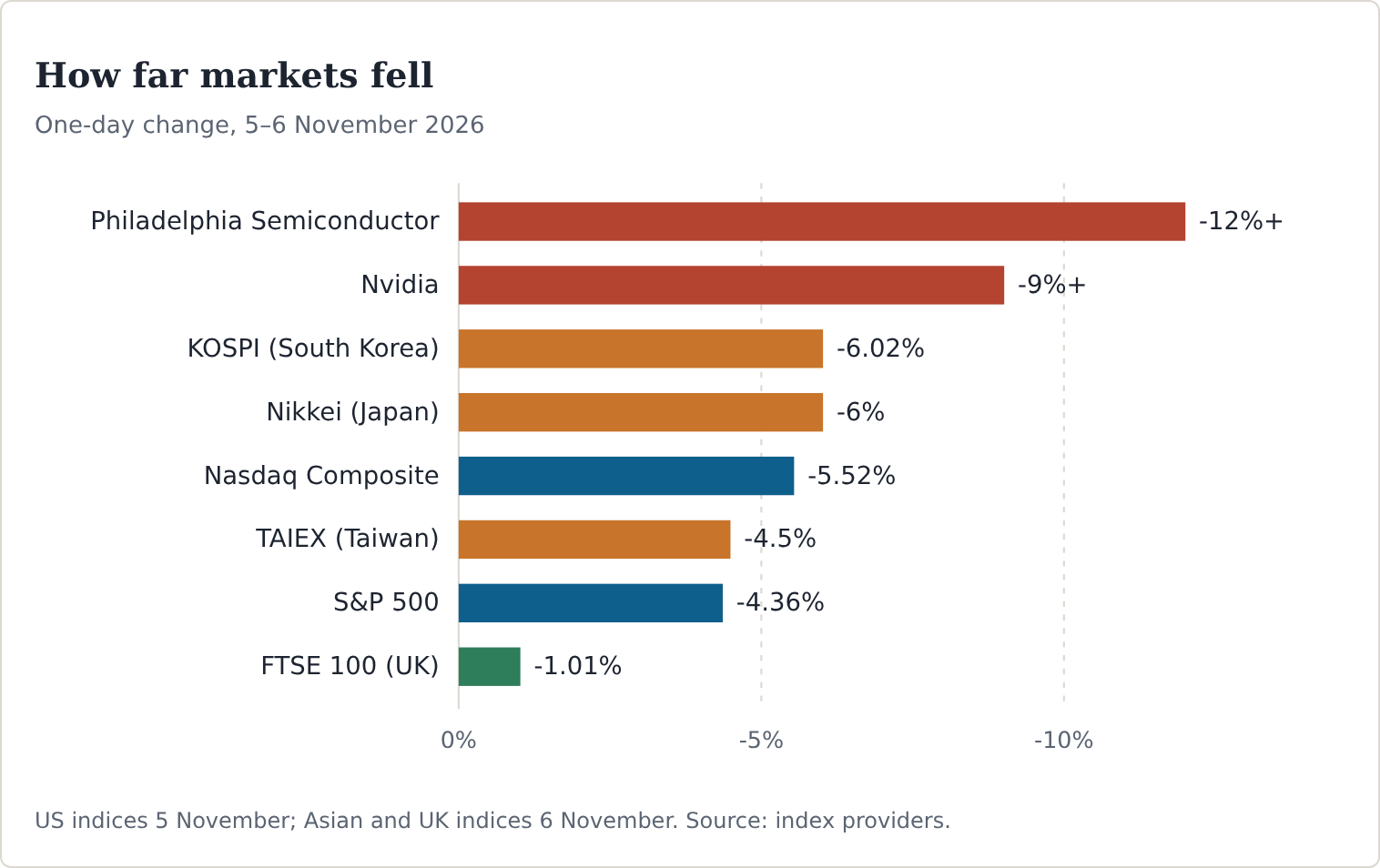
Global markets fell sharply following heavy losses among US technology and AI related companies, with the Nasdaq Composite falling 5.52% on 5 November and the S&P 500 losing 4.36%, before recovering some ground the following day.
-
The falls quickly spread beyond America, with major losses across Japan, South Korea and Taiwan before European markets also moved lower on 6 November.
-
Many UK investors could be more exposed than they realise. US companies made up around 72% of the MSCI World Index earlier this year, meaning even a global portfolio can be heavily influenced by America's largest companies.
-
The latest sell off highlights the risks of building portfolios around past performance, particularly where investors have repeatedly added funds from the same successful markets and sectors.
-
Owning several funds does not automatically mean a portfolio is well diversified. Different global, US and technology funds can hold many of the same underlying companies.
-
For investors approaching retirement, poor portfolio balance can become particularly important, because withdrawing money following a substantial market fall can make it harder for the portfolio to recover.
The sharp falls across global markets in early November followed a period of strong returns for US technology and AI related shares. For investors, the movements provide a reminder of why portfolio construction matters.
The scale of the decline was particularly evident in US technology. On 5 November, the Nasdaq Composite, which has substantial exposure to technology companies, fell 5.52%, while the broader S&P 500 declined 4.36%. Nvidia, a major supplier of AI chips, lost more than 9%, and the Philadelphia Semiconductor Index, which tracks semiconductor companies, fell more than 12%. Around $3 trillion was wiped from the value of companies in the S&P 500 in one trading session.
Those losses quickly spread. Japan’s Nikkei fell almost 6% the following day, South Korea’s KOSPI dropped 6.02% and Taiwan’s TAIEX fell around 4.5%. European markets also moved lower, although their falls were generally less severe.
US markets recovered some ground on 6 and 9 November, with the Nasdaq gaining 2.74% and the S&P 500 rising 2.35% on 9 November alone. But the bigger issue for investors is not simply how far markets fell or recovered in a few days. It is what the movements reveal about how portfolios have been constructed.
Years of strong returns from US shares, technology companies and funds exposed to artificial intelligence may have encouraged some investors to add to these areas. Investors who have selected funds mainly because of their recent performance can therefore find themselves with portfolios that look diversified on paper, but are actually dependent on a relatively narrow group of markets and companies continuing to perform well.
When those areas fall sharply, the weakness in the portfolio can become much easier to see.
US markets recovered some ground on 6 and 9 November, with the Nasdaq gaining 2.74% and the S&P 500 rising 2.35% on 9 November alone. But the bigger issue for investors is not simply how far markets fell or recovered in a few days. It is what the movements reveal about how portfolios have been constructed.
Years of strong returns from US shares, technology companies and funds exposed to artificial intelligence may have encouraged some investors to add to these areas. Investors who have selected funds mainly because of their recent performance can therefore find themselves with portfolios that look diversified on paper, but are actually dependent on a relatively narrow group of markets and companies continuing to perform well.
When those areas fall sharply, the weakness in the portfolio can become much easier to see.

Many UK portfolios have more US exposure than investors realise
A UK investor does not need to own a specialist US technology fund to be affected by a major fall in American technology shares.
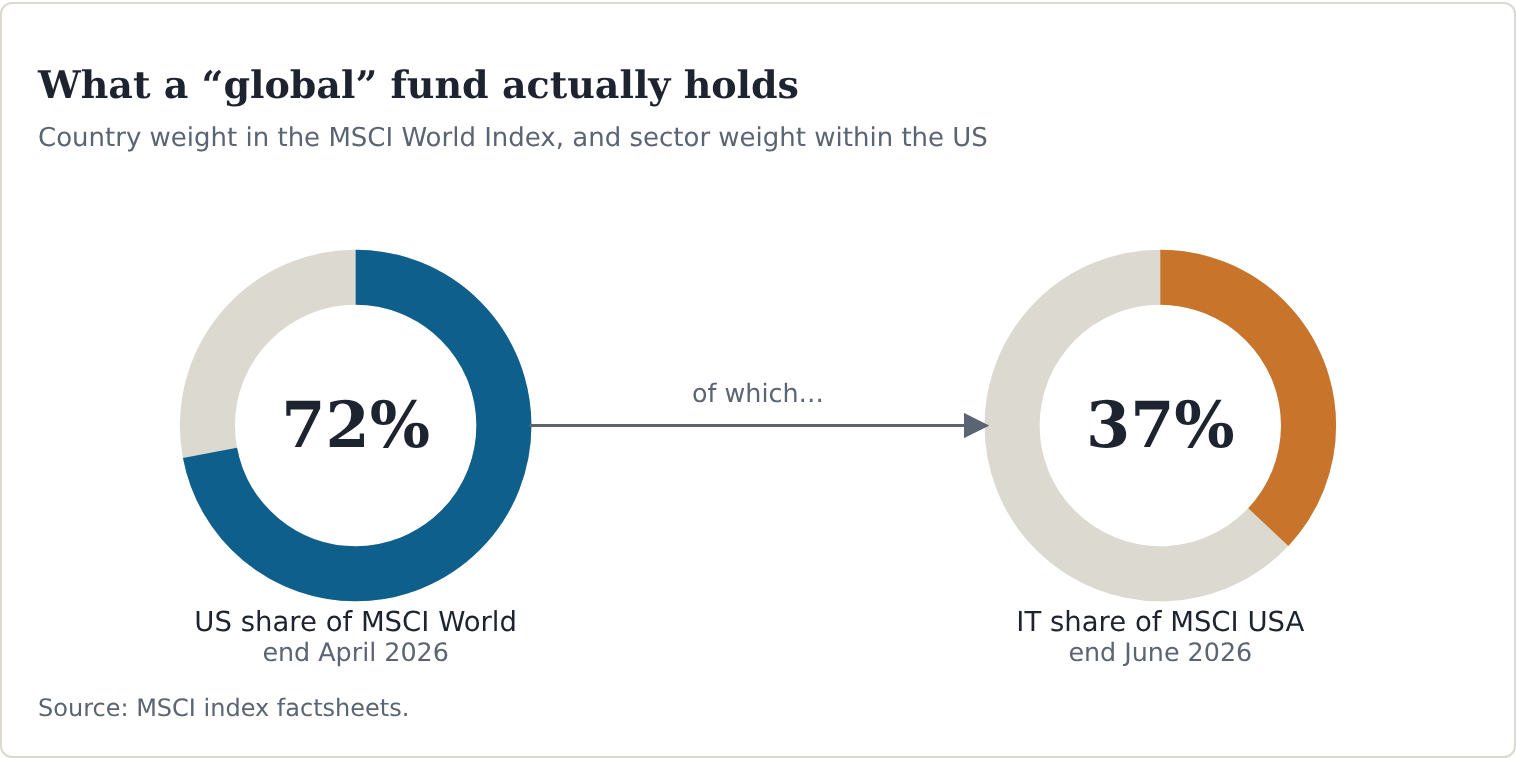
Global funds have become increasingly dominated by the US simply because American companies have grown to represent such a large proportion of the global stock market. At the end of April 2026, US companies represented around 72% of the MSCI World Index, one of the most widely used global equity benchmarks covering large and medium-cap companies. Within the US market itself, information technology accounted for 37% of the MSCI USA Index by the end of June.
That creates an important issue for investors who assume that owning global funds automatically gives them a broadly balanced portfolio.
Consider an investor who owns a global index tracker, a US equity fund, a technology fund and two actively managed global funds. On the surface they own five different funds managed in different ways.
Underneath, however, several of those funds may have substantial exposure to the same companies.
This is how concentration can build without an investor deliberately deciding to take more risk. One strong performing fund is added, followed by another fund with an impressive three or five year record, and then perhaps a technology fund because technology has been one of the strongest areas of the market.
Each individual decision can appear reasonable when viewed in isolation. The problem only becomes clear when all of those investments are considered together.
This is particularly relevant for self investors because fund performance tables make it very easy to identify yesterday’s winners. They don’t identify whether adding another successful fund is actually improving the portfolio.
Past performance can become the portfolio strategy
This is where the distinction between analysing a fund and constructing a portfolio becomes important.
At Yodelar, we analyse how funds have historically performed against other funds within the same sectors. That information can help identify funds that have delivered competitive past performance and those that have consistently struggled against their peers.
But historic performance is not an asset allocation plan.
A fund can have an excellent performance record and still make an existing portfolio less balanced. If an investor already has substantial exposure to the US and technology, adding another strong performing global growth or technology fund may increase the same risks rather than improve diversification.
The same problem occurs when investors continually replace weaker performing funds with whichever funds have recently produced the highest returns.
Past performance then stops being one piece of information used to assess an investment and effectively becomes the investment strategy itself.
That can work extremely well while the strongest parts of the market continue rising. The investor sees good returns, which reinforces the belief that the strategy is working, and may encourage further investment in the same areas.
But there is a second effect taking place at the same time. The areas producing the strongest returns are also becoming a larger proportion of the portfolio.
The portfolio gradually moves further away from a deliberate balance between different markets and types of investment and becomes increasingly dependent on the recent winners continuing to win.
The falls in early November provide a clear example of what can happen when expectations change.

What changed in the AI market?
The US midterm elections were an important part of the latest market movement, but they were not the only cause.
Democrats won control of Congress following the 3 November elections. US markets actually rose initially on 4 November, but investors also began considering whether the result could lead to greater restrictions on AI development and new data centres.
Those political concerns arrived when questions were already being asked about the huge amounts being invested in artificial intelligence infrastructure, the borrowing being used to finance some of that spending and how quickly those investments would generate sufficient profits.
The resulting fall was therefore not simply a reaction to an election result. It reflected a rapid change in expectations towards an area of the market where expectations had previously become extremely high.
That is precisely why chasing returns can carry risks.
A successful company does not need to become unsuccessful for its share price to fall. If investors had expected exceptional future growth, even a reduction in those expectations can have a significant impact on its value.
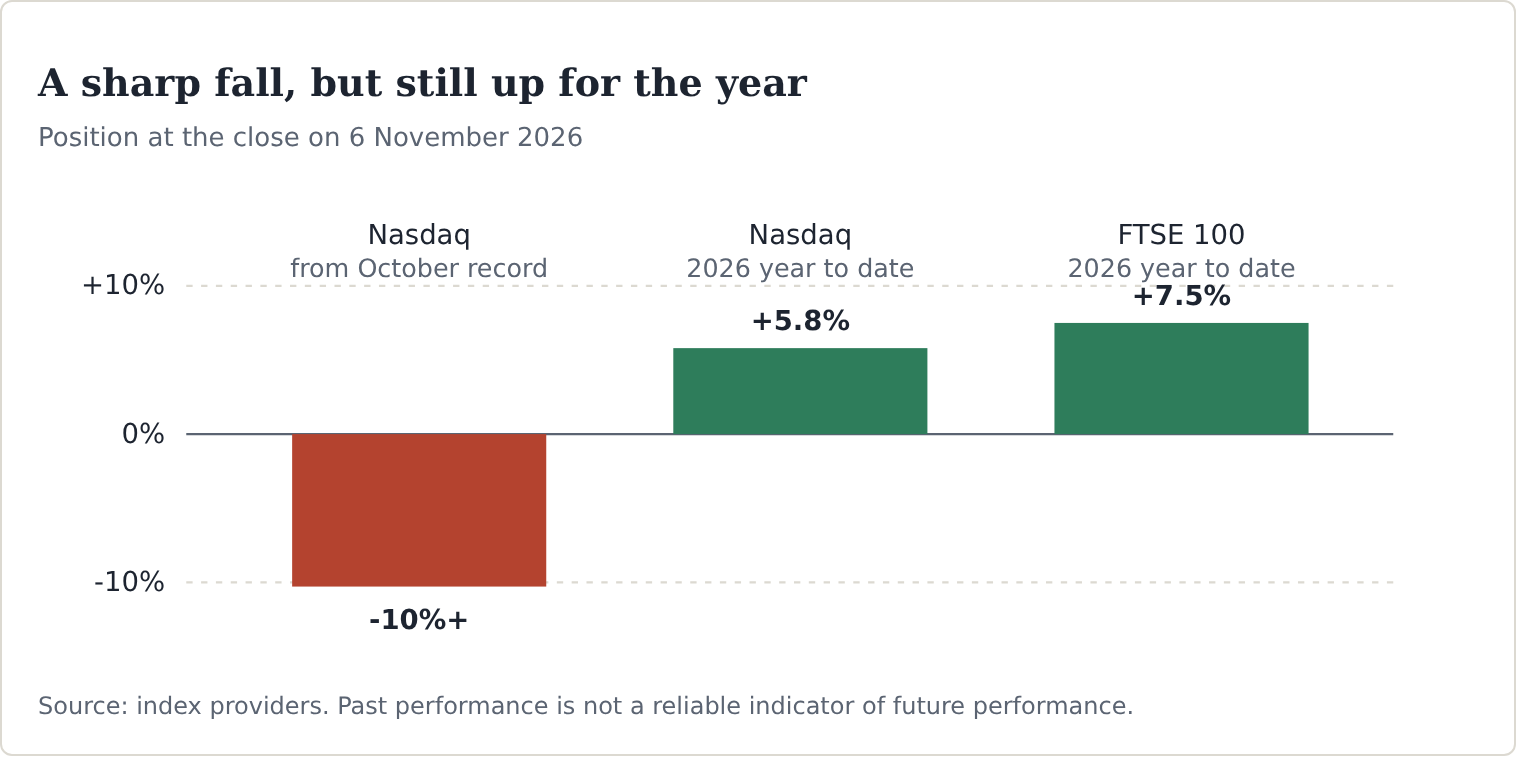
The Nasdaq had reached a record only a month before the latest fall. Following the 5 November decline, it was more than 10% below that peak.
Even a well diversified portfolio can experience substantial falls, although spreading investments across different markets and types of investment can reduce reliance on any one area. For somebody whose portfolio has gradually become concentrated in the areas that had previously performed best, the impact can be greater.
Diversification is about what you own, not how many funds you hold
This brings the issue back to portfolio construction.
The FCA describes diversification as spreading investments across different markets and types of investment so that an investor is less reliant on any single area performing well. It also makes clear that diversification cannot remove investment risk completely.
This is an important distinction in the current market.
The fact that markets in America, Asia and Europe have fallen at the same time does not mean diversification does not work. During major periods of uncertainty, different stock markets can fall together.
A genuinely diversified portfolio is instead designed to avoid making the investor unnecessarily dependent on one market, one sector or one type of company.
For many self investors, the starting point should therefore not be which fund has performed best. It should be how the overall portfolio is divided.
How much is invested in company shares? How much is in bonds or other less volatile investments? How much of the equity exposure is concentrated in America? How much is indirectly dependent on technology? Are several funds repeatedly holding the same companies?
Only once that structure is understood does individual fund selection have the proper context.
This is especially important as retirement approaches.

Market falls can increase risk when money is needed
A younger investor who is decades from retirement may have considerable time to recover from a market downturn.
An investor planning to start drawing from a pension next year does not necessarily have the same flexibility.
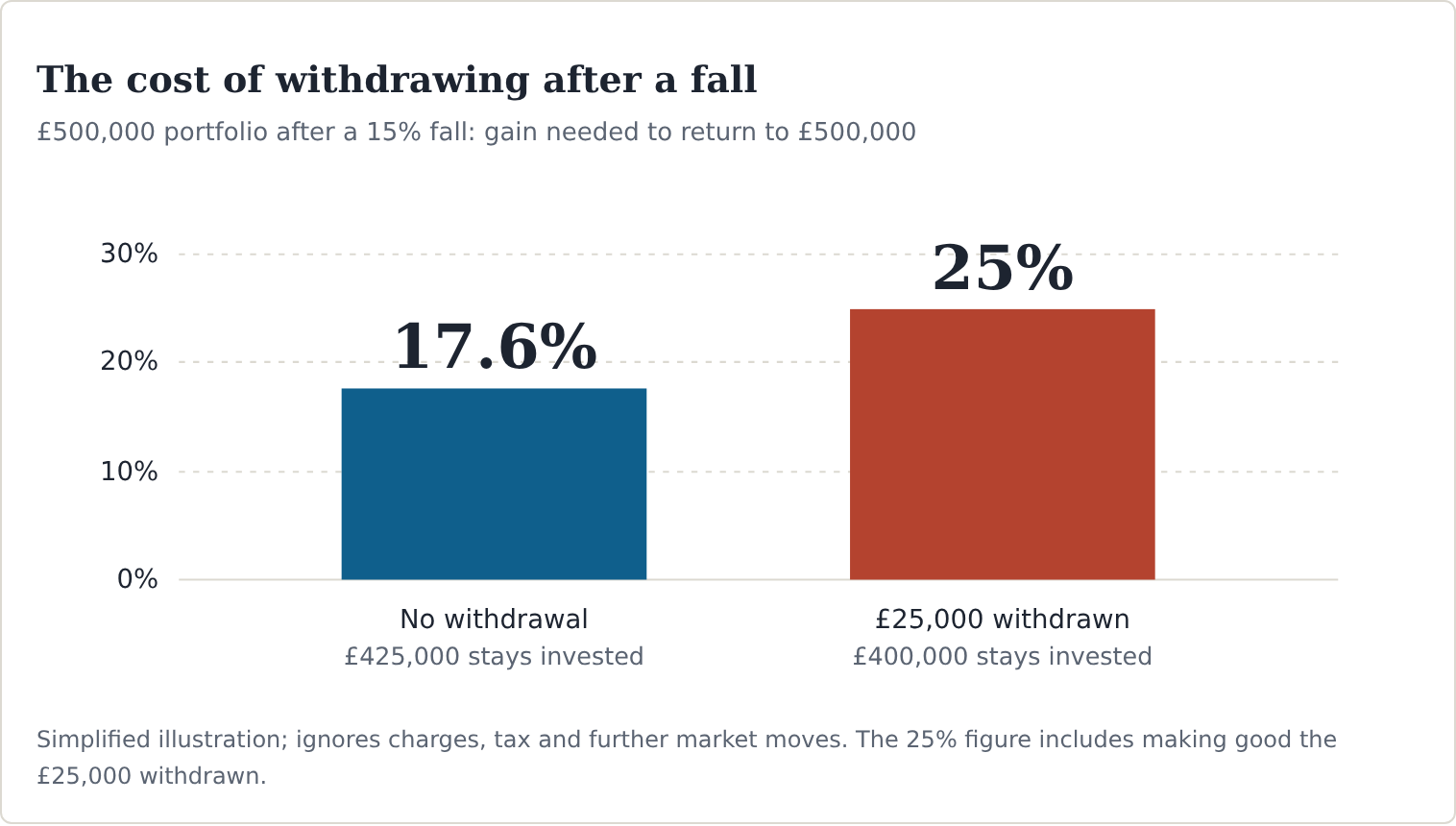
Take a simplified £500,000 portfolio. A 15% fall would reduce its value to £425,000. Without withdrawals, a subsequent rise of approximately 17.6% would return it to £500,000.
But if the investor needed to withdraw £25,000 while the portfolio value was lower, only £400,000 would remain invested. Returning from £400,000 to £500,000 would require a 25% increase, although this comparison also reflects the £25,000 already withdrawn.
The example is deliberately simple, but the principle is important. Losses can have a greater long term impact when an investor is simultaneously taking money from the portfolio, as might be the case in retirement.
MoneyHelper warns that withdrawing from a pension while investment values are low can require more investments to be sold to produce the required income. That leaves fewer investments remaining to participate in any subsequent recovery.
This does not mean somebody approaching retirement should abandon shares or move their pension into cash whenever markets fall. It means their asset allocation should have been designed around the fact that the money may soon be needed for lump sum withdrawals, regular withdrawals or both.
A portfolio constructed mainly by selecting the funds with the strongest recent returns may not have considered that risk at all.

What investors should take from the latest falls
The latest sell off does not prove that US shares, technology companies or artificial intelligence are poor investments. Nor does it tell us whether markets will fall further or recover quickly.
Indeed, despite the severity of the decline, the Nasdaq was still around 4.6% higher for 2026 on the morning of 6 November, while the FTSE 100 was almost 6.9% ahead for the year at that point. These figures are a snapshot before subsequent market movements.
The more important lesson is about how portfolios are built.
Investors who have spent several years adding whichever funds produced the strongest returns may now have considerably more exposure to the same markets and companies than they intended. Owning five, ten or even twenty funds does not solve that problem if those funds repeatedly invest in similar areas.
Past performance remains useful evidence when assessing funds, but it should support a portfolio strategy rather than become the strategy.
A well structured portfolio starts with the investor: their objectives, how long the money will remain invested, how much risk they can reasonably tolerate and when they expect to need access to it. Asset allocation should then determine how the portfolio is spread, with individual funds selected to fulfil those roles.
The market will always produce new winners, new investment themes and periods when one region or sector appears difficult to ignore. The events of early November are a reminder of why repeatedly following those winners can eventually leave a portfolio taking risks the investor never intended.
For UK investors, particularly those managing their own pensions and approaching retirement, understanding that risk is considerably more important than trying to predict which market will recover first.

Investment values can fall as well as rise and investors may get back less than they invest. Past performance is not a reliable indicator of future performance. The information in this article is for general information only and does not constitute personal financial advice.